1
2
3
4
5
6
7
8
9
10
11
12
13
14
15
16
17
18
19
20
21
22
23
24
25
26
27
28
29
30
31
32
33
34
35
36
37
38
39
40
41
42
43
44
45
46
47
48
49
50
51
52
53
54
55
56
57
58
59
60
61
62
63
64
65
66
67
68
69
70
71
72
73
74
75
76
77
78
79
80
81
82
83
84
85
86
87
88
89
90
91
92
93
94
95
96
97
98
99
100
101
102
103
104
105
106
107
108
109
110
111
112
113
114
115
116
117
118
119
120
121
122
123
124
125
126
127
128
129
130
131
132
133
134
135
136
137
138
139
140
141
142
143
144
145
146
147
148
149
150
151
152
153
154
155
156
157
158
159
160
161
162
163
164
165
166
167
168
169
170
171
172
173
174
175
176
177
178
179
180
181
182
183
184
185
186
187
188
189
190
191
192
193
194
195
196
197
198
199
200
201
202
203
204
205
206
207
208
209
210
211
212
213
214
215
216
217
218
219
220
221
222
223
224
225
226
227
228
229
230
231
232
233
234
235
236
237
238
239
240
241
242
243
244
245
246
247
248
249
250
251
252
253
254
255
256
257
258
259
260
261
262
263
264
265
266
267
268
269
270
271
272
273
274
275
276
277
278
279
280
281
282
283
284
285
286
287
288
289
290
291
292
293
294
295
296
297
298
299
300
301
302
303
304
305
306
307
308
309
310
311
312
313
314
315
316
317
318
319
320
321
322
323
324
325
326
327
328
329
330
331
332
333
334
335
336
337
338
339
340
341
342
343
344
345
346
347
348
349
350
351
352
353
354
355
356
357
358
359
360
361
362
363
364
365
366
367
368
369
370
371
372
373
374
375
376
377
378
379
380
381
382
383
384
385
386
387
388
389
390
391
392
393
394
395
396
397
398
399
400
401
402
403
404
405
406
407
408
409
410
411
412
413
414
415
416
417
418
419
420
421
422
423
424
425
426
427
428
429
430
431
432
433
434
435
436
437
438
439
440
441
442
443
444
445
446
447
448
449
450
451
452
453
454
455
456
457
458
459
460
461
462
463
464
465
466
467
468
469
470
471
472
473
474
475
476
477
478
479
480
481
482
483
484
485
486
487
488
489
490
491
492
493
494
495
496
497
498
499
500
501
502
503
504
505
506
507
508
509
510
511
512
513
514
515
516
517
518
519
520
521
522
523
524
525
526
527
528
529
530
531
532
533
534
535
536
537
538
539
540
541
542
543
544
545
546
547
548
549
550
551
552
553
554
555
556
557
558
559
560
561
562
563
564
565
566
567
568
569
570
571
572
573
574
575
576
577
578
579
580
581
582
583
584
585
586
587
588
589
590
591
592
593
594
595
596
597
598
599
600
601
602
603
604
605
606
607
608
609
610
611
612
613
614
615
616
617
618
619
620
621
622
623
624
625
626
627
628
629
630
631
632
633
634
635
636
637
638
639
640
641
642
643
644
645
646
647
648
649
650
651
652
653
654
655
656
657
658
659
660
661
662
663
664
665
666
667
668
669
670
671
672
673
674
675
676
677
678
679
680
681
682
683
684
685
686
687
688
689
690
691
692
693
694
695
696
697
698
699
700
701
702
703
704
705
706
707
708
709
710
711
712
713
714
715
716
717
718
719
720
721
722
723
724
725
726
727
728
729
730
731
732
733
734
735
736
737
738
739
740
741
742
743
744
745
746
747
748
749
750
751
752
753
754
755
756
757
758
759
760
761
762
763
764
765
766
767
768
769
770
771
772
773
774
775
776
777
778
779
780
781
782
783
784
785
786
787
788
789
790
791
792
793
794
795
796
797
798
799
800
801
802
803
804
805
806
807
808
809
810
811
812
813
814
815
816
817
818
819
820
821
822
823
824
825
826
827
828
829
830
831
832
833
834
835
836
837
838
839
840
841
842
843
844
845
846
847
848
849
850
851
852
853
854
855
856
857
858
859
860
861
862
863
864
865
866
867
868
869
870
871
872
873
874
875
876
877
878
879
880
881
882
883
884
885
886
887
888
889
890
891
892
893
894
895
896
897
898
899
900
901
902
903
904
905
906
907
908
909
910
911
912
913
914
915
916
917
918
919
920
921
922
923
924
925
926
927
928
929
930
931
932
933
934
935
936
937
938
939
940
941
942
943
944
945
946
947
948
949
950
951
952
953
954
955
956
957
958
959
960
961
962
963
964
965
966
967
968
969
970
971
972
973
974
975
976
977
978
979
980
981
982
983
984
985
986
987
988
989
990
991
992
993
994
995
996
997
998
999
1000
1001
1002
1003
1004
1005
1006
1007
1008
1009
1010
1011
1012
1013
1014
1015
1016
1017
1018
1019
1020
1021
1022
1023
1024
1025
1026
1027
1028
1029
1030
1031
1032
1033
1034
1035
1036
1037
1038
1039
1040
1041
1042
1043
1044
1045
1046
1047
1048
1049
1050
1051
1052
1053
1054
1055
1056
1057
1058
1059
1060
1061
1062
1063
1064
1065
1066
1067
1068
1069
1070
1071
1072
1073
1074
1075
1076
1077
1078
1079
1080
1081
1082
1083
1084
1085
1086
1087
1088
1089
1090
1091
1092
1093
1094
1095
1096
1097
1098
1099
1100
1101
1102
1103
1104
1105
1106
1107
1108
1109
1110
1111
1112
1113
1114
1115
1116
1117
1118
1119
1120
1121
1122
1123
1124
1125
1126
1127
1128
1129
1130
1131
1132
1133
1134
1135
1136
1137
1138
1139
1140
1141
1142
1143
1144
1145
1146
1147
1148
1149
1150
1151
1152
1153
1154
1155
1156
1157
1158
1159
1160
1161
1162
1163
1164
1165
1166
1167
1168
1169
1170
1171
1172
1173
1174
1175
1176
1177
1178
1179
1180
1181
1182
1183
1184
1185
1186
1187
1188
1189
1190
1191
1192
1193
1194
1195
1196
1197
1198
1199
1200
1201
1202
1203
1204
1205
1206
1207
1208
1209
1210
1211
1212
1213
1214
1215
1216
1217
1218
1219
1220
1221
1222
1223
1224
1225
1226
1227
1228
1229
1230
1231
1232
1233
1234
1235
1236
1237
1238
1239
1240
1241
1242
1243
1244
1245
1246
1247
1248
1249
1250
1251
1252
1253
1254
1255
1256
1257
1258
1259
1260
1261
1262
1263
1264
1265
1266
1267
1268
1269
1270
1271
1272
1273
1274
1275
1276
1277
1278
1279
1280
1281
1282
1283
1284
1285
1286
1287
1288
1289
1290
1291
1292
1293
1294
1295
1296
1297
1298
1299
1300
1301
1302
1303
1304
1305
1306
1307
1308
1309
1310
1311
1312
1313
1314
1315
1316
1317
1318
1319
1320
1321
1322
1323
1324
1325
1326
1327
1328
1329
1330
1331
1332
1333
1334
1335
1336
1337
1338
1339
1340
1341
1342
1343
1344
1345
1346
1347
1348
1349
1350
1351
1352
1353
1354
1355
1356
1357
1358
1359
1360
1361
1362
1363
1364
1365
1366
1367
1368
1369
1370
1371
1372
1373
1374
1375
1376
1377
1378
1379
1380
1381
1382
1383
1384
1385
1386
1387
1388
1389
1390
1391
1392
1393
1394
1395
1396
1397
1398
1399
1400
1401
1402
1403
1404
1405
1406
1407
1408
1409
1410
1411
1412
1413
1414
1415
1416
1417
1418
1419
1420
1421
1422
1423
1424
1425
1426
1427
1428
1429
1430
1431
1432
1433
1434
1435
1436
1437
1438
1439
1440
1441
1442
1443
1444
1445
1446
1447
1448
1449
1450
1451
1452
1453
1454
1455
1456
1457
1458
1459
1460
1461
1462
1463
1464
1465
1466
1467
1468
1469
1470
1471
1472
1473
1474
1475
1476
1477
1478
1479
1480
1481
1482
1483
1484
1485
1486
1487
1488
1489
1490
1491
1492
1493
1494
1495
1496
1497
1498
1499
1500
1501
1502
1503
1504
1505
1506
1507
1508
1509
1510
1511
1512
1513
1514
1515
1516
1517
1518
1519
1520
1521
1522
1523
1524
1525
1526
1527
1528
1529
1530
1531
1532
1533
1534
1535
1536
1537
1538
1539
1540
1541
1542
1543
1544
1545
1546
1547
1548
1549
1550
1551
1552
1553
1554
1555
1556
1557
1558
1559
1560
1561
1562
1563
1564
1565
1566
1567
1568
1569
1570
1571
1572
1573
1574
1575
1576
1577
1578
1579
1580
1581
1582
1583
1584
1585
1586
1587
1588
1589
1590
1591
1592
1593
1594
1595
1596
1597
1598
1599
1600
1601
1602
1603
1604
1605
1606
1607
1608
1609
1610
1611
1612
1613
1614
1615
1616
1617
1618
1619
1620
1621
1622
1623
1624
1625
1626
1627
1628
1629
1630
1631
1632
1633
1634
1635
1636
1637
1638
1639
1640
1641
1642
1643
1644
1645
1646
1647
1648
1649
1650
1651
1652
1653
1654
1655
1656
1657
1658
1659
1660
1661
1662
1663
1664
1665
1666
1667
1668
1669
1670
1671
1672
1673
1674
1675
1676
1677
1678
1679
1680
1681
1682
1683
1684
1685
1686
1687
1688
1689
1690
1691
1692
1693
1694
1695
1696
1697
1698
1699
1700
1701
1702
1703
1704
1705
1706
1707
1708
1709
1710
1711
1712
1713
1714
1715
1716
1717
1718
1719
1720
1721
1722
1723
1724
1725
1726
1727
1728
1729
1730
1731
1732
1733
1734
1735
1736
1737
1738
1739
1740
1741
1742
1743
1744
1745
1746
1747
1748
1749
1750
1751
1752
1753
1754
1755
1756
1757
1758
1759
1760
1761
1762
1763
1764
1765
1766
1767
1768
1769
1770
1771
1772
1773
1774
1775
1776
1777
1778
1779
1780
1781
1782
1783
1784
1785
1786
1787
1788
1789
1790
1791
1792
1793
1794
1795
1796
1797
1798
1799
1800
1801
1802
1803
1804
1805
1806
1807
1808
1809
1810
1811
1812
1813
1814
1815
1816
1817
1818
1819
1820
1821
1822
1823
1824
1825
1826
1827
1828
1829
1830
1831
1832
1833
1834
1835
1836
1837
1838
1839
1840
1841
1842
1843
1844
1845
1846
1847
1848
1849
1850
1851
1852
1853
1854
1855
1856
1857
1858
1859
1860
1861
1862
1863
1864
1865
1866
1867
1868
1869
1870
1871
1872
1873
1874
1875
1876
1877
1878
1879
1880
1881
1882
1883
1884
1885
1886
1887
1888
1889
1890
1891
1892
1893
1894
1895
1896
1897
1898
1899
1900
1901
1902
1903
1904
1905
1906
1907
1908
1909
1910
1911
1912
1913
1914
1915
1916
1917
1918
1919
1920
1921
1922
1923
1924
1925
1926
1927
1928
1929
1930
1931
1932
1933
1934
1935
1936
1937
1938
1939
1940
1941
1942
1943
1944
1945
1946
1947
1948
1949
1950
1951
1952
1953
1954
1955
1956
1957
1958
1959
1960
1961
1962
1963
1964
1965
1966
1967
1968
1969
1970
1971
1972
1973
1974
1975
1976
1977
1978
1979
1980
1981
1982
1983
1984
1985
1986
1987
1988
1989
1990
1991
1992
1993
1994
1995
1996
1997
1998
1999
2000
2001
2002
2003
2004
2005
2006
2007
2008
2009
2010
2011
2012
2013
2014
2015
2016
2017
2018
2019
2020
2021
2022
2023
2024
2025
2026
2027
2028
2029
2030
2031
2032
2033
2034
2035
2036
2037
2038
2039
2040
2041
2042
2043
2044
2045
2046
2047
2048
2049
2050
2051
2052
2053
2054
2055
2056
2057
2058
2059
2060
2061
2062
2063
2064
2065
2066
2067
2068
2069
2070
2071
2072
2073
2074
2075
2076
2077
2078
2079
2080
2081
2082
2083
2084
2085
2086
2087
2088
2089
2090
2091
2092
2093
2094
2095
2096
2097
2098
2099
2100
2101
2102
2103
2104
2105
2106
2107
2108
2109
2110
2111
2112
2113
2114
2115
2116
2117
2118
2119
2120
2121
2122
2123
2124
2125
2126
2127
2128
2129
2130
2131
2132
2133
2134
2135
2136
2137
2138
2139
2140
2141
2142
2143
2144
2145
2146
2147
2148
2149
2150
2151
2152
2153
2154
2155
2156
2157
2158
2159
2160
2161
2162
2163
2164
2165
2166
2167
2168
2169
2170
2171
2172
2173
2174
2175
2176
2177
2178
2179
2180
2181
2182
2183
2184
2185
2186
2187
2188
2189
2190
2191
2192
2193
2194
2195
2196
2197
2198
2199
2200
2201
2202
2203
2204
2205
2206
2207
2208
2209
2210
2211
2212
2213
2214
2215
2216
2217
2218
2219
2220
2221
2222
2223
2224
2225
2226
2227
2228
2229
2230
2231
2232
2233
2234
2235
2236
2237
2238
2239
2240
2241
2242
2243
2244
2245
2246
2247
2248
2249
2250
2251
2252
2253
2254
2255
2256
2257
2258
2259
2260
2261
2262
2263
2264
2265
2266
2267
2268
2269
2270
2271
2272
2273
2274
2275
2276
2277
2278
2279
2280
2281
2282
2283
2284
2285
2286
2287
2288
2289
2290
2291
2292
2293
2294
2295
2296
2297
2298
2299
2300
2301
2302
2303
2304
2305
2306
2307
2308
2309
2310
2311
2312
2313
2314
2315
2316
2317
2318
2319
2320
2321
2322
2323
2324
2325
2326
2327
2328
2329
2330
2331
2332
2333
2334
2335
2336
2337
2338
2339
2340
2341
2342
2343
2344
2345
2346
2347
2348
2349
2350
2351
2352
2353
2354
2355
2356
2357
2358
2359
2360
2361
2362
2363
2364
2365
2366
2367
2368
2369
2370
2371
2372
2373
2374
2375
2376
2377
2378
2379
2380
2381
2382
2383
2384
2385
2386
2387
2388
2389
2390
2391
2392
2393
2394
2395
2396
2397
2398
2399
2400
2401
2402
2403
2404
2405
2406
2407
2408
2409
2410
2411
2412
2413
2414
2415
2416
2417
2418
2419
2420
2421
2422
2423
2424
2425
2426
2427
2428
2429
2430
2431
2432
2433
2434
2435
2436
2437
2438
2439
2440
2441
2442
2443
2444
2445
2446
2447
2448
2449
2450
2451
2452
2453
2454
2455
2456
2457
2458
2459
2460
2461
2462
2463
2464
2465
2466
2467
2468
2469
2470
2471
2472
2473
2474
2475
2476
2477
2478
2479
2480
2481
2482
2483
2484
2485
2486
2487
2488
2489
2490
2491
2492
2493
2494
2495
2496
2497
2498
2499
2500
2501
2502
2503
2504
2505
2506
2507
2508
2509
2510
2511
2512
2513
2514
2515
2516
2517
2518
2519
2520
2521
2522
2523
2524
2525
2526
2527
2528
2529
2530
2531
2532
2533
2534
2535
2536
2537
2538
2539
2540
2541
2542
2543
2544
2545
2546
2547
2548
2549
2550
2551
2552
2553
2554
2555
2556
2557
2558
2559
2560
2561
2562
2563
2564
2565
2566
2567
2568
2569
2570
2571
2572
2573
2574
2575
2576
2577
2578
2579
2580
2581
2582
2583
2584
2585
2586
2587
2588
2589
2590
2591
2592
2593
2594
2595
2596
2597
2598
2599
2600
2601
2602
2603
2604
2605
2606
2607
2608
2609
2610
2611
2612
2613
2614
2615
2616
2617
2618
2619
2620
2621
2622
2623
2624
2625
2626
2627
2628
2629
2630
2631
2632
2633
2634
2635
2636
2637
2638
2639
2640
2641
2642
2643
2644
2645
2646
2647
2648
2649
2650
2651
2652
2653
2654
2655
2656
2657
2658
2659
2660
2661
2662
2663
2664
2665
2666
2667
2668
2669
2670
2671
2672
2673
2674
2675
2676
2677
2678
2679
2680
2681
2682
2683
2684
2685
2686
2687
2688
2689
2690
2691
2692
2693
2694
2695
2696
2697
2698
2699
2700
2701
2702
2703
2704
2705
2706
2707
2708
2709
2710
2711
2712
2713
2714
2715
2716
2717
2718
2719
2720
2721
2722
2723
2724
2725
2726
2727
2728
2729
2730
2731
2732
2733
2734
2735
2736
2737
2738
2739
2740
2741
2742
2743
2744
2745
2746
2747
2748
2749
2750
2751
2752
2753
2754
2755
2756
2757
2758
2759
2760
2761
2762
2763
2764
2765
2766
2767
2768
2769
2770
2771
2772
2773
2774
2775
2776
2777
2778
2779
2780
2781
2782
2783
2784
2785
2786
2787
2788
2789
2790
2791
2792
2793
2794
2795
2796
2797
2798
2799
2800
2801
2802
2803
2804
2805
2806
2807
2808
2809
2810
2811
2812
2813
2814
2815
2816
2817
2818
2819
2820
2821
2822
2823
2824
2825
2826
2827
2828
2829
2830
2831
2832
2833
2834
2835
2836
2837
2838
2839
2840
2841
2842
2843
2844
2845
2846
2847
2848
2849
2850
2851
2852
2853
2854
2855
2856
2857
2858
2859
2860
2861
2862
2863
2864
2865
2866
2867
2868
2869
2870
2871
2872
2873
2874
2875
2876
2877
2878
2879
2880
2881
2882
2883
2884
2885
2886
2887
2888
2889
2890
2891
2892
2893
2894
2895
2896
2897
2898
2899
2900
2901
2902
2903
2904
2905
2906
2907
2908
2909
2910
2911
2912
2913
2914
2915
2916
2917
2918
2919
2920
2921
2922
2923
2924
2925
2926
2927
2928
2929
2930
2931
2932
2933
2934
2935
2936
2937
2938
2939
2940
2941
2942
2943
2944
2945
2946
2947
2948
2949
2950
2951
2952
2953
2954
2955
2956
2957
2958
2959
2960
2961
2962
2963
2964
2965
2966
2967
2968
2969
2970
2971
2972
2973
2974
2975
2976
2977
2978
2979
2980
2981
2982
2983
2984
2985
2986
2987
2988
2989
2990
2991
2992
2993
2994
2995
2996
2997
2998
2999
3000
3001
3002
3003
3004
3005
3006
3007
3008
3009
3010
3011
3012
3013
3014
3015
3016
3017
3018
3019
3020
3021
3022
3023
3024
3025
3026
3027
3028
3029
3030
3031
3032
3033
3034
3035
3036
3037
3038
3039
3040
3041
3042
3043
3044
3045
3046
3047
3048
3049
3050
3051
3052
3053
3054
3055
3056
3057
3058
3059
3060
3061
3062
3063
3064
3065
3066
3067
3068
3069
3070
3071
3072
3073
3074
3075
3076
3077
3078
3079
3080
3081
3082
3083
3084
3085
3086
3087
3088
3089
3090
3091
3092
3093
3094
3095
3096
3097
3098
3099
3100
3101
3102
3103
3104
3105
3106
3107
3108
3109
3110
3111
3112
3113
3114
3115
3116
3117
3118
3119
3120
3121
3122
3123
3124
3125
3126
3127
3128
3129
3130
3131
3132
3133
3134
3135
3136
3137
3138
3139
3140
3141
3142
3143
3144
3145
3146
3147
3148
3149
3150
3151
3152
3153
3154
3155
3156
3157
3158
3159
3160
3161
3162
3163
3164
3165
3166
3167
3168
3169
3170
3171
3172
3173
3174
3175
3176
3177
3178
3179
3180
3181
3182
3183
3184
3185
3186
3187
3188
3189
3190
3191
3192
3193
3194
3195
3196
3197
3198
3199
3200
3201
3202
3203
3204
3205
3206
3207
3208
3209
3210
3211
3212
3213
3214
3215
3216
3217
3218
3219
3220
3221
3222
3223
3224
3225
3226
3227
3228
3229
3230
3231
3232
3233
3234
3235
3236
3237
3238
3239
3240
3241
3242
3243
3244
3245
3246
3247
3248
3249
3250
3251
3252
3253
3254
3255
3256
3257
3258
3259
3260
3261
3262
3263
3264
3265
3266
3267
3268
3269
3270
3271
3272
3273
3274
3275
3276
3277
3278
3279
3280
3281
3282
3283
3284
3285
3286
3287
3288
3289
3290
3291
3292
3293
3294
3295
3296
3297
3298
3299
3300
3301
3302
3303
3304
3305
3306
3307
3308
3309
3310
3311
3312
3313
3314
3315
3316
3317
3318
3319
3320
3321
3322
3323
3324
3325
3326
3327
3328
3329
3330
3331
3332
3333
3334
3335
3336
3337
3338
3339
3340
3341
3342
3343
3344
3345
3346
3347
3348
3349
3350
3351
3352
3353
3354
3355
3356
3357
3358
3359
3360
3361
3362
3363
3364
3365
3366
3367
3368
3369
3370
3371
3372
3373
3374
3375
3376
3377
3378
3379
3380
3381
3382
3383
3384
3385
3386
3387
3388
3389
3390
3391
3392
3393
3394
3395
3396
3397
3398
3399
3400
3401
3402
3403
3404
3405
3406
3407
3408
3409
3410
3411
3412
3413
3414
3415
3416
3417
3418
3419
3420
3421
3422
3423
3424
3425
3426
3427
3428
3429
3430
3431
3432
3433
3434
3435
3436
3437
3438
3439
3440
3441
3442
3443
3444
3445
3446
3447
3448
3449
3450
3451
3452
3453
3454
3455
3456
3457
3458
3459
3460
3461
3462
3463
3464
3465
3466
3467
3468
3469
3470
3471
3472
3473
3474
3475
3476
3477
3478
3479
3480
3481
3482
3483
3484
3485
3486
3487
3488
3489
3490
3491
3492
3493
3494
3495
3496
3497
3498
3499
3500
3501
3502
3503
3504
3505
3506
3507
3508
3509
3510
3511
3512
3513
3514
3515
3516
3517
3518
3519
3520
3521
3522
3523
3524
3525
3526
3527
3528
3529
3530
3531
3532
3533
3534
3535
3536
3537
3538
3539
3540
3541
3542
3543
3544
3545
3546
3547
3548
3549
3550
3551
3552
3553
3554
3555
3556
3557
3558
3559
3560
3561
3562
3563
3564
3565
3566
3567
3568
3569
3570
3571
3572
3573
3574
3575
3576
3577
3578
3579
3580
3581
3582
3583
3584
3585
3586
3587
3588
3589
3590
3591
3592
3593
3594
3595
3596
3597
3598
3599
3600
3601
3602
3603
3604
3605
3606
3607
3608
3609
3610
3611
3612
3613
3614
3615
3616
3617
3618
3619
3620
3621
3622
3623
3624
3625
3626
3627
3628
3629
3630
3631
3632
3633
3634
3635
3636
3637
3638
3639
3640
3641
3642
3643
3644
3645
3646
3647
3648
3649
3650
3651
3652
3653
3654
3655
3656
3657
3658
3659
3660
3661
3662
3663
3664
3665
3666
3667
3668
3669
3670
3671
3672
3673
3674
3675
3676
3677
3678
3679
3680
3681
3682
3683
3684
3685
3686
3687
3688
3689
3690
3691
3692
3693
3694
3695
3696
3697
3698
3699
3700
3701
3702
3703
3704
3705
3706
3707
3708
3709
3710
3711
3712
3713
3714
3715
3716
3717
3718
3719
3720
3721
3722
3723
3724
3725
3726
3727
3728
3729
3730
3731
3732
3733
3734
3735
3736
3737
3738
3739
3740
3741
3742
3743
3744
3745
3746
3747
3748
3749
3750
3751
3752
3753
3754
3755
3756
3757
3758
3759
3760
3761
3762
3763
3764
3765
3766
3767
3768
3769
3770
3771
3772
3773
3774
3775
3776
3777
3778
3779
3780
3781
3782
3783
3784
3785
3786
3787
3788
3789
3790
3791
3792
3793
3794
3795
3796
3797
3798
3799
3800
3801
3802
3803
3804
3805
3806
3807
3808
3809
3810
3811
3812
3813
3814
3815
3816
3817
3818
3819
3820
3821
3822
3823
3824
3825
3826
3827
3828
3829
3830
3831
3832
3833
3834
3835
3836
3837
3838
3839
3840
3841
3842
3843
3844
3845
3846
3847
3848
3849
3850
3851
3852
3853
3854
3855
3856
3857
3858
3859
3860
3861
3862
3863
3864
3865
3866
3867
3868
3869
3870
3871
3872
3873
3874
3875
3876
3877
3878
3879
3880
3881
3882
3883
3884
3885
3886
3887
3888
3889
3890
3891
3892
3893
3894
3895
3896
3897
3898
3899
3900
3901
3902
3903
3904
3905
3906
3907
3908
3909
3910
3911
3912
3913
3914
3915
3916
3917
3918
3919
3920
3921
3922
3923
3924
3925
3926
3927
3928
3929
3930
3931
3932
3933
3934
3935
3936
3937
3938
3939
3940
3941
3942
3943
3944
3945
3946
3947
3948
3949
3950
3951
3952
3953
3954
3955
3956
3957
3958
3959
3960
3961
3962
3963
3964
3965
3966
3967
3968
3969
3970
3971
3972
3973
3974
3975
3976
3977
3978
3979
3980
3981
3982
3983
3984
3985
3986
3987
3988
3989
3990
3991
3992
3993
3994
3995
3996
3997
3998
3999
4000
4001
4002
4003
4004
4005
4006
4007
4008
4009
4010
4011
4012
4013
4014
4015
4016
4017
4018
4019
4020
4021
4022
4023
4024
4025
4026
4027
4028
4029
4030
4031
4032
4033
4034
4035
4036
4037
4038
4039
4040
4041
4042
4043
4044
4045
4046
4047
4048
4049
4050
4051
4052
4053
4054
4055
4056
4057
4058
4059
4060
4061
4062
4063
4064
4065
4066
4067
4068
4069
4070
4071
4072
4073
4074
4075
4076
4077
4078
4079
4080
4081
4082
4083
4084
4085
4086
4087
4088
4089
4090
4091
4092
4093
4094
4095
4096
4097
4098
4099
4100
4101
4102
4103
4104
4105
4106
4107
4108
4109
4110
4111
4112
4113
4114
4115
4116
4117
4118
4119
4120
4121
4122
4123
4124
4125
4126
4127
4128
4129
4130
4131
4132
4133
4134
4135
4136
4137
4138
4139
4140
4141
4142
4143
4144
4145
4146
4147
4148
4149
4150
4151
4152
4153
4154
4155
4156
4157
4158
4159
4160
4161
4162
4163
4164
4165
4166
4167
4168
4169
4170
4171
4172
4173
4174
4175
4176
4177
4178
4179
4180
4181
4182
4183
4184
4185
4186
4187
4188
4189
4190
4191
4192
4193
4194
4195
4196
4197
4198
4199
4200
4201
4202
4203
4204
4205
4206
4207
4208
4209
4210
4211
4212
4213
4214
4215
4216
4217
4218
4219
4220
4221
4222
4223
4224
4225
4226
4227
4228
4229
4230
4231
4232
4233
4234
4235
4236
4237
4238
4239
4240
4241
4242
4243
4244
4245
4246
4247
4248
4249
4250
4251
4252
4253
4254
4255
4256
4257
4258
4259
4260
4261
4262
4263
4264
4265
4266
4267
4268
4269
4270
4271
4272
4273
4274
4275
4276
4277
4278
4279
4280
4281
4282
4283
4284
4285
4286
4287
4288
4289
4290
4291
4292
4293
4294
4295
4296
4297
4298
4299
4300
4301
4302
4303
4304
4305
4306
4307
4308
4309
4310
4311
4312
4313
4314
4315
4316
4317
4318
4319
4320
4321
4322
4323
4324
4325
4326
4327
4328
4329
4330
4331
4332
4333
4334
4335
4336
4337
4338
4339
4340
4341
4342
4343
4344
4345
4346
4347
4348
4349
4350
4351
4352
4353
4354
4355
4356
4357
4358
4359
4360
4361
4362
4363
4364
4365
4366
4367
4368
4369
4370
4371
4372
4373
4374
4375
4376
4377
4378
4379
4380
4381
4382
4383
4384
4385
4386
4387
4388
4389
4390
4391
4392
4393
4394
4395
4396
4397
4398
4399
4400
4401
4402
4403
4404
4405
4406
4407
4408
4409
4410
4411
4412
4413
4414
4415
4416
4417
4418
4419
4420
4421
4422
4423
4424
4425
4426
4427
4428
4429
4430
4431
4432
4433
4434
4435
4436
4437
4438
4439
4440
4441
4442
4443
4444
4445
4446
4447
4448
4449
4450
4451
4452
4453
4454
4455
4456
4457
4458
4459
4460
4461
4462
4463
4464
4465
4466
4467
4468
4469
4470
4471
4472
4473
4474
4475
4476
4477
4478
4479
4480
4481
4482
4483
4484
4485
4486
4487
4488
4489
4490
4491
4492
4493
4494
4495
4496
4497
4498
4499
4500
4501
4502
4503
4504
4505
4506
4507
4508
4509
4510
4511
4512
4513
4514
4515
4516
4517
4518
4519
4520
4521
4522
4523
4524
4525
4526
4527
4528
4529
4530
4531
4532
4533
4534
4535
4536
4537
4538
4539
4540
4541
4542
4543
4544
4545
4546
4547
4548
4549
4550
4551
4552
4553
4554
4555
4556
4557
4558
4559
4560
4561
4562
4563
4564
4565
4566
4567
4568
4569
4570
4571
4572
4573
4574
4575
4576
4577
4578
4579
4580
4581
4582
4583
4584
4585
4586
4587
4588
4589
4590
4591
4592
4593
4594
4595
4596
4597
4598
4599
4600
4601
4602
4603
4604
4605
4606
4607
4608
4609
4610
4611
4612
4613
4614
4615
4616
4617
4618
4619
4620
4621
4622
4623
4624
4625
4626
4627
4628
4629
4630
4631
4632
4633
4634
4635
4636
4637
4638
4639
4640
4641
4642
4643
4644
4645
4646
4647
4648
4649
4650
4651
4652
4653
4654
4655
4656
4657
4658
4659
4660
4661
4662
4663
4664
4665
4666
4667
4668
4669
4670
4671
4672
4673
4674
4675
4676
4677
4678
4679
4680
4681
4682
4683
4684
4685
4686
4687
4688
4689
4690
4691
4692
4693
4694
4695
4696
4697
4698
4699
4700
4701
4702
4703
4704
4705
4706
4707
4708
4709
4710
4711
4712
4713
4714
4715
4716
4717
4718
4719
4720
4721
4722
4723
4724
4725
4726
4727
4728
4729
4730
4731
4732
4733
4734
4735
4736
4737
4738
4739
4740
4741
4742
4743
4744
4745
4746
4747
4748
4749
4750
4751
4752
4753
4754
4755
4756
4757
4758
4759
4760
4761
4762
4763
4764
4765
4766
4767
4768
4769
4770
4771
4772
4773
4774
4775
4776
4777
4778
4779
4780
4781
4782
4783
4784
4785
4786
4787
4788
4789
4790
4791
4792
4793
4794
4795
4796
4797
4798
4799
4800
4801
4802
4803
4804
4805
4806
4807
4808
4809
4810
4811
4812
4813
4814
4815
4816
4817
4818
4819
4820
4821
4822
4823
4824
4825
4826
4827
4828
4829
4830
4831
4832
4833
4834
4835
4836
4837
4838
4839
4840
4841
4842
4843
4844
4845
4846
4847
4848
4849
4850
4851
4852
4853
4854
4855
4856
4857
4858
4859
4860
4861
4862
4863
4864
4865
4866
4867
4868
4869
4870
4871
4872
4873
4874
4875
4876
4877
4878
4879
4880
4881
4882
4883
4884
4885
4886
4887
4888
4889
4890
4891
4892
4893
4894
4895
4896
4897
4898
4899
4900
4901
4902
4903
4904
4905
4906
4907
4908
4909
4910
4911
4912
4913
4914
4915
4916
4917
4918
4919
4920
4921
4922
4923
4924
4925
4926
4927
4928
4929
4930
4931
4932
4933
4934
4935
4936
4937
4938
4939
4940
4941
4942
4943
4944
4945
4946
4947
4948
4949
4950
4951
4952
4953
4954
4955
4956
4957
4958
4959
4960
4961
4962
4963
4964
4965
4966
4967
4968
4969
4970
4971
4972
4973
4974
4975
4976
4977
4978
4979
4980
4981
4982
4983
4984
4985
4986
4987
4988
4989
4990
4991
4992
4993
4994
4995
4996
4997
4998
4999
5000
5001
5002
5003
5004
5005
5006
5007
5008
5009
5010
5011
5012
5013
5014
5015
5016
5017
5018
5019
5020
5021
5022
5023
5024
5025
5026
5027
5028
5029
5030
5031
5032
5033
5034
5035
5036
5037
5038
5039
5040
5041
5042
5043
5044
5045
5046
5047
5048
5049
5050
5051
5052
5053
5054
5055
5056
5057
5058
5059
5060
5061
5062
5063
5064
5065
5066
5067
5068
5069
5070
5071
5072
5073
5074
5075
5076
5077
5078
5079
5080
5081
5082
5083
5084
5085
5086
5087
5088
5089
5090
5091
5092
5093
5094
5095
5096
5097
5098
5099
5100
5101
5102
5103
5104
5105
5106
5107
5108
5109
5110
5111
5112
5113
5114
5115
5116
5117
5118
5119
5120
5121
5122
5123
5124
5125
5126
5127
5128
5129
5130
5131
5132
5133
5134
5135
5136
5137
5138
5139
5140
5141
5142
5143
5144
5145
5146
5147
5148
5149
5150
5151
5152
5153
5154
5155
5156
5157
5158
5159
5160
5161
5162
5163
5164
5165
5166
5167
5168
5169
5170
5171
5172
5173
5174
5175
5176
5177
5178
5179
5180
5181
5182
5183
5184
5185
5186
5187
5188
5189
5190
5191
5192
5193
5194
5195
5196
5197
5198
5199
5200
5201
5202
5203
5204
5205
5206
5207
5208
5209
5210
5211
5212
5213
5214
5215
5216
5217
5218
5219
5220
5221
5222
5223
5224
5225
5226
5227
5228
5229
5230
5231
5232
5233
5234
5235
5236
5237
5238
5239
5240
5241
5242
5243
5244
5245
5246
5247
5248
5249
5250
5251
5252
5253
5254
5255
5256
5257
5258
5259
5260
5261
5262
5263
5264
5265
5266
5267
5268
5269
5270
5271
5272
5273
5274
5275
5276
5277
5278
5279
5280
5281
5282
5283
5284
5285
5286
5287
5288
5289
5290
5291
5292
5293
5294
5295
5296
5297
5298
5299
5300
5301
5302
5303
5304
5305
5306
5307
5308
5309
5310
5311
5312
5313
5314
5315
5316
5317
5318
5319
5320
5321
5322
5323
5324
5325
5326
5327
5328
5329
5330
5331
5332
5333
5334
5335
5336
5337
5338
5339
5340
5341
5342
5343
5344
5345
5346
5347
5348
5349
5350
5351
5352
5353
5354
5355
5356
5357
5358
5359
5360
5361
5362
5363
5364
5365
5366
5367
5368
5369
5370
5371
5372
5373
5374
5375
5376
5377
5378
5379
5380
5381
5382
5383
5384
5385
5386
5387
5388
5389
5390
5391
5392
5393
5394
5395
5396
5397
5398
5399
5400
5401
5402
5403
5404
5405
5406
5407
5408
5409
5410
5411
5412
5413
5414
5415
5416
5417
5418
5419
5420
5421
5422
5423
5424
5425
5426
5427
5428
5429
5430
5431
5432
5433
5434
5435
5436
5437
5438
5439
5440
5441
5442
5443
5444
5445
5446
5447
5448
5449
5450
5451
5452
5453
5454
5455
5456
5457
5458
5459
5460
5461
5462
5463
5464
5465
5466
5467
5468
5469
5470
5471
5472
5473
5474
5475
5476
5477
5478
5479
5480
5481
5482
5483
5484
5485
5486
5487
5488
5489
5490
5491
5492
5493
5494
5495
5496
5497
5498
5499
5500
5501
5502
5503
5504
5505
5506
5507
5508
5509
5510
5511
5512
5513
5514
5515
5516
5517
5518
5519
5520
5521
5522
5523
5524
5525
5526
5527
5528
5529
5530
5531
5532
5533
5534
5535
5536
5537
5538
5539
5540
5541
5542
5543
5544
5545
5546
5547
5548
5549
5550
5551
5552
5553
5554
5555
5556
5557
5558
5559
5560
5561
5562
5563
5564
5565
5566
5567
5568
5569
5570
5571
5572
5573
5574
5575
5576
5577
5578
5579
5580
5581
5582
5583
5584
5585
5586
5587
5588
5589
5590
5591
5592
5593
5594
5595
5596
5597
5598
5599
5600
5601
5602
5603
5604
5605
5606
5607
5608
5609
5610
5611
5612
5613
5614
5615
5616
5617
5618
5619
5620
5621
5622
5623
5624
5625
5626
5627
5628
5629
5630
5631
5632
5633
5634
5635
5636
5637
5638
5639
5640
5641
5642
5643
5644
5645
5646
5647
5648
5649
5650
5651
5652
5653
5654
5655
5656
5657
5658
5659
5660
5661
5662
5663
5664
5665
5666
5667
5668
5669
5670
5671
5672
5673
5674
5675
5676
5677
5678
5679
5680
5681
5682
5683
5684
5685
5686
5687
5688
5689
5690
5691
5692
5693
5694
5695
5696
5697
5698
5699
5700
5701
5702
5703
5704
5705
5706
5707
5708
5709
5710
5711
5712
5713
5714
5715
5716
5717
5718
5719
5720
5721
5722
5723
5724
5725
5726
5727
5728
5729
5730
5731
5732
5733
5734
5735
5736
5737
5738
5739
5740
5741
5742
5743
5744
5745
5746
5747
5748
5749
5750
5751
5752
5753
5754
5755
5756
5757
5758
5759
5760
5761
5762
5763
5764
5765
5766
5767
5768
5769
5770
5771
5772
5773
5774
5775
5776
5777
5778
5779
5780
5781
5782
5783
5784
5785
5786
5787
5788
5789
5790
5791
5792
5793
5794
5795
5796
5797
5798
5799
5800
5801
5802
5803
5804
5805
5806
5807
5808
5809
5810
5811
5812
5813
5814
5815
5816
5817
5818
5819
5820
5821
5822
5823
5824
5825
5826
5827
5828
5829
5830
5831
5832
5833
5834
5835
5836
5837
5838
5839
5840
5841
5842
5843
5844
5845
5846
5847
5848
5849
5850
5851
5852
5853
5854
5855
5856
5857
5858
5859
5860
5861
5862
5863
5864
5865
5866
5867
5868
5869
5870
5871
5872
5873
5874
5875
5876
5877
5878
5879
5880
5881
5882
5883
5884
5885
5886
5887
5888
5889
5890
5891
5892
5893
5894
5895
5896
5897
5898
5899
5900
5901
5902
5903
5904
5905
5906
5907
5908
5909
5910
5911
5912
5913
5914
5915
5916
5917
5918
5919
5920
5921
5922
5923
5924
5925
5926
5927
5928
5929
5930
5931
5932
5933
5934
5935
5936
5937
5938
5939
5940
5941
5942
5943
5944
5945
5946
5947
5948
5949
5950
5951
5952
5953
5954
5955
5956
5957
5958
5959
5960
5961
5962
5963
5964
5965
5966
5967
5968
5969
5970
5971
5972
5973
5974
5975
5976
5977
5978
5979
5980
5981
5982
5983
5984
5985
5986
5987
5988
5989
5990
5991
5992
5993
5994
5995
5996
5997
5998
5999
6000
6001
6002
6003
6004
6005
6006
6007
6008
6009
6010
6011
6012
6013
6014
6015
6016
6017
6018
6019
6020
6021
6022
6023
6024
6025
6026
6027
6028
6029
6030
6031
6032
6033
6034
6035
6036
6037
6038
6039
6040
6041
6042
6043
6044
6045
6046
6047
6048
6049
6050
6051
6052
6053
6054
6055
6056
6057
6058
6059
6060
6061
6062
6063
6064
6065
6066
6067
6068
6069
6070
6071
6072
6073
6074
6075
6076
6077
6078
6079
6080
6081
6082
6083
6084
6085
6086
6087
6088
6089
6090
6091
6092
6093
6094
6095
6096
6097
6098
6099
6100
6101
6102
6103
6104
6105
6106
6107
6108
6109
6110
6111
6112
6113
6114
6115
6116
6117
6118
6119
6120
6121
6122
6123
6124
6125
6126
6127
6128
6129
6130
6131
6132
6133
6134
6135
6136
6137
6138
6139
6140
6141
6142
6143
6144
6145
6146
6147
6148
6149
6150
6151
6152
6153
6154
6155
6156
6157
6158
6159
6160
6161
6162
6163
6164
6165
6166
6167
6168
6169
6170
6171
6172
6173
6174
6175
6176
6177
6178
6179
6180
6181
6182
6183
6184
6185
6186
6187
6188
6189
6190
6191
6192
6193
6194
6195
6196
6197
6198
6199
6200
6201
6202
6203
6204
6205
6206
6207
6208
6209
6210
6211
6212
6213
6214
6215
6216
6217
6218
6219
6220
6221
6222
6223
6224
6225
6226
6227
6228
6229
6230
6231
6232
6233
6234
6235
6236
6237
6238
6239
6240
6241
6242
6243
6244
6245
6246
6247
6248
6249
6250
6251
6252
6253
6254
6255
6256
6257
6258
6259
6260
6261
6262
6263
6264
6265
6266
6267
6268
6269
6270
6271
6272
6273
6274
6275
6276
6277
6278
6279
6280
6281
6282
6283
6284
6285
6286
6287
6288
6289
6290
6291
6292
6293
6294
6295
6296
6297
6298
6299
6300
6301
6302
6303
6304
6305
6306
6307
6308
6309
6310
6311
6312
6313
6314
6315
6316
6317
6318
6319
6320
6321
6322
6323
6324
6325
6326
6327
6328
6329
6330
6331
6332
6333
6334
6335
6336
6337
6338
6339
6340
6341
6342
6343
6344
6345
6346
6347
6348
6349
6350
6351
6352
6353
6354
6355
6356
6357
6358
6359
6360
6361
6362
6363
6364
6365
6366
6367
6368
6369
6370
6371
6372
6373
6374
6375
6376
6377
6378
6379
6380
6381
6382
6383
6384
6385
6386
6387
6388
6389
6390
6391
6392
6393
6394
6395
6396
6397
6398
6399
6400
6401
6402
6403
6404
6405
6406
6407
6408
6409
6410
6411
6412
6413
6414
6415
6416
6417
6418
6419
6420
6421
6422
6423
6424
6425
6426
6427
6428
6429
6430
6431
6432
6433
6434
6435
6436
6437
6438
6439
6440
6441
6442
6443
6444
6445
6446
6447
6448
6449
6450
6451
6452
6453
6454
6455
6456
6457
6458
6459
6460
6461
6462
6463
6464
6465
6466
6467
6468
6469
6470
6471
6472
6473
6474
6475
6476
6477
6478
6479
6480
6481
6482
6483
6484
6485
6486
6487
6488
6489
6490
6491
6492
6493
6494
6495
6496
6497
6498
6499
6500
6501
6502
6503
6504
6505
6506
6507
6508
6509
6510
6511
6512
6513
6514
6515
6516
6517
6518
6519
6520
6521
6522
6523
6524
6525
6526
6527
6528
6529
6530
6531
6532
6533
6534
6535
6536
6537
6538
6539
6540
6541
6542
6543
6544
6545
6546
6547
6548
6549
6550
6551
6552
6553
6554
6555
6556
6557
6558
6559
6560
6561
6562
6563
6564
6565
6566
6567
6568
6569
6570
6571
6572
6573
6574
6575
6576
6577
6578
6579
6580
6581
6582
6583
6584
6585
6586
6587
6588
6589
6590
6591
6592
6593
6594
6595
6596
6597
6598
6599
6600
6601
6602
6603
6604
6605
6606
6607
6608
6609
6610
6611
6612
6613
6614
6615
6616
6617
6618
6619
6620
6621
6622
6623
6624
6625
6626
6627
6628
6629
6630
6631
6632
6633
6634
6635
6636
6637
6638
6639
6640
6641
6642
6643
6644
6645
6646
6647
6648
6649
6650
6651
6652
6653
6654
6655
6656
6657
6658
6659
6660
6661
6662
6663
6664
6665
6666
6667
6668
6669
6670
6671
6672
6673
6674
6675
6676
6677
6678
6679
6680
6681
6682
6683
6684
6685
6686
6687
6688
6689
6690
6691
6692
6693
6694
6695
6696
6697
6698
6699
6700
6701
6702
6703
6704
6705
6706
6707
6708
6709
6710
6711
6712
6713
6714
6715
6716
6717
6718
6719
6720
6721
6722
6723
6724
6725
6726
6727
6728
6729
6730
6731
6732
6733
6734
6735
6736
6737
6738
6739
6740
6741
6742
6743
6744
6745
6746
6747
6748
6749
6750
6751
6752
6753
6754
6755
6756
6757
6758
6759
6760
6761
6762
6763
6764
6765
6766
6767
6768
6769
6770
6771
6772
6773
6774
6775
6776
6777
6778
6779
6780
6781
6782
6783
6784
6785
6786
6787
6788
6789
6790
6791
6792
6793
6794
6795
6796
6797
6798
6799
6800
6801
6802
6803
6804
6805
6806
6807
6808
6809
6810
6811
6812
6813
6814
6815
6816
6817
6818
6819
6820
6821
6822
6823
6824
6825
6826
6827
6828
6829
6830
6831
6832
6833
6834
6835
6836
6837
6838
6839
6840
6841
6842
6843
6844
6845
6846
6847
6848
6849
6850
6851
6852
6853
6854
6855
6856
6857
6858
6859
6860
6861
6862
6863
6864
6865
6866
6867
6868
6869
6870
6871
6872
6873
6874
6875
6876
6877
6878
6879
6880
6881
6882
6883
6884
6885
6886
6887
6888
6889
6890
6891
6892
6893
6894
6895
6896
6897
6898
6899
6900
6901
6902
6903
6904
6905
6906
6907
6908
6909
6910
6911
6912
6913
6914
6915
6916
6917
6918
6919
6920
6921
6922
6923
6924
6925
6926
6927
6928
6929
6930
6931
6932
6933
6934
6935
6936
6937
6938
6939
6940
6941
6942
6943
6944
6945
6946
6947
6948
6949
6950
6951
6952
6953
6954
6955
6956
6957
6958
6959
6960
6961
6962
6963
6964
6965
6966
6967
6968
6969
6970
6971
6972
6973
6974
6975
6976
6977
6978
6979
6980
6981
6982
6983
6984
6985
6986
6987
6988
6989
6990
6991
6992
6993
6994
6995
6996
6997
6998
6999
7000
7001
7002
7003
7004
7005
7006
7007
7008
7009
7010
7011
7012
7013
7014
7015
7016
7017
7018
7019
7020
7021
7022
7023
7024
7025
7026
7027
7028
7029
7030
7031
7032
7033
7034
7035
7036
7037
7038
7039
7040
7041
7042
7043
7044
7045
7046
7047
7048
7049
7050
7051
7052
7053
7054
7055
7056
7057
7058
7059
7060
7061
7062
7063
7064
7065
7066
7067
7068
7069
7070
7071
7072
7073
7074
7075
7076
7077
7078
7079
7080
7081
7082
7083
7084
7085
7086
7087
7088
7089
7090
7091
7092
7093
7094
7095
7096
7097
7098
7099
7100
7101
7102
7103
7104
7105
7106
7107
7108
7109
7110
7111
7112
7113
7114
7115
7116
7117
7118
7119
7120
7121
7122
7123
7124
7125
7126
7127
7128
7129
7130
7131
7132
7133
7134
7135
7136
7137
7138
7139
7140
7141
7142
7143
7144
7145
7146
7147
7148
7149
7150
7151
7152
7153
7154
7155
7156
7157
7158
7159
7160
7161
7162
7163
7164
7165
7166
7167
7168
7169
7170
7171
7172
7173
7174
7175
7176
7177
7178
7179
7180
7181
7182
7183
7184
7185
7186
7187
7188
7189
7190
7191
7192
7193
7194
7195
7196
7197
7198
7199
7200
7201
7202
7203
7204
7205
7206
7207
7208
7209
7210
7211
7212
7213
7214
7215
7216
7217
7218
7219
7220
7221
7222
7223
7224
7225
7226
7227
7228
7229
7230
7231
7232
7233
7234
7235
7236
7237
7238
7239
7240
7241
7242
7243
7244
7245
7246
7247
7248
7249
7250
7251
7252
7253
7254
7255
7256
7257
7258
7259
7260
7261
7262
7263
7264
7265
7266
7267
7268
7269
7270
7271
7272
7273
7274
7275
7276
7277
7278
7279
7280
7281
7282
7283
7284
7285
7286
7287
7288
7289
7290
7291
7292
7293
7294
7295
7296
7297
7298
7299
7300
7301
7302
7303
7304
7305
7306
7307
7308
7309
7310
7311
7312
7313
7314
7315
7316
7317
7318
7319
7320
7321
7322
7323
7324
7325
7326
7327
7328
7329
7330
7331
7332
7333
7334
7335
7336
7337
7338
7339
7340
7341
7342
7343
7344
7345
7346
7347
7348
7349
7350
7351
7352
7353
7354
7355
7356
7357
7358
7359
7360
7361
7362
7363
7364
7365
7366
7367
7368
7369
7370
7371
7372
7373
7374
7375
7376
7377
7378
7379
7380
7381
7382
7383
7384
7385
7386
7387
7388
7389
7390
7391
7392
7393
7394
7395
7396
7397
7398
7399
7400
7401
7402
7403
7404
7405
7406
7407
7408
7409
7410
7411
7412
7413
7414
7415
7416
7417
7418
7419
7420
7421
7422
7423
7424
7425
7426
7427
7428
7429
7430
7431
7432
7433
7434
7435
7436
7437
7438
7439
7440
7441
7442
7443
7444
7445
7446
7447
7448
7449
7450
7451
7452
7453
7454
7455
7456
7457
7458
7459
7460
7461
7462
7463
7464
7465
7466
7467
7468
7469
7470
7471
7472
7473
7474
7475
7476
7477
7478
7479
7480
7481
7482
7483
7484
7485
7486
7487
7488
7489
7490
7491
7492
7493
7494
7495
7496
7497
7498
7499
7500
7501
7502
7503
7504
7505
7506
7507
7508
7509
7510
7511
7512
7513
7514
7515
7516
7517
7518
7519
7520
7521
7522
7523
7524
7525
7526
7527
7528
7529
7530
7531
7532
7533
7534
7535
7536
7537
7538
7539
7540
7541
7542
7543
7544
7545
7546
7547
7548
7549
7550
7551
7552
7553
7554
7555
7556
7557
7558
7559
7560
7561
7562
7563
7564
7565
7566
7567
7568
7569
7570
7571
7572
7573
7574
7575
7576
7577
7578
7579
7580
7581
7582
7583
7584
7585
7586
7587
7588
7589
7590
7591
7592
7593
7594
7595
7596
7597
7598
7599
7600
7601
7602
7603
7604
7605
7606
7607
7608
7609
7610
7611
7612
7613
7614
7615
7616
7617
7618
7619
7620
7621
7622
7623
7624
7625
7626
7627
7628
7629
7630
7631
7632
7633
7634
7635
7636
7637
7638
7639
7640
7641
7642
7643
7644
7645
7646
7647
7648
7649
7650
7651
7652
7653
7654
7655
7656
7657
7658
7659
7660
7661
7662
7663
7664
7665
7666
7667
7668
7669
7670
7671
7672
7673
7674
7675
7676
7677
7678
7679
7680
7681
7682
7683
7684
7685
7686
7687
7688
7689
7690
7691
7692
7693
7694
7695
7696
7697
7698
7699
7700
7701
7702
7703
7704
7705
7706
7707
7708
7709
7710
7711
7712
7713
7714
7715
7716
7717
7718
7719
7720
7721
7722
7723
7724
7725
7726
7727
7728
7729
7730
7731
7732
7733
7734
7735
7736
7737
7738
7739
7740
7741
7742
7743
7744
7745
7746
7747
7748
7749
7750
7751
7752
7753
7754
7755
7756
7757
7758
7759
7760
7761
7762
7763
7764
7765
7766
7767
7768
7769
7770
7771
7772
7773
7774
7775
7776
7777
7778
7779
7780
7781
7782
7783
7784
7785
7786
7787
7788
7789
7790
7791
7792
7793
7794
7795
7796
7797
7798
7799
7800
7801
7802
7803
7804
7805
7806
7807
7808
7809
7810
7811
7812
7813
7814
7815
7816
7817
7818
7819
7820
7821
7822
7823
7824
7825
7826
7827
7828
7829
7830
7831
7832
7833
7834
7835
7836
7837
7838
7839
7840
7841
7842
7843
7844
7845
7846
7847
7848
7849
7850
7851
7852
7853
7854
7855
7856
7857
7858
7859
7860
7861
7862
7863
7864
7865
7866
7867
7868
7869
7870
7871
7872
7873
7874
7875
7876
7877
7878
7879
7880
7881
7882
7883
7884
7885
7886
7887
7888
7889
7890
7891
7892
7893
7894
7895
7896
7897
7898
7899
7900
7901
7902
7903
7904
7905
7906
7907
7908
7909
7910
7911
7912
7913
7914
7915
7916
7917
7918
7919
7920
7921
7922
7923
7924
7925
7926
7927
7928
7929
7930
7931
7932
7933
7934
7935
7936
7937
7938
7939
7940
7941
7942
7943
7944
7945
7946
7947
7948
7949
7950
7951
7952
7953
7954
7955
7956
7957
7958
7959
7960
7961
7962
7963
7964
7965
7966
7967
7968
7969
7970
7971
7972
7973
7974
7975
7976
7977
7978
7979
7980
7981
7982
7983
7984
7985
7986
7987
7988
7989
7990
7991
7992
7993
7994
7995
7996
7997
7998
7999
8000
8001
8002
8003
8004
8005
8006
8007
8008
8009
8010
8011
8012
8013
8014
8015
8016
8017
8018
8019
8020
8021
8022
8023
8024
8025
8026
8027
8028
8029
8030
8031
8032
8033
8034
8035
8036
8037
8038
8039
8040
8041
8042
8043
8044
8045
8046
8047
8048
8049
8050
8051
8052
8053
8054
8055
8056
8057
8058
8059
8060
8061
8062
8063
8064
8065
8066
8067
8068
8069
8070
8071
8072
8073
8074
8075
8076
8077
8078
8079
8080
8081
8082
8083
8084
8085
8086
8087
8088
8089
8090
8091
8092
8093
8094
8095
8096
8097
8098
8099
8100
8101
8102
8103
8104
8105
8106
8107
8108
8109
8110
8111
8112
8113
8114
8115
8116
8117
8118
8119
8120
8121
8122
8123
8124
8125
8126
8127
8128
8129
8130
8131
8132
8133
8134
8135
8136
8137
8138
8139
8140
8141
8142
8143
8144
8145
8146
8147
8148
8149
8150
8151
8152
8153
8154
8155
8156
8157
8158
8159
8160
8161
8162
8163
8164
8165
8166
8167
8168
8169
8170
8171
8172
8173
8174
8175
8176
8177
8178
8179
8180
8181
8182
8183
8184
8185
8186
8187
8188
8189
8190
8191
8192
8193
8194
8195
8196
8197
8198
8199
8200
8201
8202
8203
8204
8205
8206
8207
8208
8209
8210
8211
8212
8213
8214
8215
8216
8217
8218
8219
8220
8221
8222
8223
8224
8225
8226
8227
8228
8229
8230
8231
8232
8233
8234
8235
8236
8237
8238
8239
8240
8241
8242
8243
8244
8245
8246
8247
8248
8249
8250
8251
8252
8253
8254
8255
8256
8257
8258
8259
8260
8261
8262
8263
8264
8265
8266
8267
8268
8269
8270
8271
8272
8273
8274
8275
8276
8277
8278
8279
8280
8281
8282
8283
8284
8285
8286
8287
8288
8289
8290
8291
8292
8293
8294
8295
8296
8297
8298
8299
8300
8301
8302
8303
8304
8305
8306
8307
8308
8309
8310
8311
8312
8313
8314
8315
8316
8317
8318
8319
8320
8321
8322
8323
8324
8325
8326
8327
8328
8329
8330
8331
8332
8333
8334
8335
8336
8337
8338
8339
8340
8341
8342
8343
8344
8345
8346
8347
8348
8349
8350
8351
8352
8353
8354
8355
8356
8357
8358
8359
8360
8361
8362
8363
8364
8365
8366
8367
8368
8369
8370
8371
8372
8373
8374
8375
8376
8377
8378
8379
8380
8381
8382
8383
8384
8385
8386
8387
8388
8389
8390
8391
8392
8393
8394
8395
8396
8397
8398
8399
8400
8401
8402
8403
8404
8405
8406
8407
8408
8409
8410
8411
8412
8413
8414
8415
8416
8417
8418
8419
8420
8421
8422
8423
8424
8425
8426
8427
8428
8429
8430
8431
8432
8433
8434
8435
8436
8437
8438
8439
8440
8441
8442
8443
8444
8445
8446
8447
8448
8449
8450
8451
8452
8453
8454
8455
8456
8457
8458
8459
8460
8461
8462
8463
8464
8465
8466
8467
8468
8469
8470
8471
8472
8473
8474
8475
8476
8477
8478
8479
8480
8481
8482
8483
8484
8485
|
---
search: en
---
## Specification
#### Naming conventions
The interface is named according to some of the predefined specifications, which is more convenient to understand and easy to use.
It's according to the following rules:
| Interfaces | Description |
| --------------------- | ----------------------------------------------------------------- |
| `is_`/`has_` + xxx | Condition interfaces |
| `set_` + xxx | Set and override the previous settings |
| `add_` + xxx | Set and append settings |
| `s` + xxx | Support multi-parameters, .e.g:`add_files("*.c", "test.cpp")` |
| `on_` + xxx | Set and override builtin script |
| `before_` + xxx | Set and run this script before running builtin-script |
| `after_` + xxx | Set and run this script after running builtin-script |
| `scope("name")` | Define a description scope, .e.g `target("xxx")`, `option("xxx")` |
| scope/settings | Indentation with spaces |
## Documentation
#### Conditions
Conditions are generally used to handle some special compilation platforms.
| Interfaces | Description | Support version |
| ------------------------- | ---------------------------------------- | --------------------------- |
| [is_os](#is_os) | Is the current compilation target system? | >= 2.0.1 |
| [is_arch](#is_arch) | Is the current compilation architecture? | >= 2.0.1 |
| [is_plat](#is_plat) | Is the current compilation platform? | >= 2.0.1 |
| [is_host](#is_host) | Is the current compilation host system? | >= 2.1.4 |
| [is_mode](#is_mode) | Is the current compilation mode? | >= 2.0.1 |
| [is_kind](#is_kind) | Is the current target kind? | >= 2.0.1 |
| [is_option](#is_option) | Is the given options enabled? | >= 2.0.1 < 2.2.2 deprecated |
| [is_config](#is_config) | Is the given config values? | >= 2.2.2 |
| [has_config](#has_config) | Is the given configs enabled? | >= 2.2.2 |
| [has_package](#has_package) | Is the given dependent package enabled? | >= 2.2.3 |
##### is_os
###### Is the current compilation target system
```lua
if is_os("ios") then
add_files("src/xxx/*.m")
end
```
Support operation systems:
* windows
* linux
* android
* macosx
* ios
##### is_arch
###### Is the current compilation architecture
You can this api to check the configuration command: `xmake f -a armv7`
```lua
-- if the current architecture is x86_64 or i386
if is_arch("x86_64", "i386") then
add_files("src/xxx/*.c")
end
-- if the current architecture is armv7 or arm64 or armv7s or armv7-a
if is_arch("armv7", "arm64", "armv7s", "armv7-a") then
-- ...
end
```
And you can also use the wildchard: `*` to check all matched architectures.
```lua
-- if the current architecture is arm which contains armv7, arm64, armv7s and armv7-a ...
if is_arch("arm*") then
-- ...
end
```
##### is_plat
###### Is the current compilation platform
You can this api to check the configuration command: `xmake f -p iphoneos`
```lua
-- if the current platform is android
if is_plat("android") then
add_files("src/xxx/*.c")
end
-- if the current platform is macosx or iphoneos
if is_plat("macosx", "iphoneos") then
add_mxflags("-framework Foundation")
add_ldflags("-framework Foundation")
end
```
Support platforms:
* windows
* linux
* macosx
* android
* iphoneos
* watchos
##### is_host
###### Is the current compilation host system
Some compilation platforms can be built on multiple different operating systems, for example: android ndk (on linux, macOS and windows).
So, we can use this api to determine the current host operating system.
```lua
if is_host("windows") then
add_includes("C:\\includes")
else
add_includes("/usr/includess")
end
```
Support hosts:
* windows
* linux
* macosx
We can also get it from [$(host)](#var-host) or [os.host](#os-host).
##### is_mode
###### Is the current compilation mode
You can this api to check the configuration command: `xmake f -m debug`
The compilation mode is not builtin mode for xmake, so you can set the mode value by yourself.
We often use these configuration values: `debug`, `release`, `profile`, etc.
```lua
-- if the current compilation mode is debug?
if is_mode("debug") then
-- add macro: DEBUG
add_defines("DEBUG")
-- enable debug symbols
set_symbols("debug")
-- disable optimization
set_optimize("none")
end
-- if the current compilation mode is release or profile?
if is_mode("release", "profile") then
if is_mode("release") then
-- mark symbols visibility as hidden
set_symbols("hidden")
-- strip all symbols
set_strip("all")
-- fomit frame pointer
add_cxflags("-fomit-frame-pointer")
add_mxflags("-fomit-frame-pointer")
else
-- enable debug symbols
set_symbols("debug")
end
-- add vectorexts
add_vectorexts("sse2", "sse3", "ssse3", "mmx")
end
```
##### is_kind
###### Is the current target kind
You can this api to check the configuration command: `xmake f -k [static|shared]`
```lua
target("test")
-- set target kind from the configuration command
set_kind("$(kind)")
add_files("src/*c")
-- compile target for static?
if is_kind("static") then
add_files("src/xxx.c")
end
```
You can switch the target kind by configuration command.
```bash
# compile as static library
$ xmake f -k static
$ xmake
```
```bash
# compile as shared library
$ xmake f -k shared
$ xmake
```
##### is_option
###### Is the given options enabled
<p class="tips">
This interface has been deprecated after v2.2.2, please use [has_config](#has_config) instead.
</p>
You can use this api to check the custom option configuration command:`xmake f --xxxx=y`
For example, we want to enable the custom option: `xmake f --demo=y` and check it from `xmake.lua`.
```lua
if is_option("demo") then
add_subdirs("src/demo")
end
```
##### is_config
###### Is the given config values?
This interface is introduced from version 2.2.2 to determine whether the specified configuration is a given value.
For example:
```console
$ xmake f --test=hello1
```
```lua
option("test")
set_showmenu("true")
set_description("The test config option")
option_end()
if is_config("test", "hello1", "hello2") then
add_defines("HELLO")
end
```
Not only that, we can also set pattern matching rules to determine values, such as:
```lua
if is_config("test", "hello.*") then
add_defines("HELLO")
end
```
<p class="tips">
This interface is not only able to determine the custom options defined through the [option](#option),
but also to determine the built-in global and local configuration.
</p>
##### has_config
###### Is the given configs enabled?
This interface is introduced from version 2.2.2 to detect whether a custom or built-in option/configuration exists or is enabled.
For example, the following configuration will be true:
```console
# enable the given config or option (if be boolean type)
$ xmake f --test1=y
$ xmake f --test1=yes
$ xmake f --test1=true
# set the config value
$ xmake f --test2=value
```
```lua
if has_config("test1", "test2") then
add_defines("TEST")
end
```
And the following configuration will be false:
```console
# disable config/option(if be boolean type)
$ xmake f --test1=n
$ xmake f --test1=no
$ xmake f --test1=false
```
<p class="tips">
This interface can determine not only the built-in global and local configs,
but also the custom options defined through the [option](#option).
</p>
##### has_package
###### Is the given dependent package enabled?
This interface is introduced from version 2.2.3 to detect whether a dependent package exists or is enabled.
It is usually used to [add_requires](#add_requires).
```lua
add_requires("tbox", {optional = true})
target("test")
set_kind("binary")
add_files("src/*.c")
add_packages("tbox")
if has_package("tbox") then
add_defines("HAVE_TBOX")
end
```
If the remote dependencies are added via the optional add-on package added by `add_requires`, or the current platform does not support the actual installation, then `has_package` will return false.
Indicates that it does not exist, and then does some special processing for other flags definitions and even source file compilation controls.
<p class="tips">
The difference between this interface and [has_config](#has_config) is that [has_config](#has_config) is used for [option](#option) whereas this is used for [add_requires](#add_requires).
</p>
#### Global Interfaces
The global interface affects the whole project description scope and all sub-project files.
| Interfaces | Description | Version |
| ------------------------------------- | ------------------------------------- | -------- |
| [includes](#includes) | Add sub-project files and directories | >= 2.1.5 |
| [set_modes](#set_modes) | Set project compilation modes | >= 2.1.2 |
| [set_project](#set_project) | Set project name | >= 2.0.1 |
| [set_version](#set_version) | Set project version | >= 2.0.1 |
| [set_xmakever](#set_xmakever) | Set minimal xmake version | >= 2.1.1 |
| [add_subdirs](#add_subdirs) | Add sub-project directories | >= 1.0.1 |
| [add_subfiles](#add_subfiles) | Add sub-project files | >= 1.0.1 |
| [add_moduledirs](#add_moduledirs) | Add module directories | >= 2.1.5 |
| [add_plugindirs](#add_plugindirs) | Add plugin directories | >= 2.0.1 |
| [add_packagedirs](#add_packagedirs) | Add package directories | >= 2.0.1 |
| [get_config](#get_config) | Get the configuration value | >= 2.2.2 |
| [set_config](#set_config) | Set the default configuration value | >= 2.2.2 |
| [add_requires](#add_requires) | Add required package dependencies | >= 2.2.2 |
| [add_repositories](#add_repositories) | Add 3rd package repositories | >= 2.2.2 |
##### includes
###### Add sub-project files and directories
It is used to replace [add_subdirs](#add_subdirs) and [add_subfiles](#add_subfiles).
In addition, in 2.2.5 and later, this interface provides some built-in helper functions, which can be used directly after the include, specifically which built-in functions can be seen at: https://github.com/xmake-io/xmake/tree/master/xmake/includes
For a more complete description of this, see: [https://github.com/xmake-io/xmake/issues/342](https://github.com/xmake-io/xmake/issues/342 )
##### set_modes
###### Set project compilation modes
This is an optional api, just to make it easy for plugins to get mode configuration information.
```lua
set_modes("debug", "release")
```
If you set this configuration, you need not set them manually when generating vs201x project.
```bash
$ xmake project -k vs2017
```
Otherwise, you need to run:
```bash
$ xmake project -k vs2017 -m "debug,release"
```
<p class="tip">
If you do not set this configuration, [is_mode](#is_mode) can also be used normally.
</p>
##### set_project
###### Set project name
Set the whole project name, we can set it at the beginning of `xmake.lua`.
```lua
-- set project name
set_project("tbox")
-- set project version
set_version("1.5.1")
```
##### set_version
###### Set project version
Set the whole project version, we can set it at the beginning of `xmake.lua`.
```lua
set_version("1.5.1")
```
It will add project version info to this file automatically if we call [set_config_header](#targetset_config_header) to set `config.h`.`
For example:
```c
// version
#define TB_CONFIG_VERSION "1.5.1"
#define TB_CONFIG_VERSION_MAJOR 1
#define TB_CONFIG_VERSION_MINOR 5
#define TB_CONFIG_VERSION_ALTER 1
#define TB_CONFIG_VERSION_BUILD 201510220917
```
We can set build version in v2.1.7 version:
```lua
set_version("1.5.1", {build = "%Y%m%d%H%M"})
```
##### set_xmakever
###### Set minimal xmake version
If the current xmake version less than the required version, it will prompt an error.
```lua
-- the current xmake version must be larger than 2.1.0
set_xmakever("2.1.0")
```
##### add_subdirs
###### Add sub-project directories
This interface will add sub-project directories to the current `xmake.lua`, it will load the `xmake.lua` file of the sub-directories.
For example, assume we have the following project directory tree:
```
./tbox
├── src
│ ├── demo
│ │ └── xmake.lua
│ └── tbox
│ └── xmake.lua
└── xmake.lua
````
We can add sub-project `tbox` and `demo` directories to the root `xmake.lua`.
```lua
add_subdirs("src/tbox")
if is_option("demo") then
add_subdirs("src/demo")
end
```
By default, xmake will compile all targets. If you only want to compile a specific target, you can do:
```bash
# only build `tbox` target
$ xmake build tbox
```
##### add_subfiles
###### Add sub-project files
`add_subfiles` is similar to [add_subdirs](#add_subdirs).
The only difference is that this interface specifies the path to the 'xmake.lua' file directly, rather than a directory.
for example:
```lua
add_subfiles("src/tbox/xmake.lua")
```
##### add_moduledirs
###### Add module directories
The builtin modules are placed in the 'xmake/modules' directory, but for user-defined modules for a specific project, you can configure additional module directories in the 'xmake.lua` file.
```lua
add_moduledirs("$(projectdir)/modules")
```
xmake will load the given module in the given directory when calling `import`.
##### add_plugindirs
###### Add plugin directories
The builtin plugins are placed in the 'xmake/plugins' directory, but for user-defined plugins for a specific project, you can configure additional plugin directories in the 'xmake.lua` file.
```lua
add_plugindirs("$(projectdir)/plugins")
```
xmake will load all plugins in the given directory.
##### add_packagedirs
###### Add package directories
By setting up a dependency package directory, you can easily integrate some third-party dependent libraries.
Taking the tbox project as an example, its package directory is as follows:
```
tbox.pkg
- base.pkg
- zlib.pkg
- polarssl.pkg
- openssl.pkg
- mysql.pkg
- pcre.pkg
- ...
```
If you want the current project to load these packages, first specify the package directory path, for example:
```lua
add_packagedirs("pkg")
```
Then, please add these packages to the given target by [add_packages](#add_packages):
```lua
target("tbox")
add_packages("zlib", "polarssl", "pcre", "mysql")
```
xmake will check these packages automatically and link with them if they exist, and we can disable them manually.
```bash
$ xmake f --openssl=n
```
##### get_config
###### Get the configuration value
This interface is introduced from version 2.2.2 to get the configuration value from the given name.
```lua
if get_config("myconfig") == "xxx" then
add_defines("HELLO")
end
```
##### set_config
###### Set the default configuration value
This interface is introduced from version 2.2.2 to set the default configuration value in xmake.lua.
Many previous configurations, including the build toolchain, build directory, etc.
We can only be configured by `$xmake f --name=value`. If we want to write a default value in xmake.lua, we can use the following method:
```lua
set_config("name", "value")
set_config("buildir", "other/buildir")
set_config("cc", "gcc")
set_config("ld", "g++")
```
However, we can still modify the default configuration in xmake.lua by `$xmake f --name=value`.
##### add_requires
###### Add package dependencies
Xmake's dependency package management fully supports semantic version selection, for example: "~1.6.1". For a detailed description of semantic versioning, see: [http://semver.org/] (http://semver.org/)
Some examples:
```lua
add_requires("tbox 1.6.*", "pcre 1.3.x", "libpng ^1.18")
add_requires("libpng ~1.16", "zlib 1.1.2 || >=1.2.11 <1.3.0")
```
The semantic version parser currently used by xmake is the [sv](https://github.com/uael/sv) library contributed by [uael](https://github.com/uael), which also has a description of the version. For detailed instructions, please refer to the following: [Version Description] (https://github.com/uael/sv#versions)
Of course, if we have no special requirements for the version of the dependency package, we can omit the version:
```lua
add_requires("tbox", "libpng", "zlib")
```
This will use the latest known version of the package, or the source code compiled from the master branch. If the current package has a git repo address we can also specify a specific branch version:
```lua
add_requires("tbox master")
add_requires("tbox dev")
```
If the specified dependency package is not supported by the current platform, or if the compilation and installation fails, then xmake will exit with an error, which is reasonable for some projects that must rely on certain packages to work.
However, if some packages are optional dependencies, they can be set to optional packages even if they are not compiled properly.
```lua
add_requires("tbox", {optional = true})
```
With the default settings, xmake will first check to see if the system library exists (if no version is required). If the user does not want to use the system library and the library is provided by a third-party package manager, then you can set:
```lua
add_requires("tbox", {system = false})
```
If we want to debug the dependencies at the same time, we can set them to use the debug version of the package (provided that this package supports debug compilation):
```lua
add_requires("tbox", {debug = true})
```
If the current package does not support debug compilation, you can submit the modified compilation rules in the repository to support the debug, for example:
```lua
package("openssl")
on_install("linux", "macosx", function (package)
os.vrun("./config %s --prefix=\"%s\"", package:debug() and "--debug" or "", package:installdir())
os.vrun("make -j4")
os.vrun("make install")
end)
```
Some packages have various compile options at compile time, and we can pass them in. Of course, the package itself supports:
```lua
add_requires("tbox", {config = {small=true}})
```
Pass `--small=true` to the tbox package so that compiling the installed tbox package is enabled.
After v2.2.3, you can control whether you need to add a dependency package in your own definition configuration option parameter by [option](#option) and [has_config](#has_config):
```lua
option("luajit")
set_default(false)
set_showmenu(true)
set_category("option")
set_description("Enable the luajit runtime engine.")
option_end()
if has_config("luajit") then
add_requires("luajit")
else
add_requires("lua")
end
```
We can switch dependencies by `$xmake f --luajit=y`.
And we also added the group parameter to group the dependencies, all the dependencies under the same group, only one can be enabled, the order of the dependencies is the same as the order in which they were added by `add_requires`:
```lua
add_requires("openssl", {group = "ssl", optional = true})
add_requires("mbedtls", {group = "ssl", optional = true})
target("test")
add_packages("openssl", "mbedtls")
```
After version 2.2.5, xmake supports third-party package managers, such as: conan, brew, vcpkg, etc.
Add a homebrew dependency package:
```lua
add_requires("brew::zlib", {alias = "zlib"}})
add_requires("brew::pcre2/libpcre2-8", {alias = "pcre2"}})
target("test")
set_kind("binary")
add_files("src/*.c")
add_packages("pcre2", "zlib")
```
Add a dependency package for vcpkg:
```lua
add_requires("vcpkg::zlib", "vcpkg::pcre2")
target("test")
set_kind("binary")
add_files("src/*.c")
add_packages("vcpkg::zlib", "vcpkg::pcre2")
```
Add a conan dependency package:
```lua
add_requires("CONAN::zlib/1.2.11@conan/stable", {alias = "zlib", debug = true})
add_requires("CONAN::OpenSSL/1.0.2n@conan/stable", {alias = "openssl",
configs = {options = "OpenSSL:shared=True"}})
target("test")
set_kind("binary")
add_files("src/*.c")
add_packages("openssl", "zlib")
```
After executing xmake to compile:
```console
ruki:test_package ruki$ xmake
checking for the architecture ... x86_64
checking for the Xcode directory ... /Applications/Xcode.app
checking for the SDK version of Xcode ... 10.14
note: try installing these packages (pass -y to skip confirm)?
-> CONAN::zlib/1.2.11@conan/stable (debug)
-> CONAN::OpenSSL/1.0.2n@conan/stable
please input: y (y/n)
=> installing CONAN::zlib/1.2.11@conan/stable .. ok
=> installing CONAN::OpenSSL/1.0.2n@conan/stable .. ok
[ 0%]: ccache compiling.release src/main.c
[100%]: linking.release test
```
We can see https://github.com/xmake-io/xmake/issues/339 to know more details.
##### add_repositories
###### Add 3rd package repositories
If the required package is not in the official repository [xmake-repo](https://github.com/xmake-io/xmake-repo), we can submit the contribution code to the repository for support.
But if some packages are only for personal or private projects, we can create a private repository repo. The repository organization structure can be found at: [xmake-repo](https://github.com/xmake-io/xmake-repo)
For example, now we have a private repository repo:`git@github.com:myrepo/xmake-repo.git`
We can add through this interface:
```lua
add_repositories("my-repo git@github.com:myrepo/xmake-repo.git")
```
If we just want to add one or two private packages, this time to build a git repo is too big, we can directly put the package repository into the project, for example:
```
projectdir
- myrepo
- packages
- t/tbox/xmake.lua
- z/zlib/xmake.lua
- src
- main.c
- xmake.lua
```
The above myrepo directory is your own private package repository, built into your own project, and then add this repository location in xmake.lua:
```lua
add_repositories("my-repo myrepo")
```
This can be referred to [benchbox](https://github.com/tboox/benchbox) project, which has a built-in private repository.
#### Project Target
We can use `target("test")` to define a project target named "test", each target generates an executable program, a static library, or a dynamic library.
<p class="tip">
All interfaces of target can be set in the global scope, which affects all sub-targets.
</p>
For example:
```lua
-- affects both test and test2 targets
add_defines("DEBUG")
target("test")
add_files("*.c")
target("test2")
add_files("*.c")
```
<p class="tip">
`target()' interface can be repeatedly invoked in different places to set the same target.
</p>
| Interfaces | Description | Support version |
| --------------------------------------------- | ------------------------------------------------------ | --------------------------- |
| [target](#target) | Define a project target | >= 1.0.1 |
| [target_end](#target_end) | End target definition | >= 2.1.1 |
| [set_kind](#targetset_kind) | Set target kind | >= 1.0.1 |
| [set_strip](#targetset_strip) | Strip target symbols | >= 1.0.1 |
| [set_enabled](#targetset_enabled) | Enable or disable target | >= 2.2.2 |
| [set_default](#targetset_default) | Mark as default target | >= 2.1.3 |
| [set_options](#targetset_options) | Set configuartion options | >= 1.0.1 |
| [set_symbols](#targetset_symbols) | Set symbol info | >= 1.0.1 |
| [set_basename](#targetset_basename) | Set the base name of target file | >= 2.1.2 |
| [set_filename](#targetset_filename) | Set the full name of target file | >= 2.1.2 |
| [set_warnings](#targetset_warnings) | Set compilation warning level | >= 1.0.1 |
| [set_optimize](#targetset_optimize) | Set compilation optimization level | >= 1.0.1 |
| [set_languages](#targetset_languages) | Set source code language standards | >= 1.0.1 |
| [set_headerdir](#targetset_headerdir) | Set output directories for header files | >= 1.0.1 < 2.2.5 deprecated |
| [set_targetdir](#targetset_targetdir) | Set output directories for target file | >= 1.0.1 |
| [set_objectdir](#targetset_objectdir) | Set output directories for object files | >= 1.0.1 |
| [set_dependir](#targetset_dependir) | Set output directories for dependent files | >= 2.2.2 |
| [add_imports](#targetadd_imports) | Add imported modules for the custom script | >= 2.1.7 |
| [add_rules](#targetadd_rules) | Add custom compilation rule to target | >= 2.1.9 |
| [on_load](#targeton_load) | Run custom load target configuartion script | >= 2.1.5 |
| [on_build](#targeton_build) | Run custom build target script | >= 2.0.1 |
| [on_build_file](#targeton_build_file) | Run custom build single file script | >= 2.2.3 |
| [on_build_files](#targeton_build_files) | Run custom build files script | >= 2.2.3 |
| [on_clean](#targeton_clean) | Run custom clean files script | >= 2.0.1 |
| [on_package](#targeton_package) | Run custom package target script | >= 2.0.1 |
| [on_install](#targeton_install) | Run custom install target file script | >= 2.0.1 |
| [on_uninstall](#targeton_uninstall) | Run custom uninstall target file script | >= 2.0.1 |
| [on_run](#targeton_run) | Run custom run target script | >= 2.0.1 |
| [before_build](#targetbefore_build) | Run custom script before building target | >= 2.0.1 |
| [before_build_file](#targetbefore_build_file) | Run custom script before building single file | >= 2.2.3 |
| [before_build_files](#targetbefore_build_files) | Run custom script before building files | >= 2.2.3 |
| [before_clean](#targetbefore_clean) | Run custom script before cleaning target | >= 2.0.1 |
| [before_package](#targetbefore_package) | Run custom script before packaging target | >= 2.0.1 |
| [before_install](#targetbefore_install) | Run custom script before installing target | >= 2.0.1 |
| [before_uninstall](#targetbefore_uninstall) | Run custom script before uninstalling target | >= 2.0.1 |
| [before_run](#targetbefore_run) | Run custom script before running target | >= 2.0.1 |
| [after_build](#targetafter_build) | Run custom script after building target | >= 2.0.1 |
| [after_build_file](#targetafter_build_file) | Run custom script after building single file | >= 2.2.3 |
| [after_build_files](#targetafter_build_files) | Run custom script after building files | >= 2.2.3 |
| [after_clean](#targetafter_clean) | Run custom script after cleaning target | >= 2.0.1 |
| [after_package](#targetafter_package) | Run custom script after packaging target | >= 2.0.1 |
| [after_install](#targetafter_install) | Run custom script after installing target | >= 2.0.1 |
| [after_uninstall](#targetafter_uninstall) | Run custom script after uninstalling target | >= 2.0.1 |
| [after_run](#targetafter_run) | Run custom script after running target | >= 2.0.1 |
| [set_config_h](#targetset_config_h) | Set auto-generated config header file | >= 1.0.1 < 2.1.5 deprecated |
| [set_config_h_prefix](#targetset_config_h) | Set macro prefix in auto-generated config header | >= 1.0.1 < 2.1.5 deprecated |
| [set_config_header](#targetset_config_header) | Set auto-generated config header file | >= 2.1.5 < 2.2.5 deprecated |
| [set_pcheader](#targetset_pcheader) | Set pre-compiled c header file | >= 2.1.5 |
| [set_pcxxheader](#targetset_pcxxheader) | Set pre-compiled c++ header file | >= 2.1.5 |
| [add_deps](#targetadd_deps) | Add target dependencies | >= 1.0.1 |
| [add_links](#targetadd_links) | Add link libraries | >= 1.0.1 |
| [add_syslinks](#targetadd_syslinks) | Add system link libraries | >= 2.2.3 |
| [add_files](#targetadd_files) | Add source files | >= 1.0.1 |
| [del_files](#targetdel_files) | Remove source files | >= 2.1.9 |
| [add_headers](#targetadd_headers) | Add installed header files | >= 1.0.1 < 2.2.5 deprecated |
| [add_linkdirs](#targetadd_linkdirs) | Add link search directories | >= 1.0.1 |
| [add_rpathdirs](#targetadd_rpathdirs) | Add load search directories for dynamic library | >= 2.1.3 |
| [add_includedirs](#targetadd_includedirs) | Add include search directories | >= 1.0.1 |
| [add_defines](#targetadd_defines) | Add macro definition | >= 1.0.1 |
| [add_undefines](#targetadd_undefines) | Add macro undefinition | >= 1.0.1 |
| [add_defines_h](#targetadd_defines_h) | Add macro definition to auto-generated config header | >= 1.0.1 < 2.1.5 deprecated |
| [add_undefines_h](#targetadd_undefines_h) | Add macro undefinition to auto-generated config header | >= 1.0.1 < 2.1.5 deprecated |
| [add_cflags](#targetadd_cflags) | Add c compilation flags | >= 1.0.1 |
| [add_cxflags](#targetadd_cxflags) | Add c/c++ compilation flags | >= 1.0.1 |
| [add_cxxflags](#targetadd_cxxflags) | Add c++ compilation flags | >= 1.0.1 |
| [add_mflags](#targetadd_mflags) | Add objc compilation flags | >= 1.0.1 |
| [add_mxflags](#targetadd_mxflags) | Add objc/objc++ compilation flags | >= 1.0.1 |
| [add_mxxflags](#targetadd_mxxflags) | Add objc++ compilation flags | >= 1.0.1 |
| [add_scflags](#targetadd_scflags) | Add swift compilation flags | >= 2.0.1 |
| [add_asflags](#targetadd_asflags) | Add asm compilation flags | >= 2.0.1 |
| [add_gcflags](#targetadd_gcflags) | Add go compilation flags | >= 2.1.1 |
| [add_dcflags](#targetadd_dcflags) | Add dlang compilation flags | >= 2.1.1 |
| [add_rcflags](#targetadd_rcflags) | Add rust compilation flags | >= 2.1.1 |
| [add_cuflags](#targetadd_cuflags) | Add cuda compilation flags | >= 2.1.1 |
| [add_ldflags](#targetadd_ldflags) | Add static library link flags | >= 1.0.1 |
| [add_arflags](#targetadd_arflags) | Add archive library flags | >= 1.0.1 |
| [add_shflags](#targetadd_shflags) | Add dynamic library link flags | >= 1.0.1 |
| [add_cfunc](#targetadd_cfunc) | Add single c function for checking | >= 2.0.1 |
| [add_cxxfunc](#targetadd_cxxfunc) | Add single c++ function for checking | >= 2.0.1 |
| [add_cfuncs](#targetadd_cfuncs) | Add c functions for checking | >= 2.0.1 |
| [add_cxxfuncs](#targetadd_cxxfuncs) | Add c++ functions for checking | >= 2.0.1 |
| [add_packages](#targetadd_packages) | Add package dependencies | >= 2.0.1 |
| [add_options](#targetadd_options) | Add options dependencies | >= 2.0.1 |
| [add_languages](#targetadd_languages) | Add language standards | >= 1.0.1 |
| [add_vectorexts](#targetadd_vectorexts) | Add vector extensions | >= 1.0.1 |
| [add_frameworks](#targetadd_frameworks) | Add frameworks | >= 2.1.1 |
| [add_frameworkdirs](#targetadd_frameworkdirs) | Add framework search directories | >= 2.1.5 |
| [set_tools](#targetset_tools) | Set toolchains | >= 2.2.1 |
| [add_tools](#targetadd_tools) | Add toolchains | >= 2.2.1 |
| [set_values](#targetset_values) | Set custom configuartion values | >= 2.2.1 |
| [add_values](#targetadd_values) | Add custom configuartion values | >= 2.2.1 |
| [set_installdir](#targetset_installdir) | Set the installation directory | >= 2.2.5 |
| [add_installfiles](#targetadd_installfiles) | add installation files | >= 2.2.5 |
| [add_headerfiles](#targetadd_headerfiles) | Add header files | >= 2.2.5 |
| [set_configdir](#targetset_configdir) | Set the output directory of configuartion files | >= 2.2.5 |
| [set_configvar](#targetset_configvar) | Set template configuartion variable | >= 2.2.5 |
| [add_configfiles](#targetadd_configfiles) | Add template configuartion files | >= 2.2.5 |
##### target
###### Define a project target
Defines a console target named `test` in project and the default target filename is `test`.
```lua
target("test")
set_kind("binary")
add_files("src/*.c")
```
And we can call `target("demo")` repeatly to enter the target scope for modifying it's configuartion.
```lua
-- defines target: demo and enter it's scope to set configuartion
target("demo")
set_kind("binary")
add_files("src/demo.c")
-- defines and set `other` target
target("other")
...
-- re-enter demo target scope and add file `test.c` to `demo`
target("demo")
add_files("src/test.c")
```
<p class="tip">
All configuartion in root scope affects all targets, but does not affect the configuartion of `option()`.
</p>
For example:
```lua
add_defines("DEBUG")
target("demo") -- add -DDEBUG
set_kind("binary")
add_files("src/demo.c")
target("test") -- add -DDEBUG
set_kind("binary")
add_files("src/test.c")
```
##### target_end
###### End target definition
<p class="warning">
Translating ..., help me please! [Edit this page](https://github.com/xmake-io/xmake/blob/master/docs/manual.md)
</p>
This is an optional api. If not called, then all settings after
`target("xxx")` are made for that target, unless you enter other
`target`, `option` or `task` scope. If you want to leave the current
`target` and enter the root scope setting, then you can use this api. For example:
```lua
target("test")
set_kind("static")
add_files("src/*.c")
target_end()
-- Here we are in the root scope
-- ...
```
If you don't call this api:
```lua
target("test")
set_kind("static")
add_files("src/*.c")
-- Here we are in the target scope above, the subsequent settings are still
set for test
-- ...
-- Enter another target scope
target("test2")
...
```
##### target:set_kind
###### Set target kind
Set the target type. Currently supported types are:
| Value | Description |
| ------ | -----------|
| binary | Binary Program |
| static | Static library program |
| shared | dynamic library program |
```lua
target("demo")
set_kind("binary")
```
##### target:set_strip
###### Strip target symbols
Set the current target strip mode, currently supports the mode:
| Value | Description |
| ------ | ----------------------------------------- |
| debug | When you link, strip off debugging symbols |
| all | When you link, strip all symbols, including debugging symbols |
This api is generally used in release mode and can generate smaller binary programs.
```lua
target("xxxx")
set_strip("all")
```
<p class="tip">
This api does not have to be used after the target. If no target is specified, it will be set to global mode. .
</p>
##### target:set_enabled
###### Enable or disable target
If `set_enabled(false)` is set, the corresponding target will be directly disabled, including target loading and information acquisition, while [set_default](#targetset_default) is just set to not compile by default, but the target can still get related information. , the default will also be loaded.
##### target:set_default
###### Mark as default target
This interface is used to set whether the given project target is the default build. If this interface is not called for setting, then this target is built by default, for example:
```lua
target("test1")
set_default(false)
target("test2")
set_default(true)
target("test3")
...
```
The three goals of the above code, when executing the `xmake`, `xmake install`, `xmake package`, `xmake run` and other commands, if you do not specify the target name, then:
| Target Name | Behavior |
| ------ | -------------------------------- |
| test1 | will not be built, installed, packaged, and run by default |
| test2 | Default build, install, package, and run |
| test3 | Default build, install, package, and run |
Through the above example, you can see that the default target can be set more than one, and it will run in turn when running.
<p class="tip">
Note that the `xmake uninstall` and `xmake clean` commands are not affected by this interface setting, as most users prefer to clean and unload all of them.
</p>
If you don't want to use the default target, you can manually specify which targets you need to build the installation:
```bash
$ xmake build targetname
$ xmake install targetname
```
If you want to force the build to install all targets, you can pass in the `[-a|--all]` parameter:
```bash
$ xmake build [-a|--all]
$ xmake install [-a|--all]
```
##### target:set_options
###### Set configuartion options
Add option dependencies. If you have customized some options through the [option](#option) interface, you can add associations only if you specify this option under the target target field.
```lua
-- Define a hello option
option("hello")
set_default(false)
set_showmenu(true)
add_defines("HELLO_ENABLE")
target("test")
-- If the hello option is enabled, this time the -DHELLO_ENABLE macro will be applied to the test target.
set_options("hello")
```
<p class="warning">
Some settings defined in [option](#option) will affect this `target` target only after calling `set_options` for the association to take effect, such as macro definitions, link libraries, compile options, etc.
</p>
##### target:set_symbols
###### Set symbol info
Set the symbol mode of the target. If no target is currently defined, it will be set to the global state, affecting all subsequent targets.
At present, we mainly support several levels:
| Value | Description |
| ------ | ---------------------- |
| debug | Add debug symbols |
| hidden | set symbol not visible |
These two values can also be set at the same time, for example:
```lua
-- Add debug symbols, set symbols are not visible
set_symbols("debug", "hidden")
```
If this api is not called, the debug symbol is disabled by default. .
##### target:set_basename
###### Set the base name of target file
By default, the generated target file name is based on the value configured in `target("name")`, for example:
```lua
-- The target file name is: libxxx.a
target("xxx")
set_kind("static")
-- The target file name is: libxxx2.so
target("xxx2")
set_kind("shared")
```
The default naming method basically meets the needs of most situations, but if you want to customize the target file name sometimes
For example, to distinguish the target name by compile mode and architecture, this time you can use this interface to set:
```lua
target("xxx")
set_kind("static")
set_basename("xxx_$(mode)_$(arch)")
```
if this time, the build configuration is: `xmake f -m debug -a armv7`, then the generated file name is: `libxxx_debug_armv7.a`
If you want to further customize the directory name of the target file, refer to: [set_targetdir](#targetset_targetdir).
Or implement more advanced logic by writing custom scripts, see: [after_build](#targetafter_build) and [os.mv](#os-mv).
##### target:set_filename
###### Set the full name of target file
The difference between it and [set_basename](#targetset_basename) is that [set_basename](#targetset_basename) sets the name without a suffix and a prefix, for example: `libtest.a`, if the basename is changed to test2, it becomes `libtest2.a `.
The modification of filename is to modify the entire target file name, including the prefix and suffix. For example, you can directly change `libtest.a` to `test.dll`, which is not available for [set_basename](#targetset_basename).
##### target:set_warnings
###### Set compilation warning level
Set the warning level of the compilation of the current target, generally supporting several levels:
| Value | Description | gcc/clang | msvc |
| ----- | ---------------------- | ---------- | ----------------------------- |
| none | disable all warnings | -w | -W0 |
| less | Enable fewer warnings | -W1 | -W1 |
| more | Enable more warnings | -W3 | -W3 |
| all | Enable all warnings | -Wall | -W3 (-Wall too more warnings) |
| error | Use all warnings as compilation errors | -Werror | -WX |
The parameters of this api can be added in combination, for example:
```lua
-- Enable all warnings and handle them as compilation errors
set_warnings("all", "error")
```
If there is no target currently, calling this api will set it to global mode. .
##### target:set_optimize
###### Set competition optimization level
Set the compile optimization level of the target. If no target is currently set, it will be set to the global state, affecting all subsequent targets.
At present, we mainly support several levels:
| Value | Description | gcc/clang | msvc |
| ---------- | ---------------------- | ---------- | ------------ |
| none | disable optimization | -O0 | -Od |
| fast | quick optimization | -O1 | default |
| faster | faster optimization | -O2 | -Ox |
| fastest | Optimization of the fastest running speed | -O3 | -Ox -fp:fast |
| smallest | Minimize code optimization | -Os | -O1 |
| aggressive | over-optimization | -Ofast | -Ox -fp:fast |
E.g:
```lua
-- Optimization of the fastest running speed
set_optimize("fastest")
```
##### target:set_languages
###### Set source code language standards
Set the language standard for target code compilation. If no target exists, it will be set to global mode. . .
The supported language standards currently have the following main ones:
| Value | Description |
| ---------- | ---------------------- |
| ansi | c language standard: ansi |
| c89 | c language standard: c89 |
| gnu89 | c language standard: gnu89 |
| c99 | c language standard: c99 |
| gnu99 | c language standard: gnu99 |
| cxx98 | c++ language standard: `c++98` |
| gnuxx98 | c++ language standard: `gnu++98` |
| cxx11 | c++ language standard: `c++11` |
| gnuxx11 | c++ language standard: `gnu++11` |
| cxx14 | c++ language standard: `c++14` |
| gnuxx14 | c++ language standard: `gnu++14` |
| cxx1z | c++ language standard: `c++1z` |
| gnuxx1z | c++ language standard: `gnu++1z` |
| cxx17 | c++ language standard: `c++17` |
| gnuxx17 | c++ language standard: `gnu++17` |
The c standard and the c++ standard can be set at the same time, for example:
```lua
-- Set c code standard: c99, c++ code standard: c++11
set_languages("c99", "cxx11")
```
<p class="warning">
Instead of setting the specified standard, the compiler will compile according to this standard. After all, each compiler supports different strengths, but xmake will try to adapt the support standard of the current compiler tool to the greatest extent possible. . .
<br><br>
E.g:
<br>
Windows vs compiler does not support compiling c code according to c99 standard, can only support c89, but xmake in order to support it as much as possible, so after setting c99 standard, xmake will force to compile according to c++ code mode c code, to some extent solved the c code problem of compiling c99 under windows. .
Users do not need to make any additional modifications. .
</p>
##### target:set_headerdir
###### Set output directories for header files
<p class="warning">
Note that this interface has been deprecated after version 2.2.5, please use [add_headerfiles](#targetadd_headerfiles) instead.
</p>
Set the output directory of the header file, and output it to the build directory by default.
```lua
target("test")
set_headerdir("$(buildir)/include")
```
For the header files that need to be installed, refer to the [add_headers](#targetadd_headers) interface.
##### target:set_targetdir
###### Set output directories for target files
Set the output directory of the target program file. Under normal circumstances, you do not need to set it. The default output will be in the build directory.
The build directory can be manually modified during project configuration:
```bash
Xmake f -o /tmp/build
```
After modifying to `/tmp/build`, the target file is output to `/tmp/build` by default.
And if you use this interface to set, you don't need to change the command every time, for example:
```lua
target("test")
set_targetdir("/tmp/build")
```
<p class="tip">
If the display sets `set_targetdir`, then the directory specified by `set_targetdir` is preferred as the output directory of the target file.
</p>
##### target:set_objectdir
###### Set output directories for object files
Set the output directory of the object file (`*.o/obj`) of the target target, for example:
```lua
target("test")
set_objectdir("$(buildir)/.objs")
```
##### target:set_dependir
###### Set output directories for dependent files
Set the output directory of the compile dependency file (`.deps`) of the target target, for example:
```lua
target("test")
set_dependir("$(buildir)/.deps")
```
##### target:add_imports
###### Add imports modules for the custom script
Usually, we can import extension modules via `import("core.base.task")` inside a custom script such as [on_build](#targeton_build).
However, in the case of a large number of custom scripts, each custom script is repeatedly imported again, which is very cumbersome. Then you can implement pre-import through this interface, for example:
```lua
target("test")
on_load(function (target)
import("core.base.task")
import("core.project.project")
task.run("xxxx")
end)
on_build(function (target)
import("core.base.task")
import("core.project.project")
task.run("xxxx")
end)
on_install(function (target)
import("core.base.task")
import("core.project.project")
task.run("xxxx")
end)
```
This interface can be simplified to:
```lua
target("test")
add_imports("core.base.task", "core.project.project")
on_load(function (target)
task.run("xxxx")
end)
on_build(function (target)
task.run("xxxx")
end)
on_install(function (target)
task.run("xxxx")
end)
```
##### target:add_rules
###### Add custom compilation rule to target
We can extend the build support for other files by pre-setting the file suffixes supported by the rules:
```lua
-- Define a build rule for a markdown file
rule("markdown")
set_extensions(".md", ".markdown")
on_build(function (target, sourcefile)
os.cp(sourcefile, path.join(target:targetdir(), path.basename(sourcefile) .. ".html"))
end)
target("test")
set_kind("binary")
-- Make the test target support the construction rules of the markdown file
add_rules("markdown")
-- Adding a markdown file to build
add_files("src/*.md")
add_files("src/*.markdown")
```
We can also specify the application of local files to the rules, see: [add_files] (#targetadd_files).
##### target:on_load
###### Run custom load target configuartion script
This script will be executed when the target is initialized and loaded, and some dynamic target configurations can be made to achieve more flexible target description definitions, for example:
```lua
target("test")
on_load(function (target)
target:add("defines", "DEBUG", "TEST=\"hello\"")
target:add("linkdirs", "/usr/lib", "/usr/local/lib")
target:add({includedirs = "/usr/include", "links" = "pthread"})
end)
```
You can dynamically add various target attributes in `on_load` via `target:set`, `target:add`.
##### target:on_build
###### Run custom build target script
Override the target build behavior of the target target, implement a custom compilation process, in general, do not need to do this, unless you really need to do some compiler operations that xmake does not provide by default.
You can override it by following the steps below to customize the compilation:
```lua
target("test")
-- Set up custom build scripts
on_build(function (target)
print("build it")
end)
```
Note: After version 2.1.5, all target custom scripts can be processed separately for different platforms and architectures, for example:
```lua
target("test")
on_build("iphoneos|arm*", function (target)
print("build for iphoneos and arm")
end)
```
If the first parameter is a string, then it is specified in which platform_architecture the script needs to be executed, and mode matching is supported, for example, `arm*` matches all arm architectures.
Of course, you can also set the platform only, do not set the architecture, this is to match the specified platform, execute the script:
```lua
target("test")
on_build("windows", function (target)
print("build for windows")
end)
```
<p class="tip">
Once the build process is set for this target target, the default build process for xmake will no longer be executed.
</p>
##### target:on_build_file
###### Run custom build single file script
Through this interface, you can use hook to specify the built-in build process of the target, replacing each source file compilation process:
```lua
target("test")
set_kind("binary")
add_files("src/*.c")
on_build_file(function (target, sourcefile, opt)
opt.origin(target, sourcefile, opt)
end)
```
The `opt.origin` in the above code has a built-in build script. If you want to call the built-in build script to compile the source file after hooking, just continue to call `opt.origin`.
If you don't want to rewrite the built-in build script, just add some of your own processing before and after compiling. Its utility: [target.before_build_file](#targetbefore_build_file) and [target.after_build_file](#targetafter_build_file) will be more convenient and you don't need to call it. Opt.origin`.
##### target:on_build_files
###### Run custom build files script
Through this interface, you can use hook to specify the built-in build process of the target, and replace a batch of the same type of source file compilation process:
```lua
target("test")
set_kind("binary")
add_files("src/*.c")
on_build_files(function (target, sourcebatch, opt)
opt.origin(target, sourcebatch, opt)
end)
```
After setting this interface, the corresponding file in the source file list will not appear in the custom [target.on_build_file](#targeton_build_file), because this is an inclusion relationship.
Where sourcebatch describes the same source files of the same type:
* `sourcebatch.sourcekind`: Get the type of this batch of source files, for example: cc, as, ..
* `sourcebatch.sourcefiles()`: get the list of source files
* `sourcebatch.objectfiles()`: get the list of object files
* `sourcebatch.dependfiles()`: Get the list of corresponding dependent files, compile dependency information in the stored source file, for example: xxx.d
The `opt.origin` in the above code has a built-in build script. If you want to call the built-in build script to compile the source file after hooking, just continue to call `opt.origin`.
##### target:on_clean
###### Run custom clean files script
Override the cleanup operation of the target target's `xmake [c|clean}` to implement a custom cleanup process.
```lua
target("test")
-- Set up a custom cleanup script
on_clean(function (target)
-- Delete only target files
os.rm(target:targetfile())
end)
```
Some target interfaces are described as follows:
| target interface | description |
| ----------------------------------- | -------------------------------------------- |
| target:name() | Get the target name |
| target:targetfile() | Get the target file path |
| target:get("kind") | Get the build type of the target |
| target:get("defines") | Get the macro definition of the target |
| target:get("xxx") | Other target information set by the `set_/add_` interface can be obtained through this interface |
| target:add("links", "pthread") | Add target settings |
| target:set("links", "pthread", "z") | Override target settings |
| target:deps() | Get all dependent targets of the target |
| target:dep("depname") | Get the specified dependency target |
| target:sourcebatches() | Get a list of all source files for the target |
##### target:on_package
###### Run custom package target script
Override the target object's `xmake [p|package}` package operation to implement the custom packaging process. If you want to package the specified target into the format you want, you can customize it through this interface.
This interface is quite practical. For example, after compiling jni, the generated so is packaged into the apk package.
```lua
-- Define a test demo for an android app
target("demo")
-- Generate dynamic libraries: libdemo.so
set_kind("shared")
-- Set the output directory of the object, optional
set_objectdir("$(buildir)/.objs")
-- Every time you compile the build directory of libdemo.so, set it to app/libs/armeabi
set_targetdir("libs/armeabi")
-- Add jni code files
add_files("jni/*.c")
-- Set up a custom package script. After compiling libdemo.so with xmake, execute xmake p to package
-- will automatically compile the app into an apk file using ant
--
on_package(function (target)
-- Use ant to compile the app into an apk file, and redirect the output to a log file.
os.run("ant debug")
end)
```
##### target:on_install
###### Run custom install target file script
Override the installation of `xmake [i|install}` of the target target to implement a custom installation process.
For example, the generated apk package will be installed.
```lua
target("test")
-- Set up a custom installation script to automatically install apk files
on_install(function (target)
-- Use adb to install packaged apk files
os.run("adb install -r ./bin/Demo-debug.apk")
end)
```
##### target:on_uninstall
###### Run custom uninstall target file script
Override the uninstallation of `xmake [u|uninstall}` of the target target to implement a custom uninstall process.
```lua
target("test")
on_uninstall(function (target)
...
end)
```
##### target:on_run
###### Run custom run target script
Override the running operation of the target target's `xmake [r|run}` to implement a custom running process.
For example, run the installed apk program:
```lua
target("test")
-- Set custom run scripts, automatically run the installed app, and automatically get device output information
on_run(function (target)
os.run("adb shell am start -n com.demo/com.demo.DemoTest")
os.run("adb logcat")
end)
```
##### target:before_build
###### Run custom script before building target
It does not override the default build operation, just add some custom actions before building.
```lua
target("test")
before_build(function (target)
print("")
end)
```
##### target:before_build_file
###### Run custom script before building single file
Through this interface, you can use hook to specify the built-in build process of the target, and execute some custom scripts before each source file compilation process:
```lua
target("test")
set_kind("binary")
add_files("src/*.c")
before_build_file(function (target, sourcefile, opt)
end)
```
##### target:before_build_files
###### Run custom script before building files
Through this interface, you can use hook to specify the built-in build process of the target, and execute some custom scripts before a batch of source files of the same type:
```lua
target("test")
set_kind("binary")
add_files("src/*.c")
before_build_files(function (target, sourcebatch, opt)
end)
```
##### target:before_clean
###### Run custom script before cleaning target
It does not override the default cleanup operation, just add some custom actions before cleaning.
```lua
target("test")
before_clean(function (target)
print("")
end)
```
##### target:before_package
###### Run custom script before packaging target
It does not override the default packaging operation, just add some custom operations before packaging.
```lua
target("test")
before_package(function (target)
print("")
end)
```
##### target:before_install
###### Run custom script before installing target
It does not override the default installation operation, just add some custom actions before installation.
```lua
target("test")
before_install(function (target)
print("")
end)
```
##### target:before_uninstall
###### Run custom script before uninstalling target
It does not override the default uninstall operation, just add some custom actions before uninstalling.
```lua
target("test")
before_uninstall(function (target)
print("")
end)
```
##### target:before_run
###### Run custom script before running target
It does not override the default run operation, just add some custom actions before running.
```lua
target("test")
before_run(function (target)
print("")
end)
```
##### target:after_build
###### Run custom script after building target
It does not override the default build operation, just add some custom actions after the build.
For example, for jailbreak development of ios, after the program is built, you need to use `ldid` for signature operation.
```lua
target("test")
after_build(function (target)
os.run("ldid -S %s", target:targetfile())
end)
```
##### target:after_build_file
###### Run custom script after building single file
Through this interface, you can use hook to specify the built-in build process of the target, and execute some custom scripts after each source file compilation process:
```lua
target("test")
set_kind("binary")
add_files("src/*.c")
after_build_file(function (target, sourcefile, opt)
end)
```
##### target:after_build_files
###### Run custom script after building files
Through this interface, you can use hook to specify the built-in build process of the target, and execute some custom scripts after a batch of source files of the same type:
```lua
target("test")
set_kind("binary")
add_files("src/*.c")
after_build_files(function (target, sourcebatch, opt)
end)
```
##### target:after_clean
###### Run custom script after cleaning target
It does not override the default cleanup operation, just add some custom actions after cleanup.
Generally used to clean up some extra temporary files automatically generated by a target. The default cleanup rules of these files may not be cleaned up.
To, for example:
```lua
target("test")
after_clean(function (target)
os.rm("$(buildir)/otherfiles")
end)
```
##### target:after_package
###### Run custom script after packaging target
It does not override the default packaging operation, just add some custom operations after packaging.
```lua
target("test")
after_package(function (target)
print("")
end)
```
##### target:after_install
###### Run custom script after installing target
It does not override the default installation operation, just add some custom actions after installation.
```lua
target("test")
after_install(function (target)
print("")
end)
```
##### target:after_uninstall
###### Run custom script after uninstalling target
It does not override the default uninstall operation, just add some custom actions after uninstalling.
```lua
target("test")
after_uninstall(function (target)
print("")
end)
```
##### target:after_run
###### Run custom script after running target
It does not override the default run operation, just add some custom actions after the run.
```lua
target("test")
after_run(function (target)
print("")
end)
```
##### target:set_config_h
###### Set auto-generated config header file
<p class="warning">
After the 2.2.5 version, this interface has been deprecated, please use [add_configfiles](#targetadd_configfiles).
After the 2.1.5 version, this interface has been deprecated, please use [set_config_header](#targetset_config_header).
</p>
If you want to write the result of the test to the configuration header after the xmake configuration project succeeds, or automatically detect an option, you need to call this interface to enable automatic generation of the `config.h` file.
How to use, for example:
```lua
target("test")
-- Enable and set the path to the config.h file that needs to be automatically generated
set_config_h("$(buildir)/config.h")
-- Set the name prefix of the macro switch generated by automatic detection
set_config_h_prefix("TB_CONFIG")
```
When the target passes the following interfaces, the related option dependencies, package dependencies, and interface dependencies are added to the target. If a dependency is enabled, the corresponding macro definition configuration will be automatically written to the set `config. Go to the .h` file.
* [add_options](#targetadd_options)
* [add_packages](#targetadd_packages)
* [add_cfuncs](#targetadd_cfuncs)
* [add_cxxfuncs](#targetadd_cxxfuncs)
These interfaces, in fact, use some of the detection settings in the [option] (#option) option, for example:
```lua
option("wchar")
-- Add detection of wchar_t type
add_ctypes("wchar_t")
-- If the test passes, automatically generate a macro switch of TB_CONFIG_TYPE_HAVE_WCHAR to config.h
add_defines_h("$(prefix)_TYPE_HAVE_WCHAR")
target("test")
-- Enable automatic generation of header files
set_config_h("$(buildir)/config.h")
set_config_h_prefix("TB_CONFIG")
-- Add dependency on the wchar option. Only with this association, the detection result of the wchar option will be written to the specified config.h.
add_options("wchar")
```
##### target:set_config_h_prefix
###### Set macro prefix in auto-generated config header
<p class="warning">
After the 2.2.5 version, this interface has been deprecated, please use [add_configfiles](#targetadd_configfiles).
After the 2.1.5 version, this interface has been deprecated, please use [set_config_header](#targetset_config_header).
</p>
For details, see: [set_config_h](#targetset_config_h)
If set:
```lua
target("test")
set_config_h_prefix("TB_CONFIG")
```
Then, the $(prefix) of `add_defines_h("$(prefix)_TYPE_HAVE_WCHAR")` in the option is automatically replaced with the new prefix value.
##### target:set_config_header
###### Set macro prefix in auto-generated config header and prefix
<p class="warning">
After the 2.2.5 version, this interface has been deprecated, please use [add_configfiles](#targetadd_configfiles).
After the 2.1.5 version, this interface has been deprecated, please use [set_config_header](#targetset_config_header).
</p>
This interface is an upgraded version of [set_config_h](#targetset_config_h) and [set_config_h_prefix](#targetset_config_h_prefix), supported after 2.1.5.
If you want to write the result of the test to the configuration header after the xmake configuration project succeeds, or automatically detect an option, you need to call this interface to enable automatic generation of the `config.h` file.
How to use, for example:
```lua
target("test")
set_config_header("$(buildir)/config.h", {prefix = "TB_CONFIG"})
```
The above code, enable and set the path to the config.h file that needs to be automatically generated, and set the name prefix of the macro switch generated by the automatic detection: `TB_CONFIG`, of course, the setting of this prefix is optional.
```lua
target("test")
set_config_header("$(buildir)/config.h")
```
If you do not set a prefix, it will automatically generate a unique string based on the target name.
After version 2.1.8, the version number is set separately for each local configuration file, which takes precedence over the global [set_version](#set_version), for example:
```lua
set_config_header("$(buildir)/config.h", {prefix = "TB_CONFIG", version = "2.1.8", build = "%Y%m%d%H%M"})
```
###### Generate configuration with built-in detection rules
When the target passes the following interfaces, the related option dependencies, package dependencies, and interface dependencies are added to the target. If a dependency is enabled, the corresponding macro definition configuration will be automatically written to the set `config. Go to the .h` file.
* [add_options](#targetadd_options)
* [add_packages](#targetadd_packages)
* [add_cfunc](#targetadd_cfunc)
* [add_cfuncs](#targetadd_cfuncs)
* [add_cxxfuncs](#targetadd_cxxfuncs)
###### Customize detection and generate configuration header files
These interfaces, in fact, use some of the detection settings in the [option] (#option) option, for example:
```lua
option("wchar")
-- Add detection of wchar_t type
add_ctypes("wchar_t")
-- If the test passes, automatically generate a macro switch of TB_CONFIG_TYPE_HAVE_WCHAR to config.h
add_defines_h("$(prefix)_TYPE_HAVE_WCHAR")
target("test")
-- Enable automatic generation of header files
set_config_header("$(buildir)/config.h", {prefix = "TB_CONFIG"})
-- Add dependency on the wchar option. Only with this association, the detection result of the wchar option will be written to the specified config.h.
add_options("wchar")
```
Even we can define a function in `xmake.lua`, package the option, provide more customized detection and process of generating config.h.
For example: there is a requirement here, we want to batch check some header files, if there is a macro switch such as `HAVE_LIMITS_H` in config.h, we can write
```lua
function add_checking_to_config(...)
-- Batch definition of option detection rules, only include include files
local options = {}
for _, header in ipairs({...}) do
local define = header:upper():gsub("[%./]", "_")
option(define)
add_cincludes(header)
add_defines_h("HAVE_" .. define) -- Generate a macro switch like HAVE_LIMITS_H to config.h
option_end()
table.insert(options, define)
end
-- Define a built-in __config empty target, only for association settings automatedconfig.h, and corresponding options detection rules
-- Because set_config_header is globally set, it will affect all targets, and each target will detect the generation of a macro switch.
target("__config")
set_kind("phony")
set_cOnfig_header("includes/automatedconfig.h")
add_options(options)
target_end()
end
-- Add some header file detection
add_checking_to_config("arpa/inet.h", "limits.h", "fcntl.h", "xxxx.h")
```
##### target:set_pcheader
###### Set pre-compiled c header file
Xmake supports accelerating c program compilation by precompiling header files. Currently supported compilers are: gcc, clang, and msvc.
The usage is as follows:
```lua
target("test")
set_pcheader("header.h")
```
##### target:set_pcxxheader
###### Set pre-compiled c++ header file
Xmake supports precompiled header files to speed up C++ program compilation. Currently supported compilers are: gcc, clang, and msvc.
The usage is as follows:
```lua
target("test")
set_pcxxheader("header.h")
```
##### target:add_deps
###### Add target dependencies
Add the dependency target of the current target. When compiling, it will first compile the target of the dependency and then compile the current target. . .
```lua
target("test1")
set_kind("static")
set_files("*.c")
target("test2")
set_kind("static")
set_files("*.c")
target("demo")
add_deps("test1", "test2")
```
In the above example, when compiling the target demo, you need to compile the test1 and test2 targets first, because the demo will use them.
<p class="tip">
The target will automatically inherit the configuration and properties in the dependent target. You don't need to call the interfaces `add_links`, `add_linkdirs` and `add_rpathdirs` to associate the dependent targets.
</p>
And the inheritance relationship is to support cascading, for example:
```lua
target("library1")
set_kind("static")
add_files("*.c")
add_includedirs("inc") -- The default private header file directory will not be inherited
add_includedirs("inc1", {public = true}) -- The header file related directory here will also be inherited
target("library2")
set_kind("static")
add_deps("library1")
add_files("*.c")
target("test")
set_kind("binary")
add_deps("library2")
```
If we don't want to inherit any configuration that depends on the target, what should we do?
```lua
add_deps("dep1", "dep2", {inherit = false})
```
By explicitly setting the inherit configuration, tell xmake whether the two dependent configurations need to be inherited. If not set, the default is to enable inheritance.
After version 2.2.5, you can set public to true by `add_includedirs("inc1", {public = true})`, and expose the settings of includers to other dependent child targets.
At present, for the target compilation link flags related interface settings, support for inheritance properties, you can artificially control whether you need to export to other targets to rely on inheritance, the currently supported properties are:
| Attribute | Description |
| ---- | ---- |
| private | The default setting, as the private configuration of the current target, will not be inherited by other targets that depend on |
Public | public configuration, current target, dependent child targets will be set |
Interface | interface settings, only inherited by the dependent child target, the current target does not participate |
For a detailed description of this, you can look at it: https://github.com/xmake-io/xmake/issues/368
##### target:add_links
###### Add link libraries
Add a link library for the current target, which is usually paired with [add_linkdirs](#targetadd_linkdirs).
```lua
target("demo")
-- Add a link to libtest.a, equivalent to -ltest
add_links("test")
-- Add link search directory
add_linkdirs("$(buildir)/lib")
```
##### target:add_syslinks
###### Add system link libraries
This interface is similar to [add_links](#targetadd_links). The only difference is that the link library added through this interface is in the order of all `add_links`.
Therefore, it is mainly used to add system library dependencies, because the link order of the system libraries is very backward, for example:
```lua
add_syslinks("pthread", "m", "dl")
target("demo")
add_links("a", "b")
add_linkdirs("$(buildir)/lib")
```
The above configuration, even if `add_syslinks` is set in advance, the final link order is still: `-la -lb -lpthread -lm -ldl`
##### target:add_files
###### Add source files
Source files used to add target projects, even library files, some file types currently supported:
| Supported source file types | Description |
| ------------------ | ---------------------------------- |
| .c/.cpp/.cc/.cxx | c++ file |
| .s/.S/.asm | Assembly files |
| .m/.mm | objc file |
| .swift | swift file |
| .go | golang file |
| .o/.obj | Object File |
| .a/.lib | Static library files, will automatically merge the library to the target program |
| .rc | msvc resource file |
The wildcard `*` indicates that the file in the current directory is matched, and `**` matches the file in the multi-level directory.
E.g:
```lua
add_files("src/test_*.c")
add_files("src/xxx/**.cpp")
add_files("src/asm/*.S", "src/objc/**/hello.m")
```
The use of `add_files` is actually quite flexible and convenient. Its matching mode draws on the style of premake, but it has been improved and enhanced.
This makes it possible to not only match files, but also to filter out a batch of files in the specified mode while adding files.
E.g:
```lua
-- Recursively add all c files under src, but not all c files under src/impl/
add_files("src/**.c|impl/*.c")
-- Add all cpp files under src, but not including src/test.cpp, src/hello.cpp, and all cpp files with xx_ prefix under src
add_files("src/*.cpp|test.cpp|hello.cpp|xx_*.cpp")
```
The separators after the ``` are all files that need to be excluded. These files also support the matching mode, and you can add multiple filtering modes at the same time, as long as the middle is separated by `|`. .
One of the benefits of supporting the filtering of some files when adding files is that they provide the basis for subsequent file additions based on different switching logic.
<p class="tip">
In order to make the description more streamlined, the filter descriptions after `|` are based on a schema: the directory before `*` in `src/*.cpp`.
So the above example is filtered after the file under src, this is to pay attention to.
</p>
After version 2.1.6, `add_files` has been improved to support more fine-grained compilation option controls based on files, such as:
```lua
target("test")
add_defines("TEST1")
add_files("src/*.c")
add_files("test/*.c", "test2/test2.c", {defines = "TEST2", languages = "c99", includedirs = ".", cflags = "-O0"})
```
You can pass a configuration table in the last parameter of `add_files` to control the compilation options of the specified files. The configuration parameters are consistent with the target, and these files will also inherit the target's common configuration `-DTEST1`.
After version 2.1.9, support for adding unknown code files, by setting rule custom rules, to achieve custom build of these files, for example:
```lua
target("test")
-- ...
add_files("src/test/*.md", {rule = "markdown"})
```
For instructions on using custom build rules, see: [Building Rules] (#Building Rules).
And after the 2.1.9 version, you can use the force parameter to force the automatic detection of cxflags, cflags and other compile options, directly into the compiler, even if the compiler may not support, it will also be set:
```lua
add_files("src/*.c", {force = {cxflags = "-DTEST", mflags = "-framework xxx"}})
```
##### target:del_files
###### Remove source files
Through this interface, you can delete the specified file from the list of files added by the [add_files] (targetadd_files) interface, for example:
```lua
target("test")
add_files("src/*.c")
del_files("src/test.c")
```
In the above example, you can add all files except `test.c` from the `src` directory. Of course, this can also be done by `add_files("src/*.c|test.c").To achieve the same purpose, but this way is more flexible.
For example, we can conditionally determine which files to delete, and this interface also supports the matching mode of [add_files] (targetadd_files), filtering mode, and bulk removal.
```lua
target("test")
add_files("src/**.c")
del_files("src/test*.c")
del_files("src/subdir/*.c|xxx.c")
if is_plat("iphoneos") then
add_files("xxx.m")
end
```
Through the above example, we can see that `add_files` and `del_files` are added and deleted sequentially according to the calling sequence, and deleted by `del_files("src/subdir/*.c|xxx.c")` Batch file,
And exclude `src/subdir/xxx.c` (that is, don't delete this file).
##### target:add_headers
###### Add installed header files
<p class="warning">
Note that this interface has been deprecated after version 2.2.5, please use [add_headerfiles](#targetadd_headerfiles) instead.
</p>
Install the specified header file into the build directory. If [set_headerdir](#targetset_headerdir) is set, it will be output to the specified directory.
The syntax of the installation rules is similar to [add_files](#targetadd_files), for example:
```lua
-- Install all the header files in the tbox directory (ignore the files in the impl directory), and press () to specify the part as a relative path to install
add_headers("../(tbox/**.h)|**/impl/**.h")
```
##### target:add_linkdirs
###### Add link search directories
Set the search directory of the link library. This interface is used as follows:
```lua
target("test")
add_linkdirs("$(buildir)/lib")
```
This interface is equivalent to gcc's `-Lxxx` link option.
Generally, it is used together with [add_links](#targetadd_links). Of course, it can also be added directly through the [add_ldflags](#targetadd_ldflags) or [add_shflags](#targetadd_shflags) interface. It is also possible.
<p class="tip">
If you don't want to write to death in the project, you can set it by: `xmake f --linkdirs=xxx` or `xmake f --ldflags="-L/xxx"`, of course, this manually set directory search priority. higher.
</p>
##### target:add_rpathdirs
###### Add load search directories for dynamic libraries
After [add_linkdirs](#targetadd_linkdirs) sets the link search directory of the dynamic library, the program is normally linked, but in the Linux platform, if you want to run the compiled program normally, it will report that the dynamic library fails to be loaded.
Because the dynamic library's load directory is not found, if you want to run the program that depends on the dynamic library, you need to set the `LD_LIBRARY_PATH` environment variable to specify the dynamic library directory to be loaded.
However, this method is global, and the impact is too wide. The better way is to set the dynamic library search path to be loaded when the linker is set by the linker option of `-rpath=xxx`, and xmake does it. Encapsulation, better handling cross-platform issues with `add_rpathdirs`.
The specific use is as follows:
```lua
target("test")
set_kind("binary")
add_linkdirs("$(buildir)/lib")
add_rpathdirs("$(buildir)/lib")
```
Just need to set the rpath directory when linking, although the same purpose can be achieved by `add_ldflags("-Wl,-rpath=xxx")`, but this interface is more general.
Internally, different platforms will be processed. For example, under macOS, the `-rpath` setting is not required, and the running program can be loaded normally. Therefore, for this platform, xmake internally ignores the setting directly to avoid link error.
When doing dynamic library linking for dlang programs, xmake will automatically process it into `-L-rpath=xxx` to pass in the linker of dlang, thus avoiding the need to directly use `add_ldflags` to determine and handle different platforms and compile. Problem.
The 2.1.7 version has improved this interface, supporting: `@loader_path`, `@executable_path` and `$ORIGIN` built-in variables to specify the program's load directory. Their effects are basically the same, mainly for Also compatible with macho, elf.
E.g:
```lua
target("test")
set_kind("binary")
add_linkdirs("$(buildir)/lib")
add_rpathdirs("@loader_path/lib")
```
Specify the test program to load the dynamic library file of `lib/*.[so|dylib]` in the current execution directory, which will help to improve the portability of the program without writing dead absolute paths and relative paths, resulting in program and directory switching. Causes the program to load the dynamic library failed.
<p class="tip">
It should be noted that under macos, if the add_rpathdirs setting is in effect, you need to do some preprocessing on dylib and add the `@rpath/xxx` path setting:
`$install_name_tool -add_rpath @rpath/libxxx.dylib xxx/libxxx.dylib`
We can also check if there is a path with @rpath via `otool -L libxxx.dylib`
</p>
##### target:add_includedirs
###### Add include search directories
Set the search directory for the header file. This interface is used as follows:
```lua
target("test")
add_includedirs("$(buildir)/include")
```
Of course, it can also be set directly through interfaces such as [add_cxflags] (#targetadd_cxflags) or [add_mxflags] (#targetadd_mxflags), which is also possible.
After 2.2.5, includedirs can be exported to dependent child targets via the extra `{public|interface = true}` property setting, for example:
```lua
target("test")
set_kind("static")
add_includedirs("src/include") -- only for the current target
add_includedirs("$(buildir)/include", {public = true}), the current target and child targets will be set
target("demo")
set_kind("binary")
add_deps("test")
```
For more on this block, see: [add_deps](#targetadd_deps)
<p class="tip">
If you don't want to write to death in the project, you can set it by: `xmake f --includedirs=xxx` or `xmake f --cxflags="-I/xxx"`, of course, this manually set directory search priority. higher.
</p>
##### target:add_defines
###### Add macro definition
```lua
add_defines("DEBUG", "TEST=0", "TEST2=\"hello\"")
```
Equivalent to setting the compile option:
```
-DDEBUG -DTEST=0 -DTEST2=\"hello\"
```
##### target:add_undefines
###### Add macro undefinition
```lua
add_undefines("DEBUG")
```
Equivalent to setting the compile option: `-UDEBUG`
In the code is equivalent to: `#undef DEBUG`
##### target:add_defines_h
###### Add macro definition to auto-generated config header
<p class="warning">
After the 2.2.5 version, this interface has been deprecated, please use [add_configfiles](#targetadd_configfiles).
</p>
Add macro definitions to the `config.h` configuration file, `config.h` settings, refer to the [set_config_h](#targetset_config_h) interface.
##### target:add_undefines_h
###### Add macro undefinition to auto-generated config header
<p class="warning">
After the 2.2.5 version, this interface has been deprecated, please use [add_configfiles](#targetadd_configfiles).
</p>
Disable the macro definition by `undef` in the `config.h` configuration file. For the setting of `config.h`, refer to the [set_config_h](#targetset_config_h) interface.
##### target:add_cflags
###### Add c compilation flags
Add compilation options only for c code
```lua
add_cflags("-g", "-O2", "-DDEBUG")
```
<p class="warning">
All option values are based on the definition of gcc as standard. If other compilers are not compatible (for example: vc), xmake will automatically convert it internally to the corresponding option values supported by the compiler.
Users don't have to worry about compatibility. If other compilers don't have matching values, xmake will automatically ignore the settings.
</p>
After version 2.1.9, the force parameter can be used to force the automatic detection of flags to be disabled and passed directly to the compiler. Even if the compiler may not support it, it will be set:
```lua
add_cflags("-g", "-O2", {force = true})
```
##### target:add_cxflags
###### Add c/c++ compilation flags
Add compilation options to c/c++ code at the same time
##### target:add_cxxflags
###### Add c++ compilation flags
Add compilation options only to c++ code
##### target:add_mflags
###### Add objc compilation flags
Add compilation options only to objc code
```lua
add_mflags("-g", "-O2", "-DDEBUG")
```
After version 2.1.9, the force parameter can be used to force the automatic detection of flags to be disabled and passed directly to the compiler. Even if the compiler may not support it, it will be set:
```lua
add_mflags("-g", "-O2", {force = true})
```
##### target:add_mxflags
###### Add objc/objc++ compilation flags
Also add compile options to objc/objc++ code
```lua
add_mxflAgs("-framework CoreFoundation")
```
##### target:add_mxxflags
###### Add objc++ compilation flags
Add compilation options only to objc++ code
```lua
add_mxxflags("-framework CoreFoundation")
```
##### target:add_scflags
###### Add swift compilation flags
Add compilation options to swift code
```lua
add_scflags("xxx")
```
##### target:add_asflags
###### Add asm compilation flags
Add compilation options to assembly code
```lua
add_asflags("xxx")
```
##### target:add_gcflags
###### Add go compilation flags
Add compile options to golang code
```lua
add_gcflags("xxx")
```
##### target:add_dcflags
###### Add dlang compilation flags
Add compilation options to dlang code
```lua
add_dcflags("xxx")
```
##### target:add_rcflags
###### Add MASTER compilation flags
Add compilation options to the rust code
```lua
add_rcflags("xxx")
```
##### target:add_cuflags
###### Add cuda compilation flags
Add compilation options to cuda code
```lua
add_cuflags("-gencode arch=compute_30,code=sm_30")
```
##### target:add_ldflags
###### Add static library link flags
Add static link option
```lua
add_ldflags("-L/xxx", "-lxxx")
```
##### target:add_arflags
###### Add archive library flags
Affect the generation of static libraries
```lua
add_arflags("xxx")
```
##### target:add_shflags
###### Add dynamic library link flags
Affect the generation of dynamic libraries
```lua
add_shflags("xxx")
```
##### target:add_cfunc
###### Add single c function for checking
Similar to [add_cfuncs](#targetadd_cfuncs), only a single function interface is set and only valid for the `target` domain. This interface does not exist in `option`.
The purpose of this interface is primarily to create a more highly customized macro switch in `config.h`, for example:
```lua
target("demo")
-- Set and enable config.h
set_config_header("$(buildir)/config.h", {prefix = "TEST"})
-- Set module name prefix only by parameter one
add_cfunc("libc", nil, nil, {"sys/select.h"}, "select")
-- Set the simultaneous detection of the link library via parameter three: libpthread.a
add_cfunc("pthread", nil, "pthread", "pthread.h", "pthread_create")
-- Set interface alias by parameter two
add_cfunc(nil, "PTHREAD", nil, "pthread.h", "pthread_create")
```
The resulting results are as follows:
```c
#ifndef TEST_H
#define TEST_H
// Macro naming convention: $(prefix) prefix _ module name (if non-nil) _ HAVE _ interface name or alias (uppercase)
#define TEST_LIBC_HAVE_SELECT 1
#define TEST_PTHREAD_HAVE_PTHREAD_CREATE 1
#define TEST_HAVE_PTHREAD 1
#endif
```
For more flexible function detection, you can do this in a custom script with [lib.detect.has_cfuncs](#detect-has_cfuncs).
##### target:add_cxxfunc
###### Add single c++ function for checking
Similar to [add_cfunc](#targetadd_cfunc), only the function interface detected is a c++ function.
##### target:add_cfuncs
###### Add c functions for checking
<p class="warning">
This interface is the interface shared by `target` and `option`, but the interface behavior is slightly different.
</p>
| Interface Field | Description | Examples |
| ------ | ------------------------------------------------------------------------- | -------------------------------------------------------------------------------------------------------------------------------- |
| target | header files, link libraries, and function interfaces are also specified | `add_cfuncs("libc", nil, {"signal.h", "setjmp.h"}, "signal", "setjmp", "sigsetjmp{sigjmp_buf buf ; sigsetjmp(buf, 0);}", "kill")` |
Option | only specifies the function interface, the header file depends on [add_cincludes] (#targetadd_cincludes) and other independent interfaces | `add_cincludes("setjmp.h")` `add_cfuncs("sigsetjmp")` |
For `option`, this interface is very simple to use, similar to [add_cincludes](#targetadd_cincludes), for example:
```lua
option("setjmp")
set_default(false)
add_cincludes("setjmp.h")
add_cfuncs("sigsetjmp", "setjmp")
add_defines("HAVE_SETJMP")
target("test")
add_options("setjmp")
```
This option detects if there are some interfaces of `setjmp`. If the test passes, then the `test` target program will add the macro definition of `HAVE_SETJMP`.
<p class="warning">
Note that using this interface to detect dependencies in `option` requires adding a separate [add_cincludes](#targetadd_cincludes) header file search path and specifying [add_links](#targetadd_links) link library (optional). Otherwise the specified function is not detected.
<br><br>
And some header file interfaces are defined by macro switches, so it is best to pass the dependent macro switch with [add_defines](#targetadd_defines) when detecting.
</p>
For `target`, this interface can be set at the same time: dependent header files, dependent link modules, dependent function interfaces, to ensure the integrity of the detection environment, for example:
```lua
target("test")
-- Add libc library interface related detection
-- First parameter: module name for the final macro definition prefix generation
-- The second parameter: the link library
-- The third parameter: header file
-- after the list of function interfaces
add_cfuncs("libc", nil, {"signal.h", "setjmp.h"}, "signal", "setjmp", "sigsetjmp{sigjmp_buf buf; sigsetjmp(buf, 0);}", "kill")
-- Add the pthread library interface related detection, and specify whether you need to detect the existence of the `libpthread.a` link library.
add_cfuncs("posix", "pthread", "pthread.h", "pthread_mutex_init",
"pthread_create",
"pthread_setspecific",
"pthread_getspecific",
"pthread_key_create",
"pthread_key_delete")
```
Set the `test` target, rely on these interfaces, pre-detect them when building, and automatically generate header files if set via the [set_config_h](#targetset_config_h) interface: `config.h`
Then, the test result will be automatically added to the corresponding `config.h`, which is also the function that `option` does not have, for example:
```c
#define TB_CONFIG_LIBC_HAVE_SIGNAL 1
#define TB_CONFIG_LIBC_HAVE_SETJMP 1
#define TB_CONFIG_LIBC_HAVE_SIGSETJMP 1
#define TB_CONFIG_LIBC_HAVE_KILL 1
#define TB_CONFIG_POSIX_HAVE_PTHREAD_MUTEX_INIT 1
#define TB_CONFIG_POSIX_HAVE_PTHREAD_CREATE 1
#define TB_CONFIG_POSIX_HAVE_PTHREAD_SETSPECIFIC 1
#define TB_CONFIG_POSIX_HAVE_PTHREAD_GETSPECIFIC 1
#define TB_CONFIG_POSIX_HAVE_PTHREAD_KEY_CREATE 1
#define TB_CONFIG_POSIX_HAVE_PTHREAD_KEY_DELETE 1
```
Because, in different header files, functions are defined in different ways, such as macro functions, static inline functions, extern functions, and so on.
To fully test the success, the grammar requires a certain degree of flexibility. Here are some grammar rules:
| Detection Syntax | Examples |
| ------------- | ----------------------------------------------- |
| pure function name | `sigsetjmp` |
| Single line call | `sigsetjmp((void*)0, 0)` |
| Function Block Call | `sigsetjmp{sigsetjmp((void*)0, 0);}` |
| Function Block + Variable | `sigsetjmp{int a = 0; sigsetjmp((void*)a, a);}` |
##### target:add_cxxfuncs
###### Add c++ functions for checking
Similar to [add_cfuncs](#targetadd_cfuncs), only the function interface detected is a c++ function.
##### target:add_options
###### Add option dependencies
This interface is similar to [set_options](#targetset_options), the only difference is that this is an append option, and [set_options](#targetset_options) overrides the previous settings each time.
##### target:add_packages
###### Add package dependencies
In the target scope, add integration package dependencies, for example:
```lua
target("test")
add_packages("zlib", "polarssl", "pcre", "mysql")
```
In this way, when compiling the test target, if the package exists, the macro definition, the header file search path, and the link library directory in the package will be automatically appended, and all the libraries in the package will be automatically linked.
Users no longer need to call the [add_links](#targetadd_links), [add_includedirs](#targetadd_includedirs), [add_ldflags](#targetadd_ldflags) interfaces to configure the dependent library links.
For how to set up the package search directory, please refer to: [add_packagedirs] (#targetadd_packagedirs) interface
After v2.2.2, this interface also supports packages defined by [add_requires](#add_requires) in remote dependency management.
```lua
add_requires("zlib", "polarssl")
target("test")
add_packages("zlib", "polarssl")
```
After v2.2.3, it also supports overwriting built-in links to control the actual linked libraries:
```lua
-- By default, there will be links to ncurses, panel, form, etc.
add_requires("ncurses")
target("test")
-- Display specified, only use ncurses a link library
add_packages("ncurses", {links = "ncurses"})
```
Or simply disable links and only use header files:
```lua
add_requires("lua")
target("test")
add_packages("lua", {links = {}})
```
##### target:add_languages
###### Add language standards
Similar to [set_languages](#targetset_languages), the only difference is that this interface will not overwrite the previous settings, but append settings.
##### target:add_vectorexts
###### Add vector extensions
Add extended instruction optimization options, currently supports the following extended instruction sets:
```lua
add_vectorexts("mmx")
add_vectorexts("neon")
add_vectorexts("avx", "avx2")
add_vectorexts("sse", "sse2", "sse3", "ssse3")
```
<p class="tip">
If the currently set instruction set compiler does not support it, xmake will automatically ignore it, so you don't need the user to manually determine the maintenance. Just set all the instruction sets you need.
</p>
##### target:add_frameworks
###### Add frameworks
Currently used for the `objc` and `swift` programs of the `ios` and `macosx` platforms, for example:
```lua
target("test")
add_frameworks("Foundation", "CoreFoundation")
```
Of course, you can also use [add_mxflags](#targetadd_mxflags) and [add_ldflags](#targetadd_ldflags) to set them up, but it is cumbersome and is not recommended.
```lua
target("test")
add_mxflags("-framework Foundation", "-framework CoreFoundation")
add_ldflags("-framework Foundation", "-framework CoreFoundation")
```
If it is not for both platforms, these settings will be ignored.
##### target:add_frameworkdirs
###### Add framework search directories
For some third-party frameworks, it is impossible to find them only through [add_frameworks](#targetadd_frameworks). You also need to add a search directory through this interface.
```lua
target("test")
add_frameworks("MyFramework")
add_frameworkdirs("/tmp/frameworkdir", "/tmp/frameworkdir2")
```
##### target:set_tools
###### Set toolchains
For the source files added by `add_files("*.c")`, the default is to call the system's best matching compiler to compile, or manually modify it by `xmake f --cc=clang` command, but these are Globally affects all target targets.
If there are some special requirements, you need to specify a different compiler, linker or specific version of the compiler for a specific target target under the current project. At this time, the interface can be used for purposes. For example:
```lua
target("test1")
add_files("*.c")
target("test2")
add_files("*.c")
set_tools("cc", "$(projectdir)/tools/bin/clang-5.0")
```
The above description only makes special settings for the compiler of the test2 target, compiling test2 with a specific clang-5.0 compiler, and test1 still uses the default settings.
For setting multiple compiler types at the same time, you can write:
```lua
set_tools {
cc = path.join(os.projectdir(), "tools/bin/clang-5.0"),
mm = path.join(os.projectdir(), "tools/bin/clang-5.0"),
}
```
<p class="tip">
Each setting will override the previous setting under the current target target. Different targets will not be overwritten and independent of each other. If set in the root domain, all child targets will be affected.
</p>
Or you can use [add_tools](#targetadd_tools) to set:
```lua
add_tools("cc", "$(projectdir)/tools/bin/clang-5.0")
add_tools("mm", "$(projectdir)/tools/bin/clang-5.0")
```
The previous parameter is key, which is used to specify the tool type. Currently supported (compiler, linker, archiver):
| Tool Type | Description |
| ------------ | ------------------------------------ |
| cc | c compiler |
| cxx | c++ compiler |
| mm | objc compiler |
| mxx | objc++ compiler |
| gc | go compiler |
| as | assembler |
| sc | swift compiler |
| rc | rust compiler |
| dc | dlang compiler |
| ld | Common executable program linker such as c/c++/asm/objc |
| sh | c/c++/asm/objc and other universal dynamic library linker |
| ar | general static library archiver such as c/c++/asm/objc |
| dc-ld | dlang executable linker, rc-ld/gc-ld, etc. |
Dc-sh | dlang dynamic library linker, rc-sh/gc-sh, etc. |
For some compiler file names that are irregular, causing xmake to fail to recognize the known compiler name, we can also add a tool name prompt, for example:
```lua
add_tools("cc", "gcc@$(projectdir)/tools/bin/Mipscc.exe")
```
The above description sets mipscc.exe as the c compiler, and prompts xmake to compile as a pass-through processing method for gcc.
##### target:add_tools
###### Add toolchains
Similar to [set_tools](#targetset_tools), the difference is that this interface can be called multiple times to add multiple tools, and [set_tools](#targetset_tools) will overwrite the previous settings each time.
##### target:set_values
###### Set custom configuration values
Set some extended configuration values for the target. These configurations do not have a built-in api like `set_ldflags`. You can extend the configuration by passing in a configuration name with the first argument.
Generally used to pass configuration parameters to scripts in custom rules, for example:
```lua
rule("markdown")
on_build_file(function (target, sourcefile)
-- compile .markdown with flags
local flags = target:values("markdown.flags")
if flags then
-- ..
end
end)
target("test")
add_files("src/*.md", {rule = "markdown"})
set_values("markdown.flags", "xxx", "xxx")
```
In the above code example, it can be seen that when the target applies the markdown rule, some flag values are set by set_values and provided to the markdown rule for processing.
In the rule script, you can get the extended flag value set in the target by `target:values("markdown.flags")`.
<p class="tip">
The specific extension configuration name will be different according to different rules. Currently, you can refer to the description of related rules: [built-in rules] (#built-in rules)
</p>
##### target:add_values
###### Add custom configuration values
Usage is similar to [target:set_values](#targetset_tools), the difference is that this interface is an additional setting, and will not override the settings each time.
##### target:set_installdir
###### Set the installation directory
By default, `xmake install` will be installed to the system `/usr/local` directory. We can specify other installation directories except `xmake install -o /usr/local`.
You can also set a different installation directory for the target in xmake.lua instead of the default directory.
##### target:set_configdir
###### Set the output directory of configuration files
Version 2.2.5 adds a new interface, mainly used for the output directory of the template configuration file set by the [add_configfiles] (#targetadd_configfiles) interface.
##### target:set_configvar
###### Set template configuration variable
2.2.5 version of the new interface, used to add some template configuration variables that need to be pre-compiled before compilation, generally used for [add_configfiles] (#targetadd_configfiles) interface.
##### target:add_configfiles
###### Add template configuration files
2.2.5 version of the new interface, used to add some configuration files that need to be pre-processed before compiling, used to replace the old interface such as [set_config_header] (#targetset_config_header).
Because this interface is more versatile, it is not only used to handle the automatic generation and preprocessing of config.h, but also to handle various file types, while `set_config_header` is only used to process header files and does not support template variable substitution.
Let's start with a simple example:
```lua
target("test")
set_kind("binary")
add_files("src/*.c")
set_configdir("$(buildir)/config")
add_configfiles("src/config.h.in")
```
The above settings will automatically configure the `config.h.in` header file template before compiling. After preprocessing, it will generate the output to the specified `build/config/config.h`.
If `set_configdir` is not set, the default output is in the `build` directory.
The `.in` suffix will be automatically recognized and processed. If you want to store the output as a different file name, you can pass:
```lua
add_configfiles("src/config.h", {filename = "myconfig.h"})
```
The way to rename the output, again, this interface is similar to [add_installfiles](#targetadd_configfiles), which also supports prefixdir and subdirectory extraction settings:
```lua
add_configfiles("src/*.h.in", {prefixdir = "subdir"})
add_configfiles("src/(tbox/config.h)")
```
One of the most important features of this interface is that it can be preprocessed and replaced with some of the template variables in the preprocessing, for example:
Config.h.in
```
#define VAR1 "${VAR1}"
#define VAR2 "${VAR2}"
#define HELLO "${HELLO}"
```
```lua
set_configvar("VAR1", "1")
target("test")
set_kind("binary")
add_files("main.c")
set_configvar("VAR2", 2)
add_configfiles("config.h.in", {variables = {hello = "xmake"}})
add_configfiles("*.man", {copyonly = true})
```
The template variable is set via the [set_configvar](#targetset_configvar) interface, and the substitution is handled by the variable set in `{variables = {xxx = ""}}`.
The preprocessed file `config.h` is:
```
#define VAR1 "1"
#define VAR2 "2"
#define HELLO "xmake"
```
The `{copyonly = true}` setting will force `*.man` to be treated as a normal file, copying files only during the preprocessing stage, and not replacing variables.
The default template variable matching mode is `${var}`, of course we can also set other matching modes, for example, to `@var@` matching rules:
```lua
target("test")
add_configfiles("config.h.in", {pattern = "@(.-)@"})
```
We also have some built-in variables that can be replaced with default variables even if they are not set through this interface:
```
${VERSION} -> 1.6.3
${VERSION_MAJOR} -> 1
${VERSION_MINOR} -> 6
${VERSION_ALTER} -> 3
${VERSION_BUILD} -> set_version("1.6.3", {build = "%Y%m%d%H%M"}) -> 201902031421
${PLAT} and ${plat} -> MACOS and macosx
${ARCH} and ${arch} -> ARM and arm
${MODE} and ${mode} -> DEBUG/RELEASE and debug/release
${DEBUG} and ${debug} -> 1 or 0
${OS} and ${os} -> IOS or ios
```
E.g:
Config.h.in
```c
#define CONFIG_VERSION "${VERSION}"
#define CONFIG_VERSION_MAJOR ${VERSION_MAJOR}
#define CONFIG_VERSION_MINOR ${VERSION_MINOR}
#define CONFIG_VERSION_ALTER ${VERSION_ALTER}
#define CONFIG_VERSION_BUILD ${VERSION_BUILD}
```
Config.h
```c
#define CONFIG_VERSION "1.6.3"
#define CONFIG_VERSION_MAJOR 1
#define CONFIG_VERSION_MINOR 6
#define CONFIG_VERSION_ALTER 3
#define CONFIG_VERSION_BUILD 201902031401
```
We can also perform some variable state control processing on the `#define` definition:
Config.h.in
```c
${define FOO_ENABLE}
```
```lua
set_configvar("FOO_ENABLE", 1) -- or pass true
set_configvar("FOO_STRING", "foo")
```
After setting the above variable, `${define xxx}` will be replaced with:
```c
#define FOO_ENABLE 1
#define FOO_STRING "foo"
```
Or (when set to 0 disable)
```c
/* #undef FOO_ENABLE */
/* #undef FOO_STRING */
```
This method is very useful for some automatic detection generation config.h, such as with the option to do automatic detection:
```lua
option("foo")
set_default(true)
set_description("Enable Foo")
set_configvar("FOO_ENABLE", 1) -- or pass true to enable the FOO_ENABLE variable
set_configvar("FOO_STRING", "foo")
target("test")
add_configfiles("config.h.in")
-- If the foo option is enabled -> Tianjian FOO_ENABLE and FOO_STRING definitions
add_options("foo")
```
Config.h.in
```c
${define FOO_ENABLE}
${define FOO_STRING}
```
Config.h
```c
#define FOO_ENABLE 1
#define FOO_STRING "foo"
```
Regarding the option option detection, and the automatic generation of config.h, there are some helper functions, you can look at it: https://github.com/xmake-io/xmake/issues/342
In addition to `#define`, if you want to other non-##defIne xxx` also performs state switching processing. You can use the `${default xxx 0}` mode to set default values, for example:
```
HAVE_SSE2 equ ${default VAR_HAVE_SSE2 0}
```
After `set_configvar("HAVE_SSE2", 1)` is enabled, it becomes `HAVE_SSE2 equ 1`. If no variable is set, the default value is used: `HAVE_SSE2 equ 0`
For a detailed description of this, see: https://github.com/xmake-io/xmake/issues/320
#### Configuration Option
Define and set option switches. Each `option` corresponds to an option that can be used to customize the build configuration options and switch settings.
<p class="tip">
All domain interfaces except `target`, such as `option`, `task`, etc., cannot be placed in the outer global scope by default (unless some interfaces are shared with the target).
If you want to set the value to affect all options such as `option`, `task`, you can set it by anonymous global domain.
</p>
E.g:
```lua
-- Enter the anonymous global domain of the option, the settings inside will affect the test and test2 options.
option()
add_defines("DEBUG")
option("test")
-- ...
-- Try to keep indented, because all settings after this are for the test option.
option("test2")
-- ...
```
<p class="tip">
The `option` field can be repeatedly entered to implement separate settings. If you want to display the scope settings away from the current option, you can manually call the [option_end](#option_end) interface.
</p>
| Interface | Description | Supported Versions |
| ----------------------------------------------------- | -------------------------------------------- | -------- |
| [option](#option) | Define Options | >= 2.0.1 |
| [option_end](#option_end) | End Definition Options | >= 2.1.1 |
| [add_deps](#optionadd_deps) | Add Options Dependencies | >= 2.1.5 |
| [before_check](#optionbefore_check) | Execute this script before option detection | >= 2.1.5 |
| [on_check](#optionon_check) | Custom Option Detection Script | >= 2.1.5 |
| [after_check](#optionafter_check) | Execute this script after option detection | >= 2.1.5 |
| [set_values](#optionset_values) | Setting the list of option values | >= 2.1.9 |
| [set_default](#optionset_default) | Set Defaults | >= 2.0.1 |
| [set_showmenu](#optionset_showmenu) | Set whether to enable menu display | >= 1.0.1 |
| [set_category](#optionset_category) | Set option categories, only for menu display | >= 1.0.1 |
| [set_description](#optionset_description) | Settings Menu Display Description | >= 1.0.1 |
| [add_links](#optionadd_links) | Add Linked Library Detection | >= 1.0.1 |
| [add_linkdirs](#optionadd_linkdirs) | Add a search directory for link library detection | >= 1.0.1 |
| [add_rpathdirs](#optionadd_rpathdirs) | Add runtime dynamic link library search directory | >= 2.1.3 |
| [add_cincludes](#optionadd_cincludes) | Add c header file detection | >= 1.0.1 |
| [add_cxxincludes](#optionadd_cxxincludes) | Add c++ header file detection | >= 1.0.1 |
| [add_ctypes](#optionadd_ctypes) | Add c type detection | >= 1.0.1 |
| [add_cxxtypes](#optionadd_cxxtypes) | Add c++ type detection | >= 1.0.1 |
| [add_csnippet](#optionadd_csnippet) | Add c-code snippets detection | >= 2.1.5 |
| [add_cxxsnippet](#optionadd_cxxsnippet) | Add c++ code snippet detection | >= 2.1.5 |
| [set_warnings](#targetset_warnings) | Setting the warning level | >= 1.0.1 |
| [set_optimize](#targetset_optimize) | Setting the optimization level | >= 1.0.1 |
| [set_languages](#targetset_languages) | Setting the Code Language Standard | >= 1.0.1 |
| [add_includedirs](#targetadd_includedirs) | Add Header Search Directory | >= 1.0.1 |
| [add_defines](#targetadd_defines) | Add Macro Definition | >= 1.0.1 |
| [add_undefines](#targetadd_undefines) | Cancel Macro Definition | >= 1.0.1 |
| [add_defines_h](#targetadd_defines_h) | Add macro definitions to header files | >= 1.0.1 |
| [add_undefines_h](#targetadd_undefines_h) | Cancel macro definition to header file | >= 1.0.1 |
| [add_cflags](#targetadd_cflags) | Add c Compile Options | >= 1.0.1 |
| [add_cxflags](#targetadd_cxflags) | Add c/c++ Compile Options | >= 1.0.1 |
| [add_cxxflags](#targetadd_cxxflags) | Add c++ Compile Options | >= 1.0.1 |
| [add_mflags](#targetadd_mflags) | Add objc compile options | >= 2.0.1 |
| [add_mxflags](#targetadd_mxflags) | Add objc/objc++ Compile Options | >= 2.0.1 |
| [add_mxxflags](#targetadd_mxxflags) | Add objc++ Compile Options | >= 2.0.1 |
| [add_scflags](#targetadd_scflags) | Add swift compile options | >= 2.1.1 |
| [add_asflags](#targetadd_asflags) | Add assembly compile options | >= 2.1.1 |
| [add_gcflags](#targetadd_gcflags) | Add go compile options | >= 2.1.1 |
|[add_dcflags](#targetadd_dcflags) | Add dlang compile options | >= 2.1.1 |
| [add_rcflags](#targetadd_rcflags) | Add rust compile option | >= 2.1.1 |
| [add_cuflags](#targetadd_cuflags) | Add cuda compile options | >= 2.2.1 |
| [add_ldflags](#targetadd_ldflags) | Add Link Options | >= 2.1.1 |
| [add_arflags](#targetadd_arflags) | Add Static Library Archive Options | >= 2.1.1 |
| [add_shflags](#targetadd_shflags) | Add Dynamic Library Link Options | >= 2.0.1 |
| [add_cfuncs](#targetadd_cfuncs) | Add c library function detection | >= 1.0.1 |
| [add_cxxfuncs](#targetadd_cxxfuncs) | Add C++ Library Function Interface | >= 1.0.1 |
| [add_languages](#targetadd_languages) | Add Language Standards | >= 2.0.1 |
| [add_vectorexts](#targetadd_vectorexts) | Add Vector Extension Instructions | >= 2.0.1 |
| [add_frameworks](#targetadd_frameworks) | Add Linked Framework | >= 2.1.1 |
| [add_frameworkdirs](#targetadd_frameworkdirs) | Add Linked Framework | >= 2.1.5 |
| Obsolete Interface | Description | Supported Version |
| ----------------------------------------------------- | -------------------------------------------- | ---------------- |
| [add_bindings](#optionadd_bindings) | Add Forward Association Options, Sync Enable and Disable | >= 2.0.1 < 2.1.5 |
| [add_rbindings](#optionadd_rbindings) | Add reverse association option, sync enable and disable | >= 2.0.1 < 2.1.5 |
| [add_defines_if_ok](#optionadd_defines_if_ok) | Add macro definitions if the detection option passes | >= 1.0.1 < 2.1.5 |
| [add_defines_h_if_ok](#optionadd_defines_h_if_ok) | Add macro definitions to the configuration header if the detection option passes | >= 1.0.1 < 2.1.5 |
| [add_undefines_if_ok](#optionadd_undefines_if_ok) | Cancel macro definition if detection option passes | >= 1.0.1 < 2.1.5 |
| [add_undefines_h_if_ok](#optionadd_undefines_h_if_ok) | If the detection option passes, cancel the macro definition in the configuration header file | >= 1.0.1 < 2.1.5 |
##### option
###### Defining options
Define and set option switches for custom compilation configuration options, switch settings.
For example, define an option to enable test:
```lua
option("test")
set_default(false)
set_showmenu(true)
add_defines("TEST")
```
Then associate it with the specified target:
```lua
target("demo")
add_options("test")
```
Thus, if an option is defined, if this option is enabled, the macro definition of `-DTEST` will be automatically added when compiling the target.
```lua
# Manually enable this option
$ xmake f --test=y
$ xmake
```
##### option_end
###### End definition option
This is an optional api that shows the departure option scope, similar to [target_end](#target_end).
##### option:add_deps
###### Adding options depends
By setting the dependency, you can adjust the detection order of the options, which is generally used when the detection script is called by [on_check](#optionon_check).
```lua
option("small")
set_default(true)
on_check(function (option)
-- ...
end)
option("test")
add_deps("small")
set_default(true)
on_check(function (option)
if option:dep("small"):enabled() then
option:enable(false)
end
end)
```
After the detection of the dependent small option is completed, the state of the option of the test is controlled by judging the state of the small option.
##### option:before_check
Execute this script before ###### option detection
For example: before testing, find the package by [find_package](#detect-find_package), and add information such as `links`, `includedirs` and `linkdirs` to the option.
Then start the option detection, and then automatically link to the target after passing.
```lua
option("zlib")
before_check(function (option)
import("lib.detect.find_package")
option:add(find_package("zlib"))
end)
```
##### option:on_check
###### Custom Option Detection Script
This script overrides the built-in option detection logic.
```lua
option("test")
add_deps("small")
set_default(true)
on_check(function (option)
if option:dep("small"):enabled() then
option:enable(false)
end
end)
```
If the option that test depends on passes, disable the test option.
##### option:after_check
Execute this script after ###### option detection
After the option detection is complete, execute this script for some post-processing, or you can re-disable the option at this time:
```lua
option("test")
add_deps("small")
add_links("pthread")
after_check(function (option)
option:enable(false)
end)
```
##### option:set_values
###### Setting the list of option values
For the graphical menu configuration of `xmake f --menu` only, a list of option values is provided for quick selection by the user, for example:
```lua
option("test")
set_default("b")
set_showmenu(true)
set_values("a", "b", "c")
```
The effect chart is as follows:
<img src="/assets/img/manual/option_set_values.png" width="60%" />
##### option:set_default
###### Setting options defaults
When the option value is not modified by the command `xmake f --option=[y|n}`, the option itself has a default value, which can be set through this interface:
```lua
option("test")
-- This option is disabled by default
set_default(false)
```
The value of the option supports not only the boolean type but also the string type, for example:
```lua
option("test")
set_default("value")
```
| Value Type | Description | Configuration |
| ------ | -------------------------------------- | -----------------------------------------------|
Boolean | Typically used as a parameter switch, value range: `true/false` | `xmake f --optionname=[y/n/yes/no/true/false]` |
| string | can be any string, generally used for pattern judgment | `xmake f --optionname=value` |
If it is an option of the `boolean` value, it can be judged by [is_option](#is_option), and the option is enabled.
If it is an option of type `string`, it can be used directly in built-in variables, for example:
```lua
-- Define a path configuration option, using the temporary directory by default
option("rootdir")
set_default("$(tmpdir)")Set_showmenu(true)
target("test")
-- Add source files in the specified options directory
add_files("$(rootdir)/*.c")
```
Among them, `$(rootdir)` is a custom option built-in variable, which can be dynamically modified by manual configuration:
```bash
$ xmake f --rootdir=~/projectdir/src
$ xmake
```
Specify a different source directory path for this `rootdir` option and compile it.
Detection behavior of the option:
| default value | detection behavior |
| ---------- | --------------------------------------------------------------------------------------------- |
| No setting | Priority manual configuration modification, disabled by default, otherwise automatic detection, can automatically switch boolean and string type according to the type of value manually passed in |
| false | switch option, not automatic detection, disabled by default, can be manually configured to modify |
| true | switch option, not automatic detection, enabled by default, can be manually configured to modify |
| string type | no switch state, no automatic detection, can be manually configured and modified, generally used for configuration variable transfer |
##### option:set_showmenu
###### Set whether to enable menu display
If set to `true`, then this option will appear in `xmake f --help`, which can also be configured via `xmake f --optionname=xxx`, otherwise it can only be used inside `xmake.lua` , the modification cannot be configured manually.
```lua
option("test")
set_showmenu(true)
```
After setting the menu to enable, execute `xmake f --help` to see that there is one more item in the help menu:
```
Options:
...
--test=TEST
```
##### option:set_category
###### Setting option categories, only for menu display
This is an optional configuration, only used in the help menu, the classification display options, the same category of options, will be displayed in the same group, so the menu looks more beautiful.
E.g:
```lua
option("test1")
set_showmenu(true)
set_category("test")
option("test2")
set_showmenu(true)
set_category("test")
option("demo1")
set_showmenu(true)
set_category("demo")
option("demo2")
set_showmenu(true)
set_category("demo")
```
The four options here are grouped into two groups: `test` and `demo`, and the layout shown is similar to this:
```bash
Options:
...
--test1=TEST1
--test2=TEST2
--demo1=DEMO1
--demo2=DEMO2
```
This interface is just to adjust the display layout, more beautiful, no other use.
In version 2.1.9, the hierarchical path name `set_category("root/submenu/submenu2")` can be set via category to configure the graphical menu interface of `xmake f --menu`, for example:
```lua
-- 'boolean' option
option("test1")
set_default(true)
set_showmenu(true)
set_category("root menu/test1")
-- 'choice' option with values: "a", "b", "c"
option("test2")
set_default("a")
set_values("a", "b", "c")
set_showmenu(true)
set_category("root menu/test2")
-- 'string' option
option("test3")
set_default("xx")
set_showmenu(true)
set_category("root menu/test3/test3")
-- 'number' option
option("test4")
set_default(6)
set_showmenu(true)
set_category("root menu/test4")
```
The menu interface path structure finally displayed in the above configuration:
- root menu
- test1
- test2
- test3
- test3
- test4
The effect chart is as follows:
<img src="/assets/img/manual/option_set_category.gif" width="60%" />
##### option:set_description
###### Setting menu display description
When the option menu is displayed, the description on the right is used to help the user know more clearly about the purpose of this option, for example:
```lua
option("test")
set_default(false)
set_showmenu(true)
set_description("Enable or disable test")
```
The generated menu contents are as follows:
```
Options:
...
--test=TEST Enable or disable test (default: false)
```
This interface also supports multi-line display and outputs more detailed description information, such as:
```lua
option("mode")
set_default("debug")
set_showmenu(true)
set_description("Set build mode",
" - debug",
" - release",
"-profile")
```
The generated menu contents are as follows:
```
Options:
...
--mode=MODE Set build mode (default: debug)
- debug
- release
- profile
```
When you see this menu, the user can clearly know the specific use of the defined `mode` option and how to use it:
```bash
$ xmake f --mode=release
```
##### option:add_bindings
###### Add forward association option, sync enable and disable
<p class="tip">
After the 2.1.5 version has been deprecated, please use [add_deps](#optionadd_deps), [on_check](#optionon_check), [after_check](#optionafter_check) and other interfaces instead.
</p>
Bind association options, for example I want to configure a `smallest` parameter on the command line: `xmake f --smallest=y`
At this time, it is necessary to disable multiple other option switches at the same time to prohibit compiling multiple modules. This is the requirement, which is equivalent to the linkage between one option and other options.
This interface is used to set some association options that need to be forward bound, for example:
```lua
-- Define option switches: --smallest=y|n
option("smallest")
-- Add forward binding. If smallest is enabled, all of the following option switches will also be enabled synchronously.
add_bindings("nozip", "noxml", "nojson")
```
##### option:add_rbindings
###### Add reverse association option, sync enable and disable
<p class="tip">
After the 2.1.5 version has been deprecated, please use [add_deps](#optionadd_deps), [on_check](#optionon_check), [after_check](#optionafter_check) and other interfaces instead.
</p>
Reverse binding association options, the switch state of the associated option is reversed.
```lua
-- Define option switches: --smallest=y|n
option("smallest")
-- Add reverse binding, if smallest is enabled, all modules below are disabled
add_rbindings("xml", "zip", "asio", "regex", "object", "thread", "network", "charset", "database")
add_rbindings("zlib", "mysql", "sqlite3", "openssl", "polarssl", "pcre2", "pcre", "base")
```
<p class="warning">
It should be noted that the command line configuration is sequential. You can disable all modules by enabling smallest and then add other options to enable them one by one.
</p>
E.g:
```bash
-- disable all modules and then only enable xml and zip modules
$ xmake f --smallest=y --xml=y --zip=y
```
##### option:add_links
###### Add Link Library Detection
If the specified link library is passed, this option will be enabled and the associated target will automatically be added to this link, for example:
```lua
option("pthread")
set_default(false)
add_links("pthread")
add_linkdirs("/usr/local/lib")
target("test")
add_options("pthread")
```
If the test passes, the `test` target will be automatically added when it is compiled: `-L/usr/local/lib -lpthread` compile option
##### option:add_linkdirs
###### Adding the search directory needed for link library detection
This is optional. Generally, the system library does not need to add this, and it can also pass the test. If it is not found, you can add the search directory yourself to improve the detection pass rate. For details, see: [add_links](#optionadd_links)
##### optiOn:add_rpathdirs
###### Adding a load search directory for a dynamic library at runtime
After the option passes the detection, it will be automatically added to the corresponding target. For details, see: [target.add_rpathdirs](#targetadd_rpathdirs).
##### option:add_cincludes
###### Add c header file detection
This option will be enabled if the c header file is passed, for example:
```lua
option("pthread")
set_default(false)
add_cincludes("pthread.h")
add_defines("ENABLE_PTHREAD")
target("test")
add_options("pthread")
```
This option checks if there is a `pthread.h` header file. If the test passes, then the `test` target program will add the macro definition of `ENABLE_PTHREAD`.
If you want more flexible detection, you can do this in [option.on_check](#optionon_check) via [lib.detect.has_cincludes](#detect-has_cincludes).
##### option:add_cxxincludes
###### Add c++ header file detection
Similar to [add_cincludes](#optionadd_cincludes), except that the detected header file type is a c++ header file.
##### option:add_ctypes
###### Add c type detection
This option will be enabled if the c type is passed, for example:
```lua
option("wchar")
set_default(false)
add_cincludes("wchar_t")
add_defines("HAVE_WCHAR")
target("test")
add_options("wchar")
```
This option checks if there is a type of `wchar_t`. If the test passes, then the `test` target program will add the macro definition of `HAVE_WCHAR`.
If you want more flexible detection, you can do this in [option.on_check](#optionon_check) via [lib.detect.has_ctypes](#detect-has_ctypes).
##### option:add_cxxtypes
###### Adding c++ type detection
Similar to [add_ctypes](#optionadd_ctypes), except that the type detected is a c++ type.
##### option:add_csnippet
###### Add c code fragment detection
If the existing [add_ctypes](#optionadd_ctypes), [add_cfuncs](#optionadd_cfuncs), etc. cannot meet the current detection requirements,
You can use this interface to implement more custom detection of some compiler feature detection, see: [add_cxxsnippet](#optionadd_cxxsnippet).
##### option:add_cxxsnippet
###### Adding c++ code snippet detection
This interface can be used to implement more custom detection of some compiler feature detection, especially the detection support of various features of C++, such as:
```lua
option("constexpr")
add_cxxsnippet("constexpr", "constexpr int f(int x) { int sum=0; for (int i=0; i<=x; ++i) sum += i; return sum; } constexpr int x = f (5); static_assert(x == 15);")
```
The first parameter sets the name of the code snippet as a label, and is displayed when the output information is detected.
The above code implements the detection of the constexpr feature of C++. If the test passes, the constexpr option is enabled. Of course, this is just an example.
For the detection of compiler features, there is a more convenient and efficient detection module, providing more powerful detection support, see: [compiler.has_features] (#compiler-has_features) and [detect.check_cxsnippets] (#detect-check_cxsnippets)
If you want more flexible detection, you can do this in [option.on_check](#optionon_check) via [lib.detect.check_cxsnippets](#detect-check_cxsnippets).
##### option:add_defines_if_ok
###### Add macro definition if the detection option is passed
<p class="tip">
After the 2.1.5 version has been deprecated, please use the [add_defines] (#targetadd_defines) interface instead.
</p>
The detection options will not be set until they are passed. See the example in [add_cincludes](#optionadd_cincludes) for details.
##### option:add_defines_h_if_ok
###### If the detection option is passed, add the macro definition to the configuration header file.
<p class="tip">
After the 2.1.5 version has been deprecated, please use the [add_defines_h] (#targetadd_defines_h) interface instead.
</p>
Similar to [add_defines_if_ok](#optionadd_defines_if_ok), the macro definitions are automatically added to the `config.h` header file after the test is passed.
E.g:
```lua
option("pthread")
set_default(false)
add_cincludes("pthread.h")
add_defines_h_if_ok("ENABLE_PTHREAD")
target("test")
add_options("pthread")
```
After passing, it will be added to `config.h`:
```c
#define ENABLE_PTHREAD 1
```
How to set the specific `config.h`, see: [set_config_h](#targetset_config_h)
##### option:add_undefines_if_ok
###### If the detection option is passed, cancel the macro definition
<p class="tip">
After the 2.1.5 version has been deprecated, please use the [add_undefines](#targetadd_undefines) interface instead.
</p>
Similar to [add_defines_if_ok](#optionadd_defines_if_ok), except that the macro definition is canceled after the pass is detected.
##### option:add_undefines_h_if_ok
###### If the detection option is passed, the macro definition is canceled in the configuration header file.
<p class="tip">
Deprecated after version 2.1.5, please use [add_undefines_h](#targetadd_undefines_h) interface instead.
</p>
Similar to [add_defines_h_if_ok](#optionadd_defines_h_if_ok), the macro definition will be canceled in `config.h` after the test is passed.
```c
#undef DEFINED_MACRO
```
How to set the specific `config.h`, see: [set_config_h](#targetset_config_h)
#### Plugin and Task
Xmake can implement custom tasks or plugins. The core of both is the `task` task. The two are actually the same. The xmake plugins are implemented with `task`.
In essence, they are tasks, except that the [set_category](#taskset_category) classification is different.
| Interface | Description | Supported Versions |
| ----------------------------------------------- | -------------------------------------------- | -------- |
| [task](#task) | Define plugins or tasks | >= 2.0.1 |
| [task_end](#task_end) | End defining plugins or tasks | >= 2.1.1 |
| [set_menu](#taskset_menu) | Set Task Menu | >= 2.0.1 |
| [set_category](#taskset_category) | Set Task Category | >= 2.0.1 |
| [on_run](#taskon_run) | Set Task Run Script | >= 2.0.1 |
##### task
###### Defining plugins or tasks
The `task` field is used to describe a custom task implementation, in the same level as [target](#target) and [option](#option).
For example, here is a simple task defined:
```lua
task("hello")
-- Set the run script
on_run(function ()
print("hello xmake!")
end)
```
This task only needs to print `hello xmake!`, how do you run it?
Since the [set_menu](#taskset_menu) setting menu is not used here, this task can only be called inside the custom script of `xmake.lua` or other tasks, for example:
```lua
target("test")
after_build(function (target)
-- Import task module
import("core.project.task")
-- Run the hello task
task.run("hello")
end)
```
Run the `hello` task after building the `test` target.
##### task_end
###### End defining plugins or tasks
This is an optional api that shows the departure option scope, similar to [target_end](#target_end).
##### task:set_menu
###### Setting the task menu
By setting a menu, this task can be opened to the user to manually call through the command line. The menu settings are as follows:
```lua
task("echo")
-- Set the run script
on_run(function ()
-- Import parameter option module
import("core.base.option")
-- Initialize color mode
local modes = ""
for _, mode in ipairs({"bright", "dim", "blink", "reverse"}) do
if option.get(mode) then
modes = modes .. " " .. mode
end
end
-- Get parameter content and display information
cprint("${%s%s}%s", option.get("color"), modes, table.concat(option.get("contents") or {}, " "))
end)
-- Set the command line options for the plugin. There are no parameter options here, just the plugin description.
set_menu {
-- Settings menu usage
usage = "xmake echo [options]"
-- Setup menu description
, description = "Echo the given info!"
-- Set menu options, if there are no options, you can set it to {}
, options =
{
-- Set k mode as key-only bool parameter
{'b', "bright", "k", nil, "Enable bright." }
, {'d', "dim", "k", nil, "Enable dim." }
, {'-', "blink", "k", nil, "Enable blink." }
, {'r', "reverse", "k", nil, "Reverse color." }
-- When the menu is displayed, a blank line
, {}
-- Set kv as the key-value parameter and set the default value: black
, {'c', "color", "kv", "black", "Set the output color."
, " - red"
, " - blue"
, " - yellow"
, " - green"
, " - magenta"
, " - cyan"
, " - white" }
-- Set `vs` as a value multivalued parameter and a `v` single value type
-- generally placed last, used to get a list of variable parameters
, {}
, {nil, "contents", "vs", nil, "The info contents." }
}
}
```
After defining this task, execute `xmake --help` and you will have one more task item:
```
Tasks:
...
Echo Echo the given info!
```
If the classification is `plugin` by [set_category](#taskset_category), then this task is a plugin:
```
Plugins:
...
Echo Echo the given info!
```
To run this task manually, you can execute:
```bash
$ xmake echo hello xmake!
```
Just fine, if you want to see the menu defined by this task, you only need to execute: `xmake echo [-h|--help]`, the result is as follows:
```bash
Usage: $xmake echo [options]
Echo the given info!
Options:
-v, --verbose Print lots of verbose information.
--backtrace Print backtrace information for debugging.
--profile Print performance data for debugging.
--version Print the version number and exit.
-h, --help Print this help message and exit.
-F FILE, --file=FILE Read a given xmake.lua file.
-P PROJECT, --project=PROJECT Change to the given project directory.
Search priority:
1. The Given Command Argument
2. The Envirnoment Variable: XMAKE_PROJECT_DIR
3. The Current Directory
-b, --bright Enable bright.
-d, --dim Enable dim.
--, --blink Enable blink.
-r, --reverse Reverse color.
-c COLOR, --color=COLOR Set the output color. (default: black)
- red
- blue
- yellow
- green
- magenta
- cyan
- white
Contents ... The info contents.
```
<p class="tip">
The most part of the menu is the common options built into xmake. Basically, each task will be used. You don't need to define it yourself to simplify the menu definition.
</p>
Below, let's actually run this task, for example, I want to display the red `hello xmake!`, only need to:
```bash
$ xmake echo -c red hello xmake!
```
You can also use the full name of the option and highlight it:
```bash
$ xmake echo --color=red --bright hello xmake!
```
The last variable argument list is retrieved by `option.get("contents")` in the `run` script, which returns an array of type `table`.
##### task:set_category
###### Setting task categories
It is only used for grouping of menus. Of course, the plugin will use `plugin` by default. The built-in task will use `action` by default, but it is just a convention.
<p class="tips">
You can use any name you define yourself. The same name will be grouped and displayed together. If it is set to `plugin`, it will be displayed in the Plugins group of xmake.
</p>
E.g:
```lua
plugins:
l, lua Run the lua script.
m, macro Run the given macro.
doxygen Generate the doxygen document.
project Generate the project file.
hello Hello xmake!
app2ipa Generate .ipa file from theGiven .app
echo Echo the given info!
```
If you do not call this interface to set the classification, the default is to use the `Tasks` group display, which represents the normal task.
##### task:on_run
###### Setting up a task to run a script
There are two ways to set it up. The easiest way is to set the inline function:
```lua
task("hello")
on_run(function ()
print("hello xmake!")
end)
```
This is convenient and small for small tasks, but it is not suitable for large tasks, such as plugins, which require complex scripting support.
This time you need a separate module file to set up the run script, for example:
```lua
task("hello")
on_run("main")
```
Here the `main` is set to run the main entry module for the script. The file name is `main.lua`, placed in the same directory as `xmake.lua` that defines `task`. Of course, you can use other file names.
The directory structure is as follows:
```
Projectdir
- xmake.lua
- main.lua
```
The contents of `main.lua` are as follows:
```lua
function main(...)
print("hello xmake!")
end
```
It's a simple script file with the main function of `main`. You can import various extension modules via [import](#import) to implement complex functions, such as:
```lua
-- Import parameter option module
import("core.base.option")
-- Entrance function
function main(...)
-- Get the parameter content
print("color: %s", option.get("color"))
end
```
You can also create multiple custom module files in the current directory and use them after importing via [import](#import), for example:
```
Projectdir
- xmake.lua
- main.lua
- module.lua
```
The contents of `module.lua` are as follows:
```lua
-- Define an export interface
function hello()
print("hello xmake!")
end
```
<p class="tip">
The private interface is named by the `_hello` with a descending line prefix, so that the imported module will not contain this interface and will only be used inside the module itself.
</p>
Then make a call in `main.lua`:
```lua
import("module")
function main(...)
module.hello()
end
```
For more modules, see: [Built-in Module] (#Built-in Module) and [Extension Module] (Extension Module)
Among them, the parameter in `main(...)` is specified by `task.run`, for example:
```lua
task.run("hello", {color="red"}, arg1, arg2, arg3)
```
Inside the `arg1, arg2` these are the arguments to the `hello` task `main(...)` entry, and `{color="red"}` to specify the parameter options in the task menu.
For a more detailed description of `task.run`, see: [task.run](#task-run)
#### Custom Rule
After the 2.2.1 release, xmake not only natively supports the construction of multi-language files, but also allows users to implement complex unknown file builds by custom building rules.
We can extend the build support for other files by pre-setting the file suffixes supported by the rules:
```lua
-- Define a build rule for a markdown file
rule("markdown")
set_extensions(".md", ".markdown")
on_build_file(function (target, sourcefile)
os.cp(sourcefile, path.join(target:targetdir(), path.basename(sourcefile) .. ".html"))
end)
target("test")
set_kind("binary")
-- Make the test target support the construction rules of the markdown file
add_rules("markdown")
-- Adding a markdown file to build
add_files("src/*.md")
add_files("src/*.markdown")
```
We can also specify some other scattered files to be processed as markdown rules:
```lua
target("test")
-- ...
add_files("src/test/*.md.in", {rule = "markdown"})
```
A target can be superimposed to apply multiple rules to more customize its own build behavior, and even support different build environments.
<p class="tips">
Rules specified by `add_files("*.md", {rule = "markdown"})`, with a higher priority than the rule set by `add_rules("markdown")`.
</p>
| Interface | Description | Supported Versions |
| ----------------------------------------------- | -------------------------------------------- | -------- |
| [rule](#rule) | Defining Rules | >= 2.1.9 |
| [add_imports](#ruleadd_imports) | Pre-importing extension modules for all custom scripts | >= 2.1.9 |
| [set_extensions](#ruleset_extensions) | Setting the file extension type supported by the rule | >= 2.1.9 |
| [on_build](#ruleon_build) | Custom Compilation Script | >= 2.1.9 |
| [on_clean](#ruleon_clean) | Custom Cleanup Script | >= 2.1.9 |
| [on_package](#ruleon_package) | Custom Package Script | >= 2.1.9 |
| [on_install](#ruleon_install) | Custom Installation Script | >= 2.1.9 |
| [on_uninstall](#ruleon_uninstall) | Custom Uninstall Script | >= 2.1.9 |
| [on_build_file](#ruleon_build_file) | Customize the build script to implement single file build | >= 2.2.1 |
| [on_build_files](#ruleon_build_files) | Custom Compilation Scripts for Multi-File Construction | >= 2.2.1 |
| [before_build](#rulebefore_build) | Custom pre-compilation script | >= 2.2.1 |
| [before_clean](#rulebefore_clean) | Customizing the script before cleanup | >= 2.2.1 |
| [before_package](#rulebefore_package) | Customizing the script before packaging | >= 2.2.1 |
| [before_install](#rulebefore_install) | Custom Pre-Installation Scripts | >= 2.2.1 |
| [before_uninstall](#rulebefore_uninstall) | Customizing the script before uninstalling | >= 2.2.1 |
[before_build_file](#rulebefore_build_file) | Customize pre-compilation scripts to implement single file builds | >= 2.2.1 |
[before_build_files](#rulebefore_build_files) | Customizing pre-compilation scripts for multi-file build | >= 2.2.1 |
| [after_build](#ruleafter_build) | Custom Compiled Scripts | >= 2.2.1 |
| [after_clean](#ruleafter_clean) | Custom Cleanup Script | >= 2.2.1 |
| [after_package](#ruleafter_package) | Custom packaged scripts | >= 2.2.1 |
| [after_install](#ruleafter_install) | Custom Installed Scripts | >= 2.2.1 |
| [after_uninstall](#ruleafter_uninstall) | Custom Uninstalled Scripts | >= 2.2.1 |
| [after_build_file](#ruleafter_build_file) | Customize the compiled script to implement single file build | >= 2.2.1 |
| [after_build_files](#ruleafter_build_files) | Custom Compiled Scripts for Multi-File Construction | >= 2.2.1 |
| [rule_end](#rule_end) | End Definition Rule | >= 2.1.9 |
##### Built-in rules
sinceAfter the 2.2.1 release, xmake provides some built-in rules to simplify the daily xmake.lua description and support for some common build environments.
| Rules | Description | Supported Versions |
| ----------------------------------------------- | -------------------------------------------- | -------- |
| [mode.debug](#mode-debug) | Debug Mode Compilation Rules | >= 2.2.1 |
| [mode.release](#mode-release) | Release Mode Compilation Rules | >= 2.2.1 |
| [mode.check](#mode-check) | Detection Mode Compilation Rules | >= 2.2.1 |
| [mode.profile](#mode-profile) | Performance Analysis Mode Compilation Rules | >= 2.2.1 |
| [mode.coverage](#mode-coverage) | Coverage Analysis Compilation Mode Rules | >= 2.2.1 |
| [qt.static](#qt-static) | Qt Static Library Compilation Rules | >= 2.2.1 |
| [qt.shared](#qt-shared) | Qt Dynamic Library Compilation Rules | >= 2.2.1 |
| [qt.console](#qt-console) | Qt Console Compilation Rules | >= 2.2.1 |
| [qt.application](#qt-application) | Qt Application Compilation Rules | >= 2.2.1 |
| [wdk.umdf.driver](#wdk-umdf-driver) | WDK Environment umdf Driver Compilation Rules | >= 2.2.1 |
[wdk.umdf.binary](#wdk-umdf-binary) | WDK Environment umdf Driver Application Compilation Rules | >= 2.2.1 |
| [wdk.kmdf.driver](#wdk-kmdf-driver) | WDK Environment kmdf Driver Compilation Rules | >= 2.2.1 |
[wdk.kmdf.binary](#wdk-kmdf-binary) | WDK Environment kmdf Driver Application Compilation Rules | >= 2.2.1 |
| [wdk.wdm.driver](#wdk-wdm-driver) | WDK Environment wdm Driver Compilation Rules | >= 2.2.1 |
[wdk.wdm.binary](#wdk-wdm-binary) | WDK Environment wdm Driver Application Compilation Rules | >= 2.2.1 |
###### mode.debug
Add the configuration rules for the debug compilation mode for the current project xmake.lua, for example:
```lua
add_rules("mode.debug")
```
Equivalent to:
```lua
-- the debug mode
if is_mode("debug") then
-- enable the debug symbols
set_symbols("debug")
-- disable optimization
set_optimize("none")
end
```
We can switch to this compilation mode by ``xmake f -m debug`.
###### mode.release
Add the configuration rules for the release compilation mode for the current project xmake.lua, for example:
```lua
add_rules("mode.release")
```
Equivalent to:
```lua
-- the release mode
if is_mode("release") then
-- set the symbols visibility: hidden
set_symbols("hidden")
-- enable2017 optimization
set_optimize("fastest")
-- strip all symbols
set_strip("all")
end
```
We can switch to this compilation mode by ``xmake f -m release`.
###### mode.check
Add the check compilation mode configuration rules for the current project xmake.lua, generally used for memory detection, for example:
```lua
add_rules("mode.check")
```
Equivalent to:
```lua
-- the check mode
if is_mode("check") then
-- enable the debug symbols
set_symbols("debug")
-- disable optimization
set_optimize("none")
-- attempt to enable some checkers for pc
add_cxflags("-fsanitize=address", "-ftrapv")
add_mxflags("-fsanitize=address", "-ftrapv")
add_ldflags("-fsanitize=address")
end
```
We can switch to this compilation mode by ``xmake f -m check`.
###### mode.profile
Add configuration rules for the profile compilation mode for the current project xmake.lua, which is generally used for performance analysis, for example:
```lua
add_rules("mode.profile")
```
Equivalent to:
```lua
-- the profile mode
if is_mode("profile") then
-- enable the debug symbols
set_symbols("debug")
-- enable gprof
add_cxflags("-pg")
add_ldflags("-pg")
end
```
We can switch to this compilation mode by ``xmake f -m profile`.
###### mode.coverage
Add the configuration rules for the coverage compilation mode for the current project xmake.lua, which is generally used for coverage analysis, for example:
```lua
add_rules("mode.coverage")
```
Equivalent to:
```lua
-- the coverage mode
if is_mode("coverage") then
add_cxflags("--coverage")
add_mxflags("--coverage")
add_ldflags("--coverage")
end
```
We can switch to this compilation mode by ``xmake f -m coverage`.
###### qt.static
A static library program used to compile and generate Qt environments:
```lua
target("qt_static_library")
add_rules("qt.static")
add_files("src/*.cpp")
add_frameworks("QtNetwork", "QtGui")
```
###### qt.shared
Dynamic library program for compiling and generating Qt environment:
```lua
target("qt_shared_library")
add_rules("qt.shared")
add_files("src/*.cpp")
add_frameworks("QtNetwork", "QtGui")
```
###### qt.console
A console program for compiling and generating a Qt environment:
```lua
target("qt_console")
add_rules("qt.console")
add_files("src/*.cpp")
```
###### qt.application
Used to compile ui applications that generate Qt environments.
Quick(qml) application:
```lua
target("qt_quickapp")
add_rules("qt.application")
add_files("src/*.cpp")
add_files("src/qml.qrc")
add_frameworks("QtQuick")
```
Qt Widgets (ui/moc) application:
```lua
-- add target
target("qt_widgetapp")
add_rules("qt.application")
add_files("src/*.cpp")
add_files("src/mainwindow.ui")
add_files("src/mainwindow.h") -- Add a meta header file with Q_OBJECT
add_frameworks("QtWidgets")
```
For more descriptions of Qt, see: [#160](https://github.com/xmake-io/xmake/issues/160)
###### wdk.env.kmdf
Application of the compilation environment setting of kmdf under WDK, need to cooperate with: `wdk.[driver|binary|static|shared]` and other rules to use.
###### wdk.env.umdf
Application of the umdf compiler environment settings under WDK, you need to cooperate with: `wdk.[driver|binary|static|shared]` and other rules to use.
###### wdk.env.wdm
Application wdm compiler environment settings under WDK, need to cooperate with: `wdk.[driver|binary|static|shared]` and other rules to use.
###### wdk.driver
Compile and generate drivers based on the WDK environment under Windows. Currently, only the WDK10 environment is supported.
Note: need to cooperate: `wdk.env.[umdf|kmdf|wdm]`Environmental rules are used.
```lua
-- add target
target("echo")
-- add rules
add_rules("wdk.driver", "wdk.env.kmdf")
-- add files
add_files("driver/*.c")
add_files("driver/*.inx")
-- add includedirs
add_includedirs("exe")
```
###### wdk.binary
Compile and generate executable programs based on WDK environment under Windows. Currently, only WDK10 environment is supported.
Note: It is necessary to cooperate with: environment rules such as `wdk.env.[umdf|kmdf|wdm]`.
```lua
-- add target
target("app")
-- add rules
add_rules("wdk.binary", "wdk.env.umdf")
-- add files
add_files("exe/*.cpp")
```
###### wdk.static
Compile and generate static library programs based on WDK environment under Windows. Currently, only WDK10 environment is supported.
Note: It is necessary to cooperate with: environment rules such as `wdk.env.[umdf|kmdf|wdm]`.
```lua
target("nonpnp")
-- add rules
add_rules("wdk.static", "wdk.env.kmdf")
-- add flags for rule: wdk.tracewpp
add_values("wdk.tracewpp.flags", "-func:TraceEvents(LEVEL,FLAGS,MSG,...)", "-func:Hexdump((LEVEL,FLAGS,MSG,...))")
-- add files
add_files("driver/*.c", {rule = "wdk.tracewpp"})
```
###### wdk.shared
Compile and generate dynamic library programs based on WDK environment under Windows. Currently, only WDK10 environment is supported.
Note: It is necessary to cooperate with: environment rules such as `wdk.env.[umdf|kmdf|wdm]`.
```lua
target("nonpnp")
-- add rules
add_rules("wdk.shared", "wdk.env.wdm")
-- add flags for rule: wdk.tracewpp
add_values("wdk.tracewpp.flags", "-func:TraceEvents(LEVEL,FLAGS,MSG,...)", "-func:Hexdump((LEVEL,FLAGS,MSG,...))")
-- add files
add_files("driver/*.c", {rule = "wdk.tracewpp"})
```
###### wdk.tracewpp
Used to enable tracewpp to preprocess source files:
```lua
target("nonpnp")
-- add rules
add_rules("wdk.driver", "wdk.env.kmdf")
-- add flags for rule: wdk.tracewpp
add_values("wdk.tracewpp.flags", "-func:TraceEvents(LEVEL,FLAGS,MSG,...)", "-func:Hexdump((LEVEL,FLAGS,MSG,...))")
-- add files
add_files("driver/*.c", {rule = "wdk.tracewpp"})
add_files("driver/*.rc")
```
For more information on WDK rules, see: [#159] (https://github.com/xmake-io/xmake/issues/159)
###### win.sdk.application
Compile and generate the winsdk application.
```lua
-- add rules
add_rules("mode.debug", "mode.release")
-- define target
target("usbview")
-- windows application
add_rules("win.sdk.application")
-- add files
add_files("*.c", "*.rc")
add_files("xmlhelper.cpp", {rule = "win.sdk.dotnet"})
```
###### wdk.sdk.dotnet
Used to specify certain c++ source files to be compiled as c++.net.
```lua
add_files("xmlhelper.cpp", {rule = "win.sdk.dotnet"})
```
For more information on WDK rules, see: [#159] (https://github.com/xmake-io/xmake/issues/159)
##### rule
###### Defining rules
```lua
rule("markdown")
set_extensions(".md", ".markdown")
on_build_file(function (target, sourcefile, opt)
os.cp(sourcefile, path.join(target:targetdir(), path.basename(sourcefile) .. ".html"))
end)
```
##### rule:add_imports
###### Pre-importing extension modules for all custom scripts
For usage and description, please see: [target:add_imports](#targetadd_imports), the usage is the same.
##### rule:set_extensions
###### Setting the file extension type supported by the rule
Apply rules to files with these suffixes by setting the supported extension file types, for example:
```lua
-- Define a build rule for a markdown file
rule("markdown")
set_extensions(".md", ".markdown")
on_build_file(function (target, sourcefile, opt)
os.cp(sourcefile, path.join(target:targetdir(), path.basename(sourcefile) .. ".html"))
end)
target("test")
set_kind("binary")
-- Make the test target support the construction rules of the markdown file
add_rules("markdown")
-- Adding a markdown file to build
add_files("src/*.md")
add_files("src/*.markdown")
```
##### rule:on_build
###### Custom compilation script
The build script used to implement the custom rules overrides the default build behavior of the target being applied, for example:
```lua
rule("markdown")
on_build(function (target)
end)
```
##### rule:on_clean
###### Custom cleanup script
The cleanup script used to implement the custom rules will override the default cleanup behavior of the applied target, for example:
```lua
rule("markdown")
on_clean(function (target)
-- remove sourcefile.html
end)
```
##### rule:on_package
###### Custom packaging script
A packaging script for implementing custom rules that overrides the default packaging behavior of the target being applied, for example:
```lua
rule("markdown")
on_package(function (target)
-- package sourcefile.html
end)
```
##### rule:on_install
###### Custom installation script
An installation script for implementing custom rules that overrides the default installation behavior of the target being applied, for example:
```lua
rule("markdown")
on_install(function (target)
end)
```
##### rule:on_uninstall
###### Custom Uninstall Script
An uninstall script for implementing custom rules that overrides the default uninstall behavior of the target being applied, for example:
```lua
rule("markdown")
on_uninstall(function (target)
end)
```
##### rule:on_build_file
###### Customizing the build script to process one source file at a time
```lua
rule("markdown")
on_build_file(function (target, sourcefile, opt)
print("%%%d: %s", opt.progress, sourcefile)
end)
```
The third parameter opt is an optional parameter, which is used to obtain some information state during the compilation process. For example, opt.progress is the compilation progress of the current period.
##### rule:on_build_files
###### Customizing the build script to process multiple source files at once
Most of the custom build rules, each time processing a single file, output a target file, for example: a.c => a.o
However, in some cases, we need to enter multiple source files together to build an object file, for example: a.c b.c d.c => x.o
For this situation, we can achieve this by customizing this script:
```lua
rule("markdown")
on_build_files(function (target, sourcebatch, opt)
-- build some source files
for _, sourcefile in ipairs(sourcebatch.sourcefiles) do
-- ...
end
end)
```
##### rule:before_build
###### Custom pre-compilation script
Used to implement the execution script before the custom target is built, for example:
```lua
rule("markdown")
before_build(function (target)
end)
```
##### rule:before_clean
###### Custom pre-cleanup script
Used to implement the execution script before the custom target cleanup, for example:
```lua
rule("markdown")
before_clean(function (target)
end)
```
##### rule:before_package
###### Customizing the pre-package script
Used to implement the execution script before the custom target is packaged, for example:
```lua
rule("markdown")
before_package(function (target)
end)
```
##### rule:before_install
###### Custom pre-installation script
Used to implement the execution script before the custom target installation, for example:
```lua
rule("markdown")
before_install(function (target)
end)
```
##### rule:before_uninstall
###### Custom pre-uninstall script
Used to implement the execution script before the custom target is uninstalled, for example:
```lua
rule("markdown")
before_uninstall(function (target)
end)
```
##### rule:before_build_file
###### Custom pre-compilation script to process one source file at a time
Similar to [rule:on_build_file](#ruleon_build_file), but the timing of this interface is called before compiling a source file.
Generally used to preprocess some source files before compiling.
##### rule:before_build_files
###### Custom pre-compilation script to process multiple source files at once
Similar to [rule:on_build_files](#ruleon_build_files), but the timing of this interface is called before compiling some source files.
Generally used to preprocess some source files before compiling.
##### rule:after_build
###### Custom pre-compilation script
The execution script used to implement the custom target build is similar to [rule:before_build](#rulebefore_build).
##### rule:after_clean
###### Custom Cleanup Script
The execution script used to implement the custom target cleanup is similar to [rule:before_clean](#rulebefore_clean).
##### rule:after_package
###### Custom packaged script
The execution script used to implement the custom target package is similar to [rule:before_package](#rulebefore_package).
##### rule:after_install
###### Custom Post-Installation Script
The execution script used to implement the custom target installation is similar to [rule:before_install](#rulebefore_install).
##### rule:after_uninstall
###### Custom Uninstallation Script
The execution script used to implement the custom target uninstallation is similar to [rule:before_uninstall](#rulebefore_uninstall).
##### rule:after_build_file
###### Customizing post-compilation scripts to process one source file at a time
Similar to [rule:on_build_file](#ruleon_build_file), but the timing of this interface is called after compiling a source file.
Generally used to post-process some compiled object files.
##### rule:after_build_files
###### Customizing post-compilation scripts to process multiple source files at once
Similar to [rule:on_build_files](#ruleon_build_files), but the timing of this interface is called after compiling some source files.
Generally used to post-process some compiled object files.
##### rule_end
###### End definition rules
This is optional. If you want to manually end the rule definition, you can call it:
```lua
rule("test")
-- ..
rule_end()
```
#### Remote package dependencies
The repository depends on the package definition description, the `package()` related interface definition, etc. There will be time to elaborate, so stay tuned. .
Please refer to the existing package description in the official repository: [xmake-repo] (https://github.com/xmake-io/xmake-repo)
Here is a more representative example for reference:
```lua
package("libxml2")
set_homepage("http://xmlsoft.org/")
set_description("The XML C parser and toolkit of Gnome.")
set_urls("https://github.com/GNOME/libxml2/archive/$(version).zip", {excludes = {"*/result/*", "*/test/*"}})
add_versions("v2.9.8", "c87793e45e66a7aa19200f861873f75195065de786a21c1b469bdb7bfc1230fb")
add_versions("v2.9.7", "31dd4c0e10fa625b47e27fd6a5295d246c883f214da947b9a4a9e13733905ed9")
if is_plat("macosx", "linux") then
add_deps("autoconf", "automake", "libtool", "pkg-config")
end
on_load(function (package)
package:addvar("includedirs", "include/libxml2")
package:addvar("links", "xml2")
end)
if is_plat("windows") and winos.version():gt("winxp") then
on_install("windows", function (package)
os.cd("win32")
os.vrun("cscript configure.js iso8859x=yes iconv=no compiler=msvc cruntime=/MT debug=%s prefix=\"%s\"", package:debug() and "yes" or "no", Package:installdir())
os.vrun("nmake /f Makefile.msvc")
os.vrun("nmake /f Makefile.msvc install")
end)
end
on_install("macosx", "linux", function (package)
import("package.tools.autoconf").install(package, {"--disable-dependency-tracking", "--without-python", "--without-lzma"})
end)
```
#### Builtin Variables
Xmake provides the syntax of `$(varname)` to support the acquisition of built-in variables, for example:
```lua
add_cxflags("-I$(buildir)")
```
It will convert the built-in `buildir` variable to the actual build output directory when compiling: `-I./build`
General built-in variables can be used to quickly get and splicing variable strings when passing arguments, for example:
```lua
target("test")
-- Add source files in the project source directory
add_files("$(projectdir)/src/*.c")
-- Add a header file search path under the build directory
add_includedirs("$(buildir)/inc")
```
It can also be used in the module interface of a custom script, for example:
```lua
target("test")
on_run(function (target)
-- Copy the header file in the current script directory to the output directory
os.cp("$(scriptdir)/xxx.h", "$(buildir)/inc")
end)
```
All built-in variables can also be retrieved via the [val](#val) interface.
This way of using built-in variables makes the description writing more concise and easy to read. Here are some of the variables built into xmake that can be obtained directly:
| Interface | Description | Supported Versions |
| ----------------------------------------------- | -------------------------------------------- | -------- |
| [$(os)](#var-os) | Get the operating system of the current build platform | >= 2.0.1 |
| [$(host)](#var-host) | Get native operating system | >= 2.0.1 |
| [$(tmpdir)](#var-tmpdir) | Get Temporary Directory | >= 2.0.1 |
| [$(curdir)](#var-curdir) | Get current directory | >= 2.0.1 |
| [$(buildir)](#var-buildir) | Get the build output directory | >= 2.0.1 |
| [$(scriptdir)](#var-scriptdir) | Get Project Description Script Directory | >= 2.1.1 |
| [$(globaldir)](#var-globaldir) | Get Global Configuration Directory | >= 2.0.1 |
| [$(configdir)](#var-configdir) | Get Local Project Configuration Directory | >= 2.0.1 |
| [$(programdir)](#var-programdir) | xmake installation script directory | >= 2.1.5 |
| [$(projectdir)](#var-projectdir) | Get the project root directory | >= 2.0.1 |
| [$(shell)](#var-sheLl) | Execute external shell command | >= 2.0.1 |
| [$(env)](#var-env) | Get external environment variables | >= 2.1.5 |
| [$(reg)](#var-reg) | Get the value of the windows registry configuration item | >= 2.1.5 |
Of course, this variable mode can also be extended. By default, the `xmake f --var=val` command can be used to directly obtain the parameters. For example:
```lua
target("test")
add_defines("-DTEST=$(var)")
```
<p class="tip">
All the parameter values of the `xmake f --xxx=...` configuration can be obtained through built-in variables, for example: `xmake f --arch=x86` corresponds to `$(arch)`, others have ` $(plat)`, `$(mode)` and so on.
What are the specific parameters, you can check it out by `xmake f -h`.
</p>
Since the support is directly obtained from the configuration options, it is of course convenient to extend the custom options to get the custom variables. For details on how to customize the options, see: [option](#option)
##### var.$(os)
###### Get the operating system of the current build platform
If iphoneos is currently compiled, then this value is: `ios`, and so on.
##### var.$(host)
###### Get the native operating system
Refers to the host system of the current native environment, if you compile on macOS, then the system is: `macosx`
##### var.$(tmpdir)
###### Getting a temporary directory
Generally used to temporarily store some non-permanent files.
##### var.$(curdir)
###### Get the current directory
The default is the project root directory when the `xmake` command is executed. Of course, if the directory is changed by [os.cd](#os-cd), this value will also change.
##### var.$(buildir)
###### Get the current build output directory
The default is usually the `./build` directory in the current project root directory. You can also modify the default output directory by executing the `xmake f -o /tmp/build` command.
##### var.$(scriptdir)
###### Get the directory of the current project description script
That is, the directory path corresponding to `xmake.lua`.
##### var.$(globaldir)
###### Global Configuration Directory
Xmake's `xmake g|global` global configuration command, directory path for data storage, where you can place some of your own plugins and platform scripts.
The default is: `~/.config`
##### var.$(configdir)
###### Current project configuration directory
The current project configuration storage directory, which is the storage directory of the `xmake f|config` configuration command, defaults to: `projectdir/.config`
##### var.$(programdir)
###### xmake installation script directory
That is, the directory where the `XMAKE_PROGRAM_DIR` environment variable is located. We can also modify the xmake load script by setting this environment amount to implement version switching.
##### var.$(projectdir)
###### Project root directory
That is, the directory path specified in the `xmake -P xxx` command, the default is not specified is the current directory when the `xmake` command is executed, which is generally used to locate the project file.
##### var.$(shell)
###### Executing external shell commands
In addition to the built-in variable handling, xmake also supports the native shell to handle some of the features that xmake does not support.
For example, there is a need now, I want to use the `pkg-config` to get the actual third-party link library name when compiling the Linux program, you can do this:
```lua
target("test")
set_kind("binary")
if is_plat("linux") then
add_ldflags("$(shell pkg-config --libs sqlite3)")
end
```
Of course, xmake has its own automated third library detection mechanism, which generally does not need such trouble, and lua's own scripting is very good. .
But this example shows that xmake can be used with some third-party tools through the native shell. .
##### var.$(env)
###### Get external environment variables
For example, you can get the path in the environment variable:
```lua
target("test")
add_includedirs("$(env PROGRAMFILES)/OpenSSL/inc")
```
##### var.$(reg)
###### Get the value of the windows registry configuration item
Get the value of an item in the registry by `regpath; name`:
```lua
print("$(reg HKEY_LOCAL_MACHINE\\SOFTWARE\\Microsoft\\Windows NT\\CurrentVersion\\XXXX;Name)")
```
#### Builtin Modules
Used in script code such as custom scripts, plug-in scripts, task scripts, platform extensions, template extensions, etc., that is, in code blocks like the following, you can use these module interfaces:
```lua
on_run(function (target)
print("hello xmake!")
end)
```
<p class="warning">
In order to ensure that the description field of the outer layer is as simple and secure as possible, it is generally not recommended to use the interface and module operation api in this domain. Therefore, most module interfaces can only be used in the script domain to implement complex functions. </br>
Of course, a small number of read-only built-in interfaces can still be used in the description field, as shown in the following table:
</p>
| Interface | Description | Available Domains | Supported Versions |
| ----------------------------------------------- | -------------------------------------------- | -------------------------- | -------- |
| [val](#val) | Get the value of the built-in variable | Script Field | >= 2.1.5 |
| [import](#import) | Importing Extension Blocks | Script Fields | >= 2.0.1 |
| [inherit](#inherit) | Import and inherit base class modules | Script Domain | >= 2.0.1 |
| [ifelse](#ifelse) | Similar ternary conditional judgment | Description field, script field | >= 2.0.1 |
| [try-catch-finally](#try-catch-finally) | Exception Capture | Script Field | >= 2.0.1 |
| [pairs](#pairs) | Used to Traverse the Dictionary | Description Field, Script Field | >= 2.0.1 |
| [ipairs](#ipairs) | Used to traverse arrays | Description fields, script fields | >= 2.0.1 |
[print](#print) | Wrap Print Terminal Log | Description Field, Script Field | >= 2.0.1 |
| [printf](#printf) | No Line Printing Terminal Log | Script Field | >= 2.0.1 |
[cprint](#cprint) | Wrap Color Print Terminal Log | Script Field | >= 2.0.1 |
| [cprintf](#cprintf) | No Line Color Print Terminal Log | Script Field | >= 2.0.1 |
| [format](#format) | Format String | Description Field, Script Field | >= 2.0.1 |
| [vformat](#vformat) | Format string, support for built-in variable escaping | Script Domain | >= 2.0.1 |
| [raise](#raise) | Throwing an abort program | Script Field | >= 2.0.1 |
| [os](#os) | System Operation Module | Partial Read-Only Operation Description Field, Script Field | >= 2.0.1 |
| [io](#io) | File Manipulation Module | Script Field | >= 2.0.1 |
| [path](#path) | Path Manipulation Module | Description Field, Script Field |= 2.0.1 |
| [table](#table) | Array and Dictionary Operations Module | Description Field, Script Field | >= 2.0.1 |
| [string](#string) | String Manipulation Module | Description Field, Script Field | >= 2.0.1 |
| [process](#process) | Process Operation Module | Script Field | >= 2.0.1 |
| [coroutine](#coroutine) | Coroutine Operation Module | Script Field | >= 2.0.1 |
| [find_packages](#find_packages) | Find Dependency Packages | Script Fields | >= 2.2.5 |
An example of using an interface call in a description field is as follows, generally only for conditional control:
```lua
-- Scan all subdirectories under the current xmake.lua directory, defining a task task with the name of each directory
for _, taskname in ipairs(os.dirs("*"), path.basename) do
task(taskname)
on_run(function ()
end)
end
```
The script field and description field mentioned above mainly refer to:
```lua
-- Description field
target("test")
-- Description field
set_kind("static")
add_files("src/*.c")
on_run(function (target)
-- Script domain
end)
-- Description field
```
##### val
###### Get the value of the built-in variable
[Built-in variables] (#built-in variables) can be obtained directly through this interface, without the need to add a `$()` package, which is much simpler to use, for example:
```lua
print(val("host"))
print(val("env PATH"))
local s = val("shell echo hello")
```
Using [vformat](#vformat) is cumbersome:
```lua
local s = vformat("$(shell echo hello)")
```
However, `vformat` supports string parameter formatting, which is more powerful, so the application scenario is different.
##### import
###### Importing extension blocks
Import is mainly used to import xmake's extension class library and some custom class library modules, generally used to:
* Custom script ([on_build](#targeton_build), [on_run](#targeton_run) ..)
* Plugin development
* Template development
* Platform extension
* Custom task task
The import mechanism is as follows:
1. Import from the current script directory first
2. Import from the extended class library
Imported grammar rules:
Class library path rules based on `.`, for example:
Import core core extension module
```lua
import("core.base.option")
import("core.project")
import("core.base.task") -- 2.1.5 Previously core.project.task
import("core")
function main()
-- Get parameter options
print(option.get("version"))
-- Run tasks and plugins
task.run("hello")
project.task.run("hello")
core.base.task.run("hello")
end
```
Import the custom module in the current directory:
Directory Structure:
```
Plugin
- xmake.lua
- main.lua
- modules
- hello1.lua
- hello2.lua
```
Import modules in main.lua
```lua
import("modules.hello1")
import("modules.hello2")
```
After importing, you can directly use all the public interfaces inside. The private interface is marked with the `_` prefix, indicating that it will not be exported and will not be called externally. .
In addition to the current directory, we can also import libraries in other specified directories, for example:
```lua
import("hello3", {rootdir = "/home/xxx/modules"})
```
To prevent naming conflicts, you can also specify an alias after import:
```lua
import("core.platform.platform", {alias = "p"})
function main()
-- So we can use p to call the plats interface of the platform module to get a list of all the platforms supported by xmake.
table.dump(p.plats())
end
```
Import can not only import the class library, but also import and import as inheritance, realize the inheritance relationship between modules.
```lua
import("xxx.xxx", {inherit = true})
```
This is not a reference to the module, but all the public interfaces of the module imported, so that it will be merged with the interface of the current module to achieve inheritance between modules.
Version 2.1.5 adds two new properties: `import("xxx.xxx", {try = true, anonymous = true}).
If the try is true, the imported module does not exist, only return nil, and will not interrupt xmake after throwing an exception.
If anonymous is true, the imported module will not introduce the current scope, only the imported object reference will be returned in the import interface.
##### inherit
###### Import and inherit base class modules
This is equivalent to the `inherit` mode of the [import](#import) interface, which is:
```lua
import("xxx.xxx", {inherit = true})
```
With the `inherit` interface, it will be more concise:
```lu
Inherit("xxx.xxx")
```
For an example, see the script in the xmake tools directory: [clang.lua](#https://github.com/xmake-io/xmake/blob/master/xmake/tools/clang.lua)
This is part of the clang tool module that inherits gcc.
##### ifelse
###### Similar to the ternary condition judgment
Since lua does not have a built-in ternary operator, a more concise conditional choice is achieved by encapsulating the `ifelse` interface:
```lua
local ok = ifelse(a == 0, "ok", "no")
```
##### try-catch-finally
###### Exception capture
Lua native does not provide try-catch syntax to catch exception handling, but provides interfaces such as `pcall/xpcall` to execute lua functions in protected mode.
Therefore, the capture mechanism of the try-catch block can be implemented by encapsulating these two interfaces.
We can look at the packaged try-catch usage first:
```lua
try
{
-- try code block
function ()
error("error message")
end,
-- catch code block
catch
{
-- After an exception occurs, it is executed
function (errors)
print(errors)
end
}
}
```
In the above code, an exception is thrown inside the try block, and an error message is thrown, caught in the catch, and the error message is output.
And finally processing, this role is for the `try{}` code block, regardless of whether the execution is successful, will be executed into the finally block
In other words, in fact, the above implementation, the complete support syntax is: `try-catch-finally` mode, where catch and finally are optional, according to their actual needs.
E.g:
```lua
try
{
-- try code block
function ()
error("error message")
end,
-- catch code block
catch
{
-- After an exception occurs, it is executed
function (errors)
print(errors)
end
},
-- finally block
finally
{
-- Finally will be executed here
function (ok, errors)
-- If there is an exception in try{}, ok is true, errors is the error message, otherwise it is false, and error is the return value in try
end
}
}
```
Or only the finally block:
```lua
try
{
-- try code block
function ()
return "info"
end,
-- finally block
finally
{
-- Since there is no exception in this try code, ok is true and errors is the return value: "info"
function (ok, errors)
end
}
}
```
Processing can get the normal return value in try in finally, in fact, in the case of only try, you can also get the return value:
```lua
-- If no exception occurs, result is the return value: "xxxx", otherwise nil
local result = try
{
function ()
return "xxxx"
end
}
```
In xmake's custom scripting and plugin development, it is also based entirely on this exception catching mechanism.
This makes the development of the extended script very succinct and readable, eliminating the cumbersome `if err ~= nil then` return value judgment. When an error occurs, xmake will directly throw an exception to interrupt, and then highlight the detailed error. information.
E.g:
```lua
target("test")
set_kind("binary")
add_files("src/*.c")
-- After the ios program is compiled, the target program is ldid signed
after_build(function (target))
os.run("ldid -S %s", target:targetfile())
end
```
Only one line `os.run` is needed, and there is no need to return a value to determine whether it runs successfully. After the operation fails, xmake will automatically throw an exception, interrupt the program and prompt the error.
If you want to run xmake without running interrupts directly after running, you can do it yourself.Add a try and you will be fine:
```lua
target("test")
set_kind("binary")
add_files("src/*.c")
after_build(function (target))
try
{
function ()
os.run("ldid -S %s", target:targetfile())
end
}
end
```
If you want to capture the error message, you can add a catch:
```lua
target("test")
set_kind("binary")
add_files("src/*.c")
after_build(function (target))
try
{
function ()
os.run("ldid -S %s", target:targetfile())
end,
catch
{
function (errors)
print(errors)
end
}
}
end
```
However, in general, write custom scripts in xmake, do not need to manually add try-catch, directly call a variety of api, after the error, let xmake default handler to take over, directly interrupted. .
##### pairs
###### Used to traverse the dictionary
This is lua's native built-in api. In xmake, it has been extended in its original behavior to simplify some of the daily lua traversal code.
First look at the default native notation:
```lua
local t = {a = "a", b = "b", c = "c", d = "d", e = "e", f = "f"}
for key, val in pairs(t) do
print("%s: %s", key, val)
end
```
This is sufficient for normal traversal operations, but if we get the uppercase for each of the elements it traverses, we can write:
```lua
for key, val in pairs(t, function (v) return v:upper() end) do
print("%s: %s", key, val)
end
```
Even pass in some parameters to the second `function`, for example:
```lua
for key, val in pairs(t, function (v, a, b) return v:upper() .. a .. b end, "a", "b") do
print("%s: %s", key, val)
end
```
##### ipairs
###### for traversing arrays
This is lua's native built-in api. In xmake, it has been extended in its original behavior to simplify some of the daily lua traversal code.
First look at the default native notation:
```lua
for idx, val in ipairs({"a", "b", "c", "d", "e", "f"}) do
print("%d %s", idx, val)
end
```
The extension is written like the [pairs](#pairs) interface, for example:
```lua
for idx, val in ipairs({"a", "b", "c", "d", "e", "f"}, function (v) return v:upper() end) do
print("%d %s", idx, val)
end
for idx, val in ipairs({"a", "b", "c", "d", "e", "f"}, function (v, a, b) return v:upper() .. a .. b end, "a", "b") do
print("%d %s", idx, val)
end
```
This simplifies the logic of the `for` block code. For example, if I want to traverse the specified directory and get the file name, but not including the path, I can simplify the writing by this extension:
```lua
for _, filename in ipairs(os.dirs("*"), path.filename) do
-- ...
end
```
##### print
###### Wrapping print terminal log
This interface is also the native interface of lua. xmake is also extended based on the original behavior, and supports: formatted output, multivariable output.
First look at the way native support:
```lua
print("hello xmake!")
print("hello", "xmake!", 123)
```
And also supports extended formatting:
```lua
print("hello %s!", "xmake")
print("hello xmake! %d", 123)
```
Xmake will support both types of writing at the same time, and the internal will automatically detect and select the output behavior.
##### printf
###### No line printing terminal log
Like the [print](#print) interface, the only difference is that it doesn't wrap.
##### cprint
###### Wrap color print terminal log
The behavior is similar to [print](#print), the difference is that this interface also supports color terminal output, and supports `emoji` character output.
E.g:
```lua
cprint('${bright}hello xmake')
cprint('${red}hello xmake')
cprint('${bright green}hello ${clear}xmake')
cprint('${blue onyellow underline}hello xmake${clear}')
cprint('${red}hello ${magenta}xmake')
cprint('${cyan}hello ${dim yellow}xmake')
```
The results are as follows:
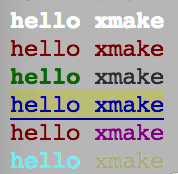
The color-related descriptions are placed in `${ }`, and you can set several different properties at the same time, for example:
```
${bright red underline onyellow}
```
Indicates: highlighted red, background yellow, and with a down line
All of these descriptions will affect the entire entire line of characters. If you only want to display partial color text, you can insert `${clear}` at the end position to clear the previous color description.
E.g:
```
${red}hello ${clear}xmake
```
In this case, only hello is displayed in red, and the others are still normal black display.
Other colors belong to, I will not introduce them here, directly paste the list of attributes in the xmake code:
```lua
colors.keys =
{
-- Attributes
reset = 0 -- reset attribute
, clear = 0 -- clear attribute
, default = 0 -- default property
, bright = 1 -- highlight
, dim = 2 -- dark
, underline = 4 -- underline
, blink = 5 -- flashing
, reverse = 7 -- reverse color
, hidden = 8 -- hidden text
-- Foreground
, black = 30
, red = 31
, green = 32
, yellow = 33
, blue = 34
, magenta = 35
, cyan = 36
, white = 37
-- Background color
, onblack = 40
, onred = 41
, ongreen = 42
, onyellow = 43
, onblue = 44
, onmagenta = 45
, oncyan = 46
, onwhite = 47
```
In addition to color highlighting, if your terminal is under macosx, lion above the system, xmake can also support the display of emoji expressions, for systems that do not support
Ignore the display, for example:
```lua
cprint("hello xmake${beer}")
cprint("hello${ok_hand} xmake")
```
The above two lines of code, I printed a classic beer symbol in the homebrew, the following line printed an ok gesture symbol, is not very dazzling. .
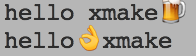
All emoji emoticons, as well as the corresponding keys in xmake, can be found in [emoji] (http://www.emoji-cheat-sheet.com/). .
Version 2.1.7 supports 24-bit true color output, if the terminal supports it:
```lua
import("core.base.colors")
if colors.truecolor() then
cprint("${255;0;0}hello")
cprint("${on;255;0;0}hello${clear} xmake")
cprint("${bright 255;0;0 underline}hello")
cprint("${bright on;255;0;0 0;255;0}hello${clear} xmake")
end
```
Xmake's detection support for truecolor is implemented by the `$COLORTERM` environment variable. If your terminal supports truecolor, you can manually set this environment variable to tell xmake to enable truecolor support.
It can be enabled and tested with the following command:
```bash
$ export COLORTERM=truecolor
$ xmake --version
```
The 2.1.7 version can disable color output with `COLORTERM=nocolor`.
##### cprintf
###### No line feed color print terminal log
This interface is similar to [cprint](#cprint), the difference is that it does not wrap the output.
##### format
###### Formatting a string
If you just want to format the string and don't output it, you can use this interface. This interface is equivalent to the [string.format](#string-format) interface, just a simplified version of the interface name.
```lua
local s = format("hello %s", xmake)
```
##### vformat
###### Formatting strings, support for built-in variable escaping
This interface is followed by [format](The #format) interface is similar, but adds support for the acquisition and escaping of built-in variables.
```lua
local s = vformat("hello %s $(mode) $(arch) $(env PATH)", xmake)
```
##### raise
###### Throwing an abort program
If you want to interrupt xmake running in custom scripts and plug-in tasks, you can use this interface to throw an exception. If the upper layer does not show the call to [try-catch](#try-catch-finally), xmake will be executed. An error message is displayed.
```lua
if (errors) raise(errors)
```
If an exception is thrown in the try block, the error information is captured in catch and finally. See: [try-catch](#try-catch-finally)
##### find_packages
###### Finding dependencies
This interface is a wrapper around the [lib.detect.find_package](#detect-find_package) interface and provides lookup support for multiple dependencies, for example:
```lua
target("test")
set_kind("binary")
add_files("src/*.c")
on_load(function (target)
target:add(find_packages("openssl", "zlib"))
end)
```
##### os
The system operation module belongs to the built-in module. It can be called directly by the script field without using [import](#import) import.
This module is also a native module of lua, and xmake has been extended to provide more practical interfaces.
<p class="tips">
Only some readonly interfaces (for example: `os.getenv`, `os.arch`) in the os module can be used in the description field. Other interfaces can only be used in the script domain, for example: `os.cp`, `os .rm`etc.
</p>
| Interface | Description | Supported Versions |
| ----------------------------------------------- | -------------------------------------------- | -------- |
| [os.cp](#os-cp) | Copy files or directories | >= 2.0.1 |
| [os.mv](#os-mv) | Move Renamed File or Directory | >= 2.0.1 |
| [os.rm](#os-rm) | Delete files or directory tree | >= 2.0.1 |
| [os.trycp](#os-trycp) | Try copying files or directories | >= 2.1.6 |
| [os.trymv](#os-trymv) | Try moving the renamed file or directory | >= 2.1.6 |
| [os.tryrm](#os-tryrm) | Try deleting a file or directory tree | >= 2.1.6 |
| [os.cd](#os-cd) | Go to the specified directory | >= 2.0.1 |
| [os.rmdir](#os-rmdir) | Delete Directory Tree | >= 2.0.1 |
| [os.mkdir](#os-mkdir) | Create the specified directory | >= 2.0.1 |
| [os.isdir](#os-isdir) | Determine if the directory exists | >= 2.0.1 |
| [os.isfile](#os-isfile) | Determine if the file exists | >= 2.0.1 |
| [os.exists](#os-exists) | Determine if a file or directory exists | >= 2.0.1 |
| [os.dirs](#os-dirs) | Traversing to get all directories under the specified directory | >= 2.0.1 |
| [os.files](#os-files) | Traversing to get all the files in the specified directory | >= 2.0.1 |
| [os.filedirs](#os-filedirs) | Traversing to get all files or directories under the specified directory | >= 2.0.1 |
| [os.run](#os-run) | Quiet running program | >= 2.0.1 |
| [os.runv](#os-runv) | Quiet running program with parameter list | >= 2.1.5 |
| [os.exec](#os-exec) | Evoke Run Program | >= 2.0.1 |
| [os.execv](#os-execv) | Echo running program with parameter list | >= 2.1.5 |
| [os.iorun](#os-iorun) | Run and get the program output | >= 2.0.1 |
| [os.iorunv](#os-iorunv) | Run and get the program output with parameter list | >= 2.1.5 |
| [os.getenv](#os-getenv) | Get Environment Variables | >= 2.0.1 |
| [os.setenv](#os-setenv) | Setting environment variables | >= 2.0.1 |
| [os.tmpdir](#os-tmpdir) | Get Temp directory path | >= 2.0.1 |
| [os.tmpfile](#os-tmpfile) | Get Temporary File Path | >= 2.0.1 |
| [os.curdir](#os-curdir) | Get current directory path | >= 2.0.1 |
| [os.filesize](#os-filesize) | Get File Size | >= 2.1.9 |
| [os.scriptdir](#os-scriptdir) | Get script directory path | >= 2.0.1 |
| [os.programdir](#os-programdir) | Get xmake install main program script directory | >= 2.1.5 |
| [os.projectdir](#os-projectdir) | Get Project Home | |= 2.1.5 |
| [os.arch](#os-arch) | Get Current System Architecture | >= 2.0.1 |
| [os.host](#os-host) | Get Current Host System | >= 2.0.1 |
###### os.cp
- Copy files or directories
The behavior is similar to the `cp` command in the shell, supporting path wildcard matching (using lua pattern matching), support for multi-file copying, and built-in variable support.
E.g:
```lua
os.cp("$(scriptdir)/*.h", "$(projectdir)/src/test/**.h", "$(buildir)/inc")
```
The above code will: all the header files in the current `xmake.lua` directory, the header files in the project source test directory are all copied to the `$(buildir)` output directory.
Among them `$(scriptdir)`, `$(projectdir)` These variables are built-in variables of xmake. For details, see the related documentation of [built-in variables] (#built-in variables).
The matching patterns in `*.h` and `**.h` are similar to those in [add_files](#targetadd_files), the former is a single-level directory matching, and the latter is a recursive multi-level directory matching.
This interface also supports `recursive replication' of directories, for example:
```lua
-- Recursively copy the current directory to a temporary directory
os.cp("$(curdir)/test/", "$(tmpdir)/test")
```
<p class="tip">
Try to use the `os.cp` interface instead of `os.run("cp ..")`, which will ensure platform consistency and cross-platform build description.
</p>
###### os.mv
- Move to rename a file or directory
Similar to the use of [os.cp](#os-cp), it also supports multi-file move operations and pattern matching, for example:
```lua
-- Move multiple files to a temporary directory
os.mv("$(buildir)/test1","$(buildir)/test2", "$(tmpdir)")
-- File movement does not support bulk operations, which is file renaming
os.mv("$(buildir)/libtest.a", "$(buildir)/libdemo.a")
```
###### os.rm
- Delete files or directory trees
Support for recursive deletion of directories, bulk delete operations, and pattern matching and built-in variables, such as:
```lua
os.rm("$(buildir)/inc/**.h", "$(buildir)/lib/")
```
###### os.trycp
- Try copying files or directories
Similar to [os.cp](#os-cp), the only difference is that this interface operation will not throw an exception interrupt xmake, but the return value indicates whether the execution is successful.
```lua
if os.trycp("file", "dest/file") then
end
```
###### os.trymv
- Try moving a file or directory
Similar to [os.mv](#os-mv), the only difference is that this interface operation will not throw an exception interrupt xmake, but the return value indicates whether the execution is successful.
```lua
if os.trymv("file", "dest/file") then
end
```
###### os.tryrm
- Try deleting files or directories
Similar to [os.rm](#os-rm), the only difference is that this interface operation will not throw an exception interrupt xmake, but the return value indicates whether the execution is successful.
```lua
if os.tryrm("file") then
end
```
###### os.cd
- Enter the specified directory
This operation is used for directory switching and also supports built-in variables, but does not support pattern matching and multi-directory processing, for example:
```lua
-- Enter the temporary directory
os.cd("$(tmpdir)")
```
If you want to leave the previous directory, there are several ways:
```lua
-- Enter the parent directory
os.cd("..")
-- Enter the previous directory, equivalent to: cd -
os.cd("-")
-- Save the previous directory before entering the directory, then use it to cut back directly after the level
local oldir = os.cd("./src")
...
os.cd(oldir)
```
###### os.rmdir
- delete only the directory
If it is not a directory, it cannot be deleted.
###### os.mkdir
- Create a directory
Support for batch creation and built-in variables, such as:
```lua
os.mkdir("$(tmpdir)/test", "$(buildir)/inc")
```
###### os.isdir
- Determine if it is a directory
Return false if the directory does not exist
```lua
if os.isdir("src") then
-- ...
end
```
###### os.isfile
- Determine if it is a file
Return false if the file does not exist
```lua
if os.isfile("$(buildir)/libxxx.a") then
-- ...
end
```
###### os.exists
- Determine if a file or directory exists
Return false if the file or directory does not exist
```lua
-- Judging the existence of the directory
if os.exists("$(buildir)") then
-- ...
end
-- Judging the existence of the file
if os.exists("$(buildir)/libxxx.a") then
-- ...
end
```
###### os.dirs
- Traverse to get all the directories under the specified directory
Supports pattern matching in [add_files](#targetadd_files), supports recursive and non-recursive mode traversal, and returns a table array. If not, returns an empty array, for example:
```lua
-- Recursive traversal to get all subdirectories
for _, dir in ipairs(os.dirs("$(buildir)/inc/**")) do
print(dir)
end
```
###### os.files
- Traverse to get all the files in the specified directory
Supports pattern matching in [add_files](#targetadd_files), supports recursive and non-recursive mode traversal, and returns a table array. If not, returns an empty array, for example:
```lua
-- Non-recursive traversal to get all child files
for _, filepath in ipairs(os.files("$(buildir)/inc/*.h")) do
print(filepath)
end
```
###### os.filedirs
- Traverse to get all files and directories under the specified directory
Supports pattern matching in [add_files](#targetadd_files), supports recursive and non-recursive mode traversal, and returns a table array. If not, returns an empty array, for example:
```lua
-- Recursive traversal to get all child files and directories
for _, filedir in ipairs(os.filedirs("$(buildir)/**")) do
print(filedir)
end
```
###### os.run
- Quietly running native shell commands
Used to execute third-party shell commands, but will not echo the output, only after the error, highlight the error message.
This interface supports parameter formatting and built-in variables such as:
```lua
-- Formatted parameters passed in
os.run("echo hello %s!", "xmake")
-- List build directory files
os.run("ls -l $(buildir)")
```
<p class="warning">
Using this interface to execute shell commands can easily reduce the cross-platform build. For `os.run("cp ..")`, try to use `os.cp` instead. <br>
If you must use this interface to run the shell program, please use the [config.plat] (#config-plat) interface to determine the platform support.
</p>
For more advanced process operations and control, see the [process](#process) module interface.
###### os.runv
- Quietly running native shell commands with parameter list
Similar to [os.run](#os-run), just the way to pass parameters is passed through the parameter list, not the string command, for example:
```lua
os.runv("echo", {"hello", "xmake!"})
```
###### os.exec
- Echo running native shell commands
Similar to the [os.run](#os-run) interface, the only difference is that when this interface executes the shell program, it has the output output, which is used in general debugging.
###### os.execv
- Echo running native shell commands with parameter list
Similar to [os.execv](#os-execv), just the way to pass parameters is passed through the parameter list, not the string command, for example:
```lua
os.execv("echo", {"hello", "xmake!"})
```
###### os.iorun
- Quietly running native shell commands and getting output
Similar to the [os.run](#os-run) interface, the only difference is that after executing the shell program, this interface will get the execution result of the shell program, which is equivalent to redirecting the output.
You can get the contents of `stdout`, `stderr` at the same time, for example:
```lua
local outdata, errdata = os.iorun("echo hello xmake!")
```
###### os.iorunv
- Run the native shell command quietly and get the output with a list of parameters
Similar to [os.iorunv](#os-iorunv), just the way to pass arguments is passed through the argument list, not the string command, for example:
```lua
local result, errors = os.iorunv("echo", {"hello", "xmake!"})
```
###### os.getenv
- Get system environment variables
```lua
print(os.getenv("PATH"))
```
###### os.setenv
- Set system environment variables
```lua
os.setenv("HOME", "/tmp/")
```
###### os.tmpdir
- Get temporary directory
Consistent with the result of [$(tmpdir)](#var-tmpdir), it is just a direct return to return a variable that can be maintained with subsequent strings.
```lua
print(path.join(os.tmpdir(), "file.txt"))
```
Equivalent to:
```lua
print("$(tmpdir)/file.txt"))
```
###### os.tmpfile
- Get temporary file path
Used to get a temporary file path, just a path, the file needs to be created by itself.
###### os.curdir
- Get the current directory path
Consistent with the result of [$(curdir)](#var-curdir), it is just a direct return to return a variable that can be maintained with subsequent strings.
Usage reference: [os.tmpdir] (#os-tmpdir).
###### os.filesize
- Get file size
```lua
print(os.filesize("/tmp/a"))
```
###### os.scriptdir
- Get the path of the current description script
Consistent with the result of [$(scriptdir)](#var-scriptdir), it is just a direct return to return a variable that can be maintained with subsequent strings.
Usage reference: [os.tmpdir] (#os-tmpdir).
###### os.programdir
- Get the xmake installation main program script directory
Consistent with the result of [$(programdir)](#var-programdir), it is just a direct get returned to a variable, which can be maintained with subsequent strings.
###### os.projectdir
- Get the project home directory
Consistent with the result of [$(projectdir)](#var-projectdir), it is just a direct return to return a variable that can be maintained with subsequent strings.
###### os.arch
- Get current system architecture
That is the default architecture of the current host system, for example, I execute xmake on `linux x86_64` to build, then the return value is: `x86_64`
###### os.host
- Get the operating system of the current host
Consistent with the result of [$(host)](#var-host), for example, if I execute xmake on `linux x86_64` to build, the return value is: `linux`
##### io
The io operation module extends lua's built-in io module to provide more easy-to-use interfaces.
| Interface | Description | Supported Versions |
| ----------------------------------------------- | -------------------------------------------- | -------- |
| [io.open](#io-open) | Open file for reading and writing | >= 2.0.1 |
| [io.load](#io-load) | De-serialize all table contents from the specified path file | >= 2.0.1 |
| [io.save](#io-save) | Serialize all table contents to the specified path file | >= 2.0.1 |
| [io.readfile](#io.readfile) | Read everything from the specified path file | >= 2.1.3 |
| [io.writefile](#io.writefile) | Write everything to the specified path file | >= 2.1.3 |
| [io.gsub](#io-gsub) | Full text replaces the contents of the specified path file | >= 2.0.1 |
| [io.tail](#io-tail) | Read and display the tail of the file | >= 2.0.1 |
| [io.cat](#io-cat) | Read and display all contents of a file | >= 2.0.1 |
| [io.print](#io-print) | Formatting output with a line feed to a file | >= 2.0.1 |
| [io.printf](#io-printf) | No line formatted output to file | >= 2.0.1 |
###### io.open
- Open file for reading and writing
This is a native interface for lua. For detailed usage, see Lua's official documentation: [The Complete I/O Model] (https://www.lua.org/pil/21.2.html)
If you want to read all the contents of the file, you can write:
```lua
local file = io.open("$(tmpdir)/file.txt", "r")
if file then
local data = file:read("*all")
file:close()
end
```
Or you can read it more quickly using [io.readfile](#io.readfile).
If you want to write a file, you can do this:
```lua
-- Open file: w is write mode, a is append write mode
local file = io.open("xxx.txt", "w")
if file then
-- Write data to file with native lua interface, does not support formatting, no line breaks, does not support built-in variables
file:write("hello xmake\n")
-- Write data to file with xmake extended interface, support formatting, no line breaks, no built-in variables
file:writef("hello %s\n", "xmake")
-- Use xmake extended formatted parameters to write to one line, with line breaks, and support for built-in variables
file:print("hello %s and $(buildir)", "xmake")
-- Write a line using the xmake extended formatted arguments, no line breaks, and support for built-in variables
file:printf("hello %s and $(buildir) \n", "xmake")
-- Close the file
file:close()
end
```
###### io.load
- Load all table contents from the specified path file deserialization
You can load serialized table contents from a file, generally used with [io.save](#io-save), for example:
```lua
-- Load the contents of the serialized file to the table
local data = io.load("xxx.txt")
if data then
-- Dump prints the contents of the entire table in the terminal, formatting the output
table.dump(data)
end
```
###### io.save
- Serialize all table contents to the specified path file
You can serialize the contents of the table to the specified file, generally used in conjunction with [io.load](#io-load), for example:
```lua
io.save("xxx.txt", {a = "a", b = "b", c = "c"})
```
The result of the storage is:
```
{
["b"] = "b"
, ["a"] = "a"
, ["c"] = "c"
}
```
###### io.readfile
- Read everything from the specified path file
It is more convenient to directly read the contents of the entire file without opening the file, for example:
```lua
local data = io.readfile("xxx.txt")
```
###### io.writefile
- Write all content to the specified path file
It is more convenient to directly write the contents of the entire file without opening the file, for example:
```lua
io.writefile("xxx.txt", "all data")
```
###### io.gsub
- Full text replaces the contents of the specified path file
Similar to the [string.gsub](#string-gsub) interface, the full-text pattern matches the replacement content, but here is the direct operation file, for example:
```lua
-- Remove all whitespace characters from the file
io.gsub("xxx.txt", "%s+", "")
```
###### io.tail
- Read and display the tail content of the file
Reads the data of the specified number of lines at the end of the file and displays a command like `cat xxx.txt | tail -n 10`, for example:
```lua
-- Display the last 10 lines of the file
io.tail("xxx.txt", 10)
```
###### io.cat
- read and display all contents of the file
Read all the contents of the file and display it, similar to the `cat xxx.txt` command, for example:
```lua
io.cat("xxx.txt")
```
###### io.print
- Formatted output content to file with newline
Directly format the passed parameter to output a line of string to the file with a line break, for example:
```lua
io.print("xxx.txt", "hello %s!", "xmake")
```
###### io.printf
- Formatted output to file without line breaks
Directly format the passed parameter to output a line of string to the file without a line break, for example:
```lua
io.printf("xxx.txt", "hello %s!\n", "xmake")
```
##### path
The path operation module implements cross-platform path operations, which is a custom module of xmake.
| Interface | Description | Supported Versions |
| ----------------------------------------------- | -------------------------------------------- | -------- |
| [path.join](#path-join) | Stitching Path | >= 2.0.1 |
| [path.translate](#path-translate) | Convert path to the path style of the current platform | >= 2.0.1 |
| [path.basename](#path-basename) | Get the file name with no suffix at the end | >= 2.0.1 |
| [path.filename](#path-filename) | Get the file name with the last suffix of the path | >= 2.0.1 |
| [path.extension](#path-extension) | Get the suffix of the path | >= 2.0.1 |
| [path.directory](#path-directory) | Get the last directory name of the path | >= 2.0.1 |
| [path.relative](#path-relative) | Convert to relative path | >= 2.0.1 |
| [path.absolute](#path-absolute) | Convert to Absolute Path | >= 2.0.1 |
| [path.is_absolute](#path-is_absolute) | Determine if it is an absolute path | >= 2.0.1 |
###### path.join
- Stitching path
Adding multiple path items by splicing. Due to the path difference of `windows/unix` style, using api to append paths is more cross-platform, for example:
```lua
print(path.join("$(tmpdir)", "dir1", "dir2", "file.txt"))
```
The above splicing on Unix is equivalent to: `$(tmpdir)/dir1/dir2/file.txt`, and on Windows is equivalent to: `$(tmpdir)\\dir1\\dir2\\file.txt`
If you find this cumbersome and not clear enough, you can use: [path.translate](path-translate) to format the conversion path string to the format supported by the current platform.
###### path.translate
- Convert path to the path style of the current platform
Formatting converts the specified path string to the path style supported by the current platform, and supports the path string parameter of the `windows/unix` format to be passed in, even mixed, such as:
```lua
print(path.translate("$(tmpdir)/dir/file.txt"))
print(path.translate("$(tmpdir)\\dir\\file.txt"))
print(path.translate("$(tmpdir)\\dir/dir2//file.txt"))
```
The path strings of the above three different formats, after being standardized by `translate`, will become the format supported by the current platform, and the redundant path separator will be removed.
###### path.basename
- Get the file name with no suffix at the end of the path
```lua
print(path.basename("$(tmpdir)/dir/file.txt"))
```
The result is: `file`
###### path.filename
- Get the file name with the last suffix of the path
```lua
print(path.filename("$(tmpdir)/dir/file.txt"))
```
The result is: `file.txt`
###### path.extension
- Get the suffix of the path
```lua
print(path.extensione("$(tmpdir)/dir/file.txt"))
```
The result is: `.txt`
###### path.directory
- Get the last directory name of the path```lua
Print(path.directory("$(tmpdir)/dir/file.txt"))
```
The result is: `dir`
###### path.relative
- Convert to relative path
```lua
print(path.relative("$(tmpdir)/dir/file.txt", "$(tmpdir)"))
```
The result is: `dir/file.txt`
The second parameter is to specify the relative root directory. If not specified, the default is relative to the current directory:
```lua
os.cd("$(tmpdir)")
print(path.relative("$(tmpdir)/dir/file.txt"))
```
The result is the same.
###### path.absolute
- Convert to absolute path
```lua
print(path.absolute("dir/file.txt", "$(tmpdir)"))
```
The result is: `$(tmpdir)/dir/file.txt`
The second parameter is to specify the relative root directory. If not specified, the default is relative to the current directory:
```lua
os.cd("$(tmpdir)")
print(path.absolute("dir/file.txt"))
```
The result is the same.
###### path.is_absolute
- Determine if it is an absolute path
```lua
if path.is_absolute("/tmp/file.txt") then
-- if it is an absolute path
end
```
##### table
Table belongs to the module provided by Lua native. For the native interface, you can refer to: [lua official document] (http://www.lua.org/manual/5.1/manual.html#5.5)
It has been extended in xmake to add some extension interfaces:
| Interface | Description | Supported Versions |
| ----------------------------------------------- | -------------------------------------------- | -------- |
| [table.join](#table-join) | Merge multiple tables and return | >= 2.0.1 |
| [table.join2](#table-join2) | Merge multiple tables into the first table | >= 2.0.1 |
| [table.dump](#table-dump) | Output all contents of table | >= 2.0.1 |
| [table.unique](#table-unique) | Deduplicate the contents of the table | >= 2.0.1 |
| [table.slice](#table-slice) | Get the slice of the table | >= 2.0.1 |
###### table.join
- Merge multiple tables and return
You can merge the elements in multiple tables and return to a new table, for example:
```lua
local newtable = table.join({1, 2, 3}, {4, 5, 6}, {7, 8, 9})
```
The result is: `{1, 2, 3, 4, 5, 6, 7, 8, 9}`
And it also supports the merging of dictionaries:
```lua
local newtable = table.join({a = "a", b = "b"}, {c = "c"}, {d = "d"})
```
The result is: `{a = "a", b = "b", c = "c", d = "d"}`
###### table.join2
- Combine multiple tables into the first table
Similar to [table.join](#table.join), the only difference is that the result of the merge is placed in the first argument, for example:
```lua
local t = {0, 9}
table.join2(t, {1, 2, 3})
```
The result is: `t = {0, 9, 1, 2, 3}`
###### table.dump
- Output all contents of the table
Recursively format all the contents of the printed table, generally used for debugging, for example:
```lua
table.dump({1, 2, 3})
```
The result is: `{1, 2, 3}`
###### table.unique
- Deduplicate the contents of the table
To de-table elements, generally used in array tables, for example:
```lua
local newtable = table.unique({1, 1, 2, 3, 4, 4, 5})
```
The result is: `{1, 2, 3, 4, 5}`
###### table.slice
- Get the slice of the table
Used to extract some elements of an array table, for example:
```lua
-- Extract all elements after the 4th element, resulting in: {4, 5, 6, 7, 8, 9}
table.slice({1, 2, 3, 4, 5, 6, 7, 8, 9}, 4)
-- Extract the 4th-8th element and the result: {4, 5, 6, 7, 8}
table.slice({1, 2, 3, 4, 5, 6, 7, 8, 9}, 4, 8)
-- Extract the 4th-8th element with an interval of 2, resulting in: {4, 6, 8}
table.slice({1, 2, 3, 4, 5, 6, 7, 8, 9}, 4, 8, 2)
```
##### string
The string module is a native module of lua. For details, see: [lua official manual] (http://www.lua.org/manual/5.1/manual.html#5.4)
It has been extended in xmake to add some extension interfaces:
| Interface | Description | Supported Versions |
| ----------------------------------------------- | -------------------------------------------- | -------- |
| [string.startswith](#string-startswith) | Determine if the beginning of the string matches | >= 1.0.1 |
| [string.endswith](#string-endswith) | Determine if the end of the string matches | >= 1.0.1 |
| [string.split](#string-split) | Split String | >= 1.0.1 |
| [string.trim](#string-trim) | Remove the left and right whitespace characters | >= 1.0.1 |
| [string.ltrim](#string-ltrim) | Remove the whitespace character to the left of the string | >= 1.0.1 |
| [string.rtrim](#string-rtrim) | Remove the whitespace character to the right of the string | >= 1.0.1 |
###### string.startswith
- Determine if the beginning of the string matches
```lua
local s = "hello xmake"
if s:startswith("hello") then
print("match")
end
```
###### string.endswith
- Determine if the end of the string matches
```lua
local s = "hello xmake"
if s:endswith("xmake") then
print("match")
end
```
###### string.split
- Split string
The string is separated by the specified separator. The separator can be: character, string, pattern matching string, for example:
```lua
local s = "hello xmake!"
s:split("%s+")
```
Split according to consecutive whitespace characters, the result is: `hello`, `xmake!`
```lua
local s = "hello,xmake:123"
s:split("[,:]")
```
The above code is split according to the `, ` or `:` characters. The result is: `hello`, `xmake`, `123`
###### string.trim
- Remove the left and right whitespace characters of the string
```lua
string.trim(" hello xmake! ")
```
The result is: "hello xmake!"
###### string.ltrim
- Remove the whitespace character to the left of the string
```lua
string.ltrim(" hello xmake! ")
```
The result is: "hello xmake! "
###### string.rtrim
- Remove the whitespace character to the right of the string
```lua
string.rtrim(" hello xmake! ")
```
The result is: " hello xmake!"
##### process
This is the xmake extension's process control module for more flexible control of the process, compared to: [os.run] (#os-run) series is more flexible and lower level.
| Interface | Description | Supported Versions |
| ----------------------------------------------- | -------------------------------------------- | -------- |
| [process.open](#process-open) | Open Process | >= 2.0.1 |
| [process.wait](#process-wait) | Waiting for the process to end | >= 2.0.1 |
| [process.close](#process-close) | Close Process Object | >=2.0.1 |
| [process.waitlist](#process-waitlist) | Waiting for multiple processes at the same time | >= 2.0.1 |
###### process.open
- Open the process
Run a specified program through path creation and return the corresponding process object:
```lua
-- Open the process, the last two parameters specify the stdout to be captured, the stderr file path
local proc = process.open("echo hello xmake!", outfile, errfile)
if proc then
-- Waiting for the process to complete
--
-- Parameter 2 is waiting for timeout, -1 is permanent waiting, 0 is trying to get process status
-- Return value waitok is wait state: 1 is waiting for the process to end normally, 0 is the process is still running, -1 bit is waiting to fail
-- The return value status is the status code returned by the process after waiting for the process to end.
local waitok, status = process.wait(proc, -1)
-- release process object
process.close(proc)
end
```
###### process.wait
- Waiting for the process to end
For specific use, see: [process.open](#process-open)
###### process.close
- close the process object
For specific use, see: [process.open](#process-open)
###### process.waitlist
- Waiting for multiple processes at the same time
```lua
-- The second parameter is waiting for a timeout, returning a list of process states
for _, procinfo in ipairs(process.waitlist(procs, -1)) do
-- For each process: process object, process pid, process end status code
local proc = procinfo[1]
local procid = procinfo[2]
local status = procinfo[3]
end
```
##### coroutine
The coroutine module is a native module of lua. For use, see: [lua official manual] (http://www.lua.org/manual/5.1/manual.html#5.2)
#### Extension Modules
All expansion modules need to be imported through the [import](#import) interface.
##### core.base.option
Commonly used to get the value of the xmake command parameter option, often used for plugin development.
| Interface | Description | Supported Versions |
| ----------------------------------------------- | -------------------------------------------- | -------- |
| [option.get](#option-get) | Get Parameter Option Value | >= 2.0.1 |
###### option.get
- Get parameter option values
Used to get parameter option values in plugin development, for example:
```lua
-- Import option module
import("core.base.option")
-- Plugin entry function
function main(...)
print(option.get("info"))
end
```
The above code gets the hello plugin and executes: `xmake hello --info=xxxx` The value of the `--info=` option passed in the command, and shows: `xxxx`
For task tasks or plugins that are not a main entry, you can use this:
```lua
task("hello")
on_run(function ())
import("core.base.option")
print(option.get("info"))
end)
```
##### core.base.global
Used to get the configuration information of xmake global, that is, the value of the parameter option passed in `xmake g|global --xxx=val`.
| Interface | Description | Supported Versions |
| ----------------------------------------------- | -------------------------------------------- | -------- |
| [global.get](#global-get) | Get the specified configuration value | >= 2.0.1 |
| [global.load](#global-load) | Load Configuration | >= 2.0.1 |
| [global.directory](#global-directory) | Get Global Configuration Information Directory | >= 2.0.1 |
| [global.dump](#global-dump) | Print out all global configuration information | >= 2.0.1 |
<p class="tip">
Prior to version 2.1.5, it was `core.project.global`.
</p>
###### global.get
- Get the specified configuration value
Similar to [config.get](#config-get), the only difference is that this is obtained from the global configuration.
###### global.load
- Load configuration
Similar to [global.get](#global-get), the only difference is that this is loaded from the global configuration.
###### global.directory
- Get the global configuration information directory
The default is the `~/.config` directory.
###### global.dump
- Print out all global configuration information
The output is as follows:
```lua
{
clean = true
, ccache = "ccache"
, xcode_dir = "/Applications/Xcode.app"
}
```
##### core.base.task
Used for task operations, generally used to call other task tasks in custom scripts and plug-in tasks.
| Interface | Description | Supported Versions |
| ----------------------------------------------- | -------------------------------------------- | -------- |
| [task.run](#task-run) | Run the specified task | >= 2.0.1 |
<p class="tip">
Prior to version 2.1.5, it was `core.project.task`.
</p>
###### task.run
- Run the specified task
Used to run tasks or plugins defined by [task](#task) in custom scripts, plugin tasks, for example:
```lua
task("hello")
on_run(function ()
print("hello xmake!")
end)
target("demo")
on_clean(function(target)
-- Import task module
import("core.base.task")
-- Run this hello task
task.run("hello")
end)
```
We can also increase parameter passing when running a task, for example:
```lua
task("hello")
on_run(function (arg1, arg2)
print("hello xmake: %s %s!", arg1, arg2)
end)
target("demo")
on_clean(function(target)
-- Import task
import("core.base.task")
-- {} This is used for the first option, which is set to null, where two arguments are passed in the last: arg1, arg2
task.run("hello", {}, "arg1", "arg2")
end)
```
The second argument to `task.run` is used to pass options from the command line menu instead of passing directly into the `function (arg, ...)` function entry, for example:
```lua
-- Import task
import("core.base.task")
-- Plugin entry
function main(...)
-- Run the built-in xmake configuration task, equivalent to: xmake f|config --plat=iphoneos --arch=armv7
task.run("config", {plat="iphoneos", arch="armv7"})
emd
```
##### core.tool.linker
Linker related operations, often used for plugin development.
| Interface | Description | Supported Versions |
| ----------------------------------------------- | -------------------------------------------- | -------- |
| [linker.link](#linker-link) | Execute Link | >= 2.0.1 |
| [linker.linkcmd](#linker-linkcmd) | Get Link Command Line | >= 2.0.1 |
| [linker.linkargv](#linker-linkargv) | Get Link Command Line List | >= 2.1.5 |
| [linker.linkflags](#linker-linkflags) | Get LinksOptions | >= 2.0.1 |
| [linker.has_flags](#linker-has_flags) | Determine if the specified link option is supported | >= 2.1.5 |
###### linker.link
- Execute link
For the target, link the specified object file list to generate the corresponding target file, for example:
```lua
linker.link("binary", "cc", {"a.o", "b.o", "c.o"}, target:targetfile(), {target = target})
```
Where [target](#target) is the project target, here is passed in, mainly used to get the target-specific link options. For the project target object, see: [core.project.project](#core-project-project )
Of course, you can also not specify the target, for example:
```lua
linker.link("binary", "cc", {"a.o", "b.o", "c.o"}, "/tmp/targetfile")
```
The first parameter specifies the link type and currently supports: binary, static, shared
The second parameter tells the linker that it should be linked as the source file object, and what compiler source files are compiled with, for example:
| Second Parameter Value | Description |
| ------------ | ------------ |
| cc | c compiler |
| cxx | c++ compiler |
| mm | objc compiler |
| mxx | objc++ compiler |
| gc | go compiler |
| as | assembler |
| sc | swift compiler |
| rc | rust compiler |
| dc | dlang compiler |
Specifying different compiler types, the linker will adapt the most appropriate linker to handle the link, and if several languages support mixed compilation, you can pass in multiple compiler types at the same time, specifying that the linker chooses to support these hybrid compilations. The linker of the language performs link processing:
```lua
linker.link("binary", {"cc", "mxx", "sc"}, {"a.o", "b.o", "c.o"}, "/tmp/targetfile")
```
The above code tells the linker that the three object files a, b, c may be c, objc++, compiled by swift code. The linker will select the most suitable linker from the current system and toolchain to handle the link process. .
###### linker.linkcmd
- Get link command line string
Get the command line string executed in [linker.link](#linker-link) directly, which is equivalent to:
```lua
local cmdstr = linker.linkcmd("static", "cxx", {"a.o", "b.o", "c.o"}, target:targetfile(), {target = target})
```
Note: The extension part of ``target = target}` is optional. If the target object is passed, the generated link command will add the link option corresponding to this target configuration.
And you can also pass various configurations yourself, for example:
```lua
local cmdstr = linker.linkcmd("static", "cxx", {"a.o", "b.o", "c.o"}, target:targetfile(), {config = {linkdirs = "/usr/lib"}})
```
###### linker.linkargv
- Get a list of link command line arguments
A little different from [linker.linkcmd](#linker-linkcmd) is that this interface returns a list of parameters, table representation, more convenient to operate:
```lua
local program, argv = linker.linkargv("static", "cxx", {"a.o", "b.o", "c.o"}, target:targetfile(), {target = target})
```
The first value returned is the main program name, followed by the parameter list, and `os.args(table.join(program, argv))` is equivalent to `linker.linkcmd`.
We can also run it directly by passing the return value to [os.runv](#os-runv): `os.runv(linker.linkargv(..))`
###### linker.linkflags
- Get link options
Get the link option string part of [linker.linkcmd](#linker-linkcmd) without shellname and object file list, and return by array, for example:
```lua
local flags = linker.linkflags("shared", "cc", {target = target})
for _, flag in ipairs(flags) do
print(flag)
end
```
The returned array of flags is an array.
###### linker.has_flags
- Determine if the specified link option is supported
Although it can be judged by [lib.detect.has_flags](detect-has_flags), but the interface is more low-level, you need to specify the linker name.
This interface only needs to specify the target type of the target, the source file type, which will automatically switch to select the currently supported linker.
```lua
if linker.has_flags(target:targetkind(), target:sourcekinds(), "-L/usr/lib -lpthread") then
-- ok
end
```
##### core.tool.compiler
Compiler related operations, often used for plugin development.
| Interface | Description | Supported Versions |
| ----------------------------------------------- | -------------------------------------------- | -------- |
| [compiler.compile](#compiler-compile) | Execute Compilation | >= 2.0.1 |
| [compiler.compcmd](#compiler-compcmd) | Get Compiler Command Line | >= 2.0.1 |
| [compiler.compargv](#compiler-compargv) | Get Compiled Command Line List | >= 2.1.5 |
| [compiler.compflags](#compiler-compflags) | Get Compilation Options | >= 2.0.1 |
| [compiler.has_flags](#compiler-has_flags) | Determine if the specified compilation option is supported | >= 2.1.5 |
| [compiler.features](#compiler-features) | Get all compiler features | >= 2.1.5 |
| [compiler.has_features](#compiler-has_features) | Determine if the specified compilation feature is supported | >= 2.1.5 |
###### compiler.compile
- Perform compilation
For the target, link the specified object file list to generate the corresponding target file, for example:
```lua
compiler.compile("xxx.c", "xxx.o", "xxx.h.d", {target = target})
```
Where [target](#target) is the project target, here is the specific compile option that is mainly used to get the taeget. If you get the project target object, see: [core.project.project](#core-project-project)
The `xxx.h.d` file is used to store the header file dependency file list for this source file. Finally, these two parameters are optional. You can not pass them when compiling:
```lua
compiler.compile("xxx.c", "xxx.o")
```
To simply compile a source file.
###### compiler.compcmd
- Get the compile command line
Get the command line string executed directly in [compiler.compile](#compiler-compile), which is equivalent to:
```lua
local cmdstr = compiler.compcmd("xxx.c", "xxx.o", {target = target})
```
Note: The extension part of ``target = target}` is optional. If the target object is passed, the generated compile command will add the link option corresponding to this target configuration.
And you can also pass various configurations yourself, for example:
```lua
local cmdstr = compiler.compcmd("xxx.c", "xxx.o", {config = {includedirs = "/usr/include", defines = "DEBUG"}})
```
With target, we can export all source file compilation commands for the specified target:
```lua
import("core.project.project")
for _, target in pairs(project.targets()) do
for sourcekind, sourcebatch in pairs(target:sourcebatches()) do
for index, objectfile in ipairs(sourcebatch.objectfiles) do
local cmdstr = compiler.compcmd(sourcebatch.sourcefiles[index], objectfile, {target = target})
end
end
end
```
###### compiler.compargv
- Get compiled command line list
A little different from [compiler.compargv] (#compiler-compargv) is that this interface returns a list of parameters, table representation, more convenient to operate:
```lua
local program, argv = compiler.compargv("xxx.c", "xxx.o")
```
###### compiler.compflags
- Get compilation options
Get the compile option string part of [compiler.compcmd](#compiler-compcmd) without shList of ellnames and files, for example:
```lua
local flags = compiler.compflags(sourcefile, {target = target})
for _, flag in ipairs(flags) do
print(flag)
end
```
The returned array of flags is an array.
###### compiler.has_flags
- Determine if the specified compilation option is supported
Although it can be judged by [lib.detect.has_flags](detect-has_flags), but the interface is more low-level, you need to specify the compiler name.
This interface only needs to specify the language type, it will automatically switch to select the currently supported compiler.
```lua
-- Determine if the c language compiler supports the option: -g
if compiler.has_flags("c", "-g") then
-- ok
end
-- Determine if the C++ language compiler supports the option: -g
if compiler.has_flags("cxx", "-g") then
-- ok
end
```
###### compiler.features
- Get all compiler features
Although it can be obtained by [lib.detect.features](detect-features), but the interface is more low-level, you need to specify the compiler name.
This interface only needs to specify the language type, it will automatically switch to select the currently supported compiler, and then get the current list of compiler features.
```lua
-- Get all the features of the current c compiler
local features = compiler.features("c")
-- Get all the features of the current C++ language compiler, enable the C++11 standard, otherwise you will not get the new standard features.
local features = compiler.features("cxx", {cofnig = {cxxflags = "-std=c++11"}})
-- Get all the features of the current C++ language compiler, pass all configuration information of the project target
local features = compiler.features("cxx", {target = target, config = {defines = "..", includedirs = ".."}})
```
A list of all c compiler features:
| Feature Name |
| --------------------- |
| c_static_assert |
| c_restrict |
| c_variadic_macros |
| c_function_prototypes |
A list of all C++ compiler features:
| Feature Name |
| ------------------------------------ |
| cxx_variable_templates |
| cxx_relaxed_constexpr |
| cxx_aggregate_default_initializers |
| cxx_contextual_conversions |
| cxx_attribute_deprecated |
| cxx_decltype_auto |
| cxx_digit_separators |
| cxx_generic_lambdas |
| cxx_lambda_init_captures |
| cxx_binary_literals |
| cxx_return_type_deduction |
| cxx_decltype_incomplete_return_types |
| cxx_reference_qualified_functions |
| cxx_alignof |
| cxx_attributes |
| cxx_inheriting_constructors |
| cxx_thread_local |
| cxx_alias_templates |
| cxx_delegating_constructors |
| cxx_extended_friend_declarations |
| cxx_final |
| cxx_nonstatic_member_init |
| cxx_override |
| cxx_user_literals |
| cxx_constexpr |
| cxx_defaulted_move_initializers |
| cxx_enum_forward_declarations |
| cxx_noexcept |
| cxx_nullptr |
| cxx_range_for |
| cxx_unrestricted_unions |
| cxx_explicit_conversions |
| cxx_lambdas |
| cxx_local_type_template_args |
| cxx_raw_string_literals |
| cxx_auto_type |
| cxx_defaulted_functions |
| cxx_deleted_functions |
| cxx_generalized_initializers |
| cxx_inline_namespaces |
| cxx_sizeof_member |
| cxx_strong_enums |
| cxx_trailing_return_types |
| cxx_unicode_literals |
| cxx_uniform_initialization |
| cxx_variadic_templates |
| cxx_decltype |
| cxx_default_function_template_args |
| cxx_long_long_type |
| cxx_right_angle_brackets |
| cxx_rvalue_references |
| cxx_static_assert |
| cxx_extern_templates |
| cxx_func_identifier |
| cxx_variadic_macros |
| cxx_template_template_parameters |
###### compiler.has_features
- Determine if the specified compiler feature is supported
Although it can be obtained by [lib.detect.has_features](detect-has-features), but the interface is more low-level, you need to specify the compiler name.
And this interface only needs to specify the special name list that needs to be detected, it can automatically switch to select the currently supported compiler, and then determine whether the specified feature is supported in the current compiler.
```lua
if compiler.has_features("c_static_assert") then
-- ok
end
if compiler.has_features({"c_static_assert", "cxx_constexpr"}, {languages = "cxx11"}) then
-- ok
end
if compiler.has_features("cxx_constexpr", {target = target, defines = "..", includedirs = ".."}) then
-- ok
end
```
For specific feature names, refer to [compiler.features](#compiler-features).
##### core.project.config
Used to get the configuration information when the project is compiled, that is, the value of the parameter option passed in `xmake f|config --xxx=val`.
| Interface | Description | Supported Versions |
| ----------------------------------------------- | -------------------------------------------- | -------- |
| [config.get](#config-get) | Get the specified configuration value | >= 2.0.1 |
| [config.load](#config-load) | Load Configuration | >= 2.0.1 |
| [config.arch](#config-arch) | Get the schema configuration of the current project | >= 2.0.1 |
| [config.plat](#config-plat) | Get the platform configuration of the current project | >= 2.0.1 |
| [config.mode](#config-mode) | Get the compilation mode configuration of the current project | >= 2.0.1 |
| [config.buildir](#config-buildir) | Get the output directory configuration of the current project | >= 2.0.1 |
| [config.directory](#config-dIrectory) | Get the configuration information directory of the current project | >= 2.0.1 |
| [config.dump](#config-dump) | Print out all configuration information for the current project | >= 2.0.1 |
###### config.get
- Get the specified configuration value
Used to get the configuration value of `xmake f|config --xxx=val`, for example:
```lua
target("test")
on_run(function (target)
-- Import configuration module
import("core.project.config")
-- Get configuration values
print(config.get("xxx"))
end)
```
###### config.load
- Load configuration
Generally used in plug-in development, the plug-in task is not like the custom script of the project, the environment needs to be initialized and loaded by itself, the default project configuration is not loaded, if you want to use [config.get](#config-get) interface to get the project Configuration, then you need to:
```lua
-- Import configuration module
import("core.project.config")
function main(...)
-- Load project configuration first
config.load()
-- Get configuration values
print(config.get("xxx"))
end
```
###### config.arch
- Get the schema configuration of the current project
That is to get the platform configuration of `xmake f|config --arch=armv7`, which is equivalent to `config.get("arch")`.
###### config.plat
- Get the platform configuration of the current project
That is to get the platform configuration of `xmake f|config --plat=iphoneos`, which is equivalent to `config.get("plat")`.
###### config.mode
- Get the compilation mode configuration of the current project
That is to get the platform configuration of `xmake f|config --mode=debug`, which is equivalent to `config.get("mode")`.
###### config.buildir
- Get the output directory configuration of the current project
That is to get the platform configuration of `xmake f|config -o /tmp/output`, which is equivalent to `config.get("buildir")`.
###### config.directory
- Get the configuration information directory of the current project
Get the storage directory of the project configuration, the default is: `projectdir/.config`
###### config.dump
- Print out all configuration information of the current project
The output is for example:
```lua
{
sh = "xcrun -sdk macosx clang++"
, xcode_dir = "/Applications/Xcode.app"
, ar = "xcrun -sdk macosx ar"
, small = true
, object = false
, arch = "x86_64"
, xcode_sdkver = "10.12"
, ex = "xcrun -sdk macosx ar"
, cc = "xcrun -sdk macosx clang"
, rc = "rustc"
, plat = "macosx"
, micro = false
, host = "macosx"
, as = "xcrun -sdk macosx clang"
, dc = "dmd"
, gc = "go"
, openssl = false
, ccache = "ccache"
, cxx = "xcrun -sdk macosx clang"
, sc = "xcrun -sdk macosx swiftc"
, mm = "xcrun -sdk macosx clang"
, buildir = "build"
, mxx = "xcrun -sdk macosx clang++"
, ld = "xcrun -sdk macosx clang++"
, mode = "release"
, kind = "static"
}
```
##### core.project.global
<p class="tip">
This module was migrated to [core.base.global](#core-base-global) since version 2.1.5.
</p>
##### core.project.task
<p class="tip">
This module has been migrated to [core.base.task](#core-base-task) since version 2.1.5.
</p>
##### core.project.project
Used to get some description information of the current project, that is, the configuration information defined in the `xmake.lua` project description file, for example: [target](#target), [option](#option), etc.
| Interface | Description | Supported Versions |
| ----------------------------------------------- | -------------------------------------------- | -------------------- |
| [project.load](#project-load) | Load Project Configuration | >= 2.0.1 (2.1.5 Obsolete) |
| [project.directory](#project-directory) | Get Project Directory | >= 2.0.1 |
| [project.target](#project-target) | Get the specified project target object | >= 2.0.1 |
| [project.targets](#project-targets) | Get the list of project target objects | >= 2.0.1 |
| [project.option](#project-option) | Get the specified option object | >= 2.1.5 |
| [project.options](#project-options) | Get all option objects for the project | >= 2.1.5 |
| [project.name](#project-name) | Get current project name | >= 2.0.1 |
| [project.version](#project-version) | Get current project version number | >= 2.0.1 |
###### project.load
- Load project description configuration
It is only used in the plugin, because the project configuration information has not been loaded at this time. In the custom script of the project target, you do not need to perform this operation, you can directly access the project configuration.
```lua
-- Import engineering modules
import("core.project.project")
-- Plugin entry
function main(...)
-- Load project description configuration
project.load()
-- access project descriptions, such as getting specified project goals
local target = project.target("test")
end
```
<p class="tip">
After version 2.1.5, if not needed, the project load will automatically load at the appropriate time.
</p>
###### project.directory
- Get the project directory
Get the current project directory, which is the directory specified in `xmake -P xxx`, otherwise it is the default current `xmake` command execution directory.
<p class="tip">
After version 2.1.5, it is recommended to use [os.projectdir](#os-projectdir) to get it.
</p>
###### project.target
- Get the specified project target object
Get and access the specified project target configuration, for example:
```lua
local target = project.target("test")
if target then
-- Get the target file name
print(target:targetfile())
-- Get the target type, which is: binary, static, shared
print(target:targetkind())
-- Get the target name
print(target:name())
-- Get the target source file
local sourcefiles = target:sourcefiles()
-- Get a list of target installation header files
local srcheaders, dstheaders = target:headerfiles()
-- Get target dependencies
print(target:get("deps"))
end
```
###### project.targets
- Get a list of project target objects
Returns all compilation targets for the current project, for example:
```lua
for targetname, target in pairs(project.targets())
print(target:targetfile())
end
```
###### project.option
- Get the specified option object
Get and access the option objects specified in the project, for example:
```lua
local option = project.option("test")
if option:enabled() then
option:enable(false)
end
```
###### project.options
- Get all project option objects
Returns all compilation targets for the current project, for example:
```lua
for optionname, option in pairs(project.options())
print(option:enabled())
end
```
###### project.name
- Get the current project name
That is, get the project name configuration of [set_project](#set_project).
```lua
print(project.name())
```
###### project.version
- Get the current project version number
That is, get [set_version](#set_version) project version configuration.
```lua
print(project.version())
```
##### core.language.language
Used to obtain information about the compiled language, generally used for the operation of code files.
| Interface | Description | Supported Versions |
| ----------------------------------------------- | -------------------------------------------- | -------- |
| [language.extensions](#language-extensions) | Get a list of code suffixes for all languages | >= 2.1.1 |
| [language.targetkinds](#language-targetkinds) | Get a list of target types for all languages | >= 2.1.1 |
| [language.sourcekinds](#language-sourcekinds) | Get a list of source file types for all languages | >= 2.1.1 |
| [language.sourceflags](#language-sourceflags) | Load source file compilation option name list for all languages | >= 2.1.1 |
| [language.load](#language-load) | Load the specified language | >= 2.1.1 |
| [language.load_sk](#language-load_sk) | Load the specified language from the source file type | >= 2.1.1 |
| [language.load_ex](#language-load_ex) | Load the specified language from the source file suffix | >= 2.1.1 |
| [language.sourcekind_of](#language-sourcekind_of) | Get the source file type of the specified source file | >= 2.1.1 |
###### language.extensions
- Get a list of code suffixes for all languages
The results are as follows:
```lua
{
[".c"] = cc
, [".cc"] = cxx
, [".cpp"] = cxx
, [".m"] = mm
, [".mm"] = mxx
, [".swift"] = sc
, [".go"] = gc
}
```
###### language.targetkinds
- Get a list of target types in all languages
The results are as follows:
```lua
{
binary = {"ld", "gc-ld", "dc-ld"}
, static = {"ar", "gc-ar", "dc-ar"}
, shared = {"sh", "dc-sh"}
}
```
###### language.sourcekinds
- Get a list of source file types in all languages
The results are as follows:
```lua
{
cc = ".c"
, cxx = {".cc", ".cpp", ".cxx"}
, mm = ".m"
, mxx = ".mm"
, sc = ".swift"
, gc = ".go"
, rc = ".rs"
, dc = ".d"
, as = {".s", ".S", ".asm"}
}
```
###### language.sourceflags
- Load a list of source file compilation option names for all languages
The results are as follows:
```lua
{
cc = {"cflags", "cxflags"}
, cxx = {"cxxflags", "cxflags"}
, ...
}
```
###### language.load
- Load the specified language
Load a specific language object from the language name, for example:
```lua
local lang = language.load("c++")
if lang then
print(lang:name())
end
```
###### language.load_sk
- Load the specified language from the source file type
Load specific language objects from the source file type: `cc, cxx, mm, mxx, sc, gc, as ..`, for example:
```lua
local lang = language.load_sk("cxx")
if lang then
print(lang:name())
end
```
###### language.load_ex
- Load the specified language from the source file suffix name
Load specific language objects from the source file extension: `.cc, .c, .cpp, .mm, .swift, .go ..`, for example:
```lua
local lang = language.load_sk(".cpp")
if lang then
print(lang:name())
end
```
###### language.sourcekind_of
- Get the source file type of the specified source file
That is, from a given source file path, get the type of source file it belongs to, for example:
```lua
print(language.sourcekind_of("/xxxx/test.cpp"))
```
The result is: `cxx`, which is the `c++` type. For the corresponding list, see: [language.sourcekinds](#language-sourcekinds)
##### core.platform.platform
Platform information related operations
| Interface | Description | Supported Versions |
| ----------------------------------------------- | -------------------------------------------- | -------- |
| [platform.get](#platform-get) | Get configuration information about the specified platform | >= 2.0.1 |
###### platform.get
- Get configuration information about the specified platform
Get the information set in the platform configuration `xmake.lua`, which is generally only used when writing plugins, for example:
```lua
-- Get all support architectures for the current platform
print(platform.get("archs"))
-- Get the target file format information of the specified iphoneos platform
local formats = platform.get("formats", "iphoneos")
table.dump(formats)
```
For specific readable platform configuration information, please refer to: [platform](#platform)
##### core.platform.environment
Environment-related operations, used to enter and leave the terminal environment corresponding to the specified environment variables, generally used for the entry and departure of the `path` environment, especially some build tools that require a specific environment, such as: msvc toolchain.
| Interface | Description | Supported Versions |
| ----------------------------------------------- | -------------------------------------------- | -------- |
| [environment.enter](#environment-enter) | Enter the specified environment | >= 2.0.1 |
| [environment.leave](#environment-leave) | Leave the specified environment | >= 2.0.1 |
The currently supported environments are:
| Interface | Description | Supported Versions |
| ----------------------------------------------- | -------------------------------------------- | -------- |
| toolchains | Toolchain Execution Environment | >= 2.0.1 |
###### environment.enter
- Enter the specified environment
Enter the specified environment, for example, msvc has its own environment variable environment for running build tools, such as: `cl.exe`, `link.exe`, these time you want to run them in xmake, you need:
```lua
-- Enter the toolchain environment
environment.enter("toolchains")
-- At this time, run cl.exe to run normally. At this time, environment variables such as path will enter the environment mode of msvc.
os.run("cl.exe ..")
-- leaving the toolchain environment
environment.leave("toolchains")
```
Therefore, for the sake of versatility, the default xmake compiler will set this environment. Under Linux, basically the internal environment does not need special switching. At present, only msvc under Windows is processed.
###### environment.leave
- leaving the designated environment
For specific use, see: [environment.enter](#environment-enter)
##### lib.detect
This module provides very powerful probing capabilities for probing programs, compilers, language features, dependencies, and more.
<p class="tip">
The interface of this module is spread across multiple module directories, try to import it by importing a single interface, which is more efficient, for example: `import("lib.detect.find_package")` instead of `import("lib.detect ") `Import all to call.
</p>
| Interface | Description | Supported Versions |
| --------------------------------------------------- | -------------------------------------------- | -------------------- |
| [detect.find_file](#detect-find_file) | Find Files | >= 2.1.5 |
| [detect.find_path](#detect-find_path) | Find File Path | >= 2.1.5 |
| [detect.find_library](#detect-find_library) | Find Library Files | >= 2.1.5 |
| [detect.find_program](#detect-find_program) | Find executables | >= 2.1.5 |
| [detect.find_programver](#detect-find_programver) | Find executable version number | >= 2.1.5 |
| [detect.find_package](#detect-find_package) | Find package files, including library files and search paths | >= 2.1.5 |
| [detect.find_tool](#detect-find_tool) | Find Tool | >= 2.1.5 |
| [detect.find_toolname](#detect-find_toolname) | Find Tool Name | >= 2.1.5 |
| [detect.features](#detect-features) | Get all the features of the specified tool | >= 2.1.5 |
| [detect.has_features](#detect-has_features) | Determine if the specified feature is supported | >= 2.1.5 |
| [detect.has_flags](#detect-has_flags) | Determine if the specified parameter options are supported | >= 2.1.5 |
| [detect.has_cfuncs](#detect-has_cfuncs) | Determine if the specified c function exists | >= 2.1.5 |
| [detect.has_cxxfuncs](#detect-has_cxxfuncs) | Determine if the specified c++ function exists | >= 2.1.5 |
| [detect.has_cincludes](#detect-has_cincludes) | Determine if the specified c header file exists | >= 2.1.5 |
| [detect.has_cxxincludess](#detect-has_cxxincludes) | Determine if the specified c++ header file exists | >= 2.1.5 |
| [detect.has_ctypes](#detect-has_ctypes) | Determine if the specified c type exists | >= 2.1.5 |
| [detect.has_cxxtypes](#detect-has_cxxtypes) | Determine if the specified c++ type exists | >= 2.1.5 |
| [detect.check_cxsnippets](#detect-check_cxsnippets) | Check if c/c++ code snippets can be compiled by | >= 2.1.5 |
###### detect.find_file
- Find files
This interface provides a more powerful project than [os.files](#os-files), which can specify multiple search directories at the same time, and can also specify additional subdirectories for each directory to match the pattern lookup, which is equivalent to [ An enhanced version of os.files](#os-files).
E.g:
```lua
import("lib.detect.find_file")
local file = find_file("ccache", { "/usr/bin", "/usr/local/bin"})
```
If found, the result returned is: `/usr/bin/ccache`
It also supports pattern matching paths for recursive lookups, similar to `os.files`:
```lua
local file = find_file("test.h", { "/usr/include", "/usr/local/include/**"})
```
Not only that, but the path inside also supports built-in variables to get the path from the environment variables and the registry to find:
```lua
local file = find_file("xxx.h", { "$(env PATH)", "$(reg HKEY_LOCAL_MACHINE\\SOFTWARE\\Microsoft\\Windows NT\\CurrentVersion\\XXXX;Name)"})
```
If the path rules are more complex, you can also dynamically generate path entries through a custom script:
```lua
local file = find_file("xxx.h", { "$(env PATH)", function () return val("HKEY_LOCAL_MACHINE\\SOFTWARE\\Microsoft\\Windows NT\\CurrentVersion\\XXXX;Name"):match ("\"(.-)\"") end})
```
In most cases, the above use has met various needs. If you need some extended functions, you can customize some optional configurations by passing in the third parameter, for example:
```lua
local file = find_file("test.h", { "/usr", "/usr/local"}, {suffixes = {"/include", "/lib"}})
```
By specifying a list of suffixes subdirectories, you can extend the list of paths (the second parameter) so that the actual search directory is expanded to:
```
/usr/include
/usr/lib
/usr/local/include
/usr/local/lib
```
And without changing the path list, you can dynamically switch subdirectories to search for files.
<p class="tip">
We can also quickly call and test this interface with the `xmake lua` plugin: `xmake lua lib.detect.find_file test.h /usr/local`
</p>
###### detect.find_path
- Find the path
The usage of this interface is similar to [lib.detect.find_file](#detect-find_file), the only difference is that the returned results are different.
After the interface finds the incoming file path, it returns the corresponding search path, not the file path itself. It is generally used to find the parent directory location corresponding to the file.
```lua
import("lib.detect.find_path")
local p = find_path("include/test.h", { "/usr", "/usr/local"})
```
If the above code is successful, it returns: `/usr/local`, if `test.h` is in `/usr/local/include/test.h`.
Another difference is that this interface is passed in not only the file path, but also the directory path to find:
```lua
local p = find_path("lib/xxx", { "$(env PATH)", "$(reg HKEY_LOCAL_MACHINE\\SOFTWARE\\Microsoft\\Windows NT\\CurrentVersion\\XXXX;Name)"})
```
Again, this interface also supports pattern matching and suffix subdirectories:
```lua
local p = find_path("include/*.h", { "/usr", "/usr/local/**"}, {suffixes = "/subdir"})
```
###### detect.find_library
- Find library files
This interface is used to find library files (static libraries, dynamic libraries) in the specified search directory, for example:
```lua
import("lib.detect.find_library")
local library = find_library("crypto", {"/usr/lib", "/usr/local/lib"})
```
Running on macosx, the results returned are as follows:
```lua
{
filename = libcrypto.dylib
, linkdir = /usr/lib
, link = crypto
, kind = shared
}
```
If you do not specify whether you need a static library or a dynamic library, then this interface will automatically select an existing library (either a static library or a dynamic library) to return.
If you need to force the library type you need to find, you can specify the kind parameter as (`static/shared`):
```lua
local library = find_library("crypto", {"/usr/lib", "/usr/local/lib"}, {kind = "static"})
```
This interface also supports suffixes suffix subdirectory search and pattern matching operations:
```lua
local library = find_library("cryp*", {"/usr", "/usr/local"}, {suffixes = "/lib"})
```
###### detect.find_program
- Find executable programs
This interface is more primitive than [lib.detect.find_tool](#detect-find_tool), looking for executables through the specified parameter directory.
```lua
import("lib.detect.find_program")
local program = find_program("ccache")
```
The above code is like not passing the search directory, so it will try to execute the specified program directly. If it runs ok, it will return directly: `ccache`, indicating that the search is successful.
Specify the search directory and modify the test command parameters that are attempted to run (default: `ccache --version`):
```lua
localProgram = find_program("ccache", {pathes = {"/usr/bin", "/usr/local/bin"}, check = "--help"})
```
The above code will try to run: `/usr/bin/ccache --help`, if it runs successfully, it returns: `/usr/bin/ccache`.
If `--help` can't satisfy the requirement, some programs don't have the `--version/--help` parameter, then you can customize the run script to run the test:
```lua
local program = find_program("ccache", {pathes = {"/usr/bin", "/usr/local/bin"}, check = function (program) os.run("%s -h", program) end })
```
Similarly, the search path list supports built-in variables and custom scripts:
```lua
local program = find_program("ccache", {pathes = {"$(env PATH)", "$(reg HKEY_LOCAL_MACHINE\\SOFTWARE\\Microsoft\\Windows NT\\CurrentVersion\\AeDebug;Debugger)"}})
local program = find_program("ccache", {pathes = {"$(env PATH)", function () return "/usr/local/bin" end}})
```
<p class="tip">
In order to speed up the efficiency of frequent lookups, this interface comes with a default cache, so even if you frequently find the same program, it will not take too much time.
If you want to disable the cache, you can clear the local cache by executing `xmake f -c` in the project directory.
</p>
We can also test quickly with `xmake lua lib.detect.find_program ccache`.
###### detect.find_programver
- Find the executable version number
```lua
import("lib.detect.find_programver")
local programver = find_programver("ccache")
```
The return result is: 3.2.2
By default it will try to get the version via `ccache --version`. If this parameter doesn't exist, you can specify other parameters yourself:
```lua
local version = find_programver("ccache", {command = "-v"})
```
Even the custom version gets the script:
```lua
local version = find_programver("ccache", {command = function () return os.iorun("ccache --version") end})
```
For the extraction rule of the version number, if the built-in matching mode does not meet the requirements, you can also customize:
```lua
local version = find_programver("ccache", {command = "--version", parse = "(%d+%.?%d*%.?%d*.-)%s"})
local version = find_programver("ccache", {command = "--version", parse = function (output) return output:match("(%d+%.?%d*%.?%d*.-)%s ") end})
```
<p class="tip">
In order to speed up the efficiency of frequent lookups, this interface is self-contained by default. If you want to disable the cache, you can execute `xmake f -c` in the project directory to clear the local cache.
</p>
We can also test quickly with `xmake lua lib.detect.find_programver ccache`.
###### detect.find_package
- Find package files
This interface is also used to find library files, but it is higher than [lib.detect.find_library](#detect-find_library), and it is more powerful and easy to use, because it is based on the strength of the package.
So what is a complete package, it contains:
1. Multiple static libraries or dynamic library files
2. Library search directory
3. Search directory for header files
4. Optional compile link options, such as `defines`
5. Optional version number
For example, we look for an openssl package:
```lua
import("lib.detect.find_package")
local package = find_package("openssl")
```
The returned results are as follows:
```lua
{links = {"ssl", "crypto", "z"}, linkdirs = {"/usr/local/lib"}, includedirs = {"/usr/local/include"}}
```
If the search is successful, return a table containing all the package information, if it fails, return nil
The return result here can be directly passed as the parameter of `target:add`, `option:add`, which is used to dynamically increase the configuration of `target/option`:
```lua
option("zlib")
set_showmenu(true)
before_check(function (option)
import("lib.detect.find_package")
option:add(find_package("zlib"))
end)
```
```lua
target("test")
on_load(function (target)
import("lib.detect.find_package")
target:add(find_package("zlib"))
end)
```
If third-party tools such as `homebrew`, `pkg-config` are installed on the system, then this interface will try to use them to improve the search results.
We can also choose to find the package of the specified version by specifying the version number (if the package does not get the version information or there is no matching version of the package, then return nil):
```lua
local package = find_package("openssl", {version = "1.0.1"})
```
The packages that are looked up by default are matched to the platform, architecture, and mode according to the following rules:
1. If the parameter passed in specifies `{plat = "iphoneos", arch = "arm64", mode = "release"}`, then match first, for example: `find_package("openssl", {plat = "iphoneos"} )`.
2. If there is a configuration file in the current project environment, try to get it from `config.get("plat")`, `config.get("arch")` and `config.get("mode")` The platform architecture is matched.
3. Finally, the matching is done from `os.host()` and `os.arch()`, which is the platform architecture environment of the current host.
If the system's library directory and `pkg-config` are not enough to meet the requirements and the package cannot be found, you can manually set the search path yourself:
```lua
local package = find_package("openssl", {linkdirs = {"/usr/lib", "/usr/local/lib"}, includedirs = "/usr/local/include"})
```
You can also specify the link name you want to search at the same time, the header file name:
```lua
local package = find_package("openssl", {links = {"ssl", "crypto"}, includes = "ssl.h"}})
```
You can even specify xmake's `packagedir/*.pkg` package directory to find the corresponding `openssl.pkg` package, which is typically used to find local packages built into the project directory.
For example, the tbox project has a built-in `pkg/openssl.pkg` local package project. We can use the following script to pass in the `{packagedirs = ""}` parameter to find the local package first. If it can't find it, go to the system. package.
```lua
target("test")
on_load(function (target)
import("lib.detect.find_package")
target:add(find_package("openssl", {packagedirs = path.join(os.projectdir(), "pkg")}))
end)
```
To summarize, the current search order:
1. If you specify the `{packagedirs = ""}` parameter, look for the local package `*.pkg` from the path specified by this parameter.
2. If there is a `detect.packages.find_xxx` script under `xmake/modules`, try calling this script to improve the lookup results.
3. If vcpkg exists in the system, obtain the package from the vcpkg package management system.
4. If the system has `pkg-config` and you are looking for a library for the system environment, try to find it using the path and link information provided by `pkg-config`
5. If the system has `homebrew` and you are looking for a library for the system environment, try to find it using the information provided by `brew --prefix xxx`
6. Find from the pathes path specified in the parameter and some known system paths `/usr/lib`, `/usr/include`
Here we need to focus on the second point, through the `detect.packages.find_xxx` script to improve the search results, many times automatic packet detection is unable to fully detect the package path,
Especially for the windows platform, there is no default library directory, and there is no package management app. When many libraries are installed, they are placed in the system directory, or add a registry key.
Therefore, there is no uniform rule for finding it. At this time, you can customize a search script to improve the lookup mechanism of `find_package` and perform more accurate search for the specified package.
In the xmake/modules/detect/packages` directory that comes with xmake, there are already many built-in package scripts for better lookup support for commonly used packages.
Of course, this is not enough for all users. If the package that the user needs is still not found, then you can define a search script yourself, for example:
To find a package named `openssl`, you can write a script for `find_openssl.lua` placed in the project directory:
```
Projectdir
- xmake
- modules
- detect/package/find_openssl.lua
```
Then specify the directory for this module at the beginning of the project's `xmake.lua` file:
```lua
add_moduledirs("$(projectdir)/xmake/modules")
```
This way xmake will be able to find custom extensions.
Next we look at the implementation of `find_openssl.lua`:
```lua
-- imports
import("lib.detect.find_path")
import("lib.detect.find_library")
-- find openssl
--
-- @param opt the package options. e.g. see the options of find_package()
--
-- @return see the return value of find_package()
--
function main(opt)
-- for windows platform
--
-- http://www.slproweb.com/products/Win32OpenSSL.html
--
if opt.plat == "windows" then
-- init bits
local bits = ifelse(opt.arch == "x64", "64", "32")
-- init search pathes
local pathes = {"$(reg HKEY_LOCAL_MACHINE\\SOFTWARE\\Microsoft\\Windows\\CurrentVersion\\Uninstall\\OpenSSL %(" .. bits .. "-bit%)_is1;Inno Setup: App Path)",
"$(env PROGRAMFILES)/OpenSSL",
"$(env PROGRAMFILES)/OpenSSL-Win" .. bits,
"C:/OpenSSL",
"C:/OpenSSL-Win" .. bits}
-- find library
local result = {links = {}, linkdirs = {}, includedirs = {}}
for _, name in ipairs({"libssl", "libcrypto"}) do
local linkinfo = find_library(name, pathes, {suffixes = "lib"})
if linkinfo then
table.insert(result.links, linkinfo.link)
table.insert(result.linkdirs, linkinfo.linkdir)
end
end
-- not found?
if #result.links ~= 2 then
return
end
-- find include
table.insert(result.includedirs, find_path("openssl/ssl.h", pathes, {suffixes = "include"}))
-- ok
return result
end
end
```
Inside the windows platform to read the registry, to find the
specified library file, the bottom layer is actually called
[find_library] (#detect-find_library) and other interfaces.
<p class="tip"> In order to speed up the efficiency of frequent
lookups, this interface is self-contained by default. If you want to
disable the cache, you can execute `xmake f -c` in the project
directory to clear the local cache. You can also disable the cache by
specifying the force parameter, forcing a re-find:
`find_package("openssl", {force = true})` </p>
We can also test quickly with `xmake lua lib.detect.find_package
openssl`.
After the 2.2.5 version, the built-in interface [find_packages]
(#find_packages) has been added, which can find multiple packages at
the same time, and can be used directly without importing by import.
And after this release, support for explicitly looking for packages
from a specified third-party package manager, for example:
```lua find_package("brew::pcre2/libpcre2-8") ```
Since the package name of each third-party package manager is not
completely consistent, for example, pcre2 has three library versions
in homebrew, we can specify the library corresponding to libpcre2-8
version by the above method.
In addition, for vcpkg, conan can also specify the library inside by
adding the `vcpkg::`, `conan::` package namespace.
###### detect.find_tool
- Find tool
This interface is also used to find executable programs, but more
advanced than [lib.detect.find_program] (#detect-find_program), the
function is also more powerful, it encapsulates the executable
program, providing the concept of tools:
* toolname: tool name, short for executable program, used to mark a
* tool, for example: `gcc`, `clang`, etc. program: executable program
* command, for example: `xcrun -sdk macosx clang`
The corresponding relationship is as follows:
| toolname | program |
| --------- | ----------------------------------- |
| clang | `xcrun -sdk macosx clang` |
| gcc | `/usr/toolchains/bin/arm-linux-gcc` |
| link | `link.exe -lib` |
[lib.detect.find_program](#detect-find_program) can only determine
whether the program exists by passing in the original program command
or path. And `find_tool` can find the tool through a more consistent
toolname, and return the corresponding program complete command path,
for example:
```lua
import("lib.detect.find_tool")
local tool = find_tool("clang")
```
The result returned is: `{name = "clang", program = "clang"}`, at this
time there is no difference, we can manually specify the executable
command:
```lua
local tool = find_tool("clang", {program = "xcrun -sdk macosx clang"})
```
The result returned is: `{name = "clang", program = "xcrun -sdk macosx
clang"}`
In macosx, gcc is clang. If we execute `gcc --version`, we can see
that it is a vest of clang. We can intelligently identify it through
the `find_tool` interface:
```lua
local tool = find_tool("gcc")
```
The result returned is: `{name = "clang", program = "gcc"}`
The difference can be seen by this result. The tool name will actually
be marked as clang, but the executable command uses gcc.
We can also specify the `{version = true}` parameter to get the
version of the tool, and specify a custom search path. It also
supports built-in variables and custom scripts:
```lua
local tool = find_tool("clang", {version = true, {pathes = {"/usr/bin", "/usr/local/bin", "$(env PATH)", function () return "/usr/xxx/bin" end}})
```
The result returned is: `{name = "clang", program = "/usr/bin/clang",
version = "4.0"}`
This interface is a high-level wrapper around `find_program`, so it
also supports custom script detection:
```lua
local tool = find_tool("clang", {check = "--help"})
local tool = find_tool("clang", {check = function (tool) os.run("%s -h", tool) end})
```
Finally, the search process of `find_tool`:
1. First try to run and detect with the argument of `{program =
"xxx"}`. 2. If there is a `detect.tools.find_xxx` script in
`xmake/modules/detect/tools`, call this script for more accurate
detection. 3. Try to detect from the system directory such as
`/usr/bin`, `/usr/local/bin`.
We can also add a custom lookup script to the module directory
specified by `add_moduledirs` in the project `xmake.lua` to improve
the detection mechanism:
```
projectdir
- xmake/modules
- detect/tools/find_xxx.lua
```
For example, we customize a lookup script for `find_7z.lua`:
```lua
import("lib.detect.find_program")
import("lib.detect.find_programver")
function main(opt)
-- init options
opt = opt or {}
-- find program
local program = find_program(opt.program or "7z", opt.pathes, opt.check or "--help")
-- find program version
local version = nil
if program and opt and opt.version then
version = find_programver(program, "--help", "(%d+%.?%d*)%s")
end
-- ok?
return program, version
end
```
After placing it in the project's module directory, execute: `xmake l
lib.detect.find_tool 7z` to find it.
<p class="tip"> In order to speed up the efficiency of frequent
lookups, this interface is self-contained by default. If you want to
disable the cache, you can execute `xmake f -c` in the project
directory to clear the local cache. </p>
We can also test quickly with `xmake lua lib.detect.find_tool clang`.
###### detect.find_toolname
- Find tool name
Match the corresponding tool name with the program command, for
example:
| program | toolname |
| ------------------------- | ---------- |
| `xcrun -sdk macosx clang` | clang |
| `/usr/bin/arm-linux-gcc` | gcc |
| `link.exe -lib` | link |
| `gcc-5` | gcc |
| `arm-android-clang++` | clangxx |
| `pkg-config` | pkg_config |
Compared with program, toolname can uniquely mark a tool, and it is also convenient to find and load the corresponding script `find_xxx.lua`.
###### detect.features
- Get all the features of the specified tool
This interface is similar to [compiler.features](#compiler-features). The difference is that this interface is more primitive. The passed argument is the actual tool name toolname.
And this interface not only can get the characteristics of the compiler, the characteristics of any tool can be obtained, so it is more versatile.
```lua
import("lib.detect.features")
local features = features("clang")
local features = features("clang", {flags = "-O0", program = "xcrun -sdk macosx clang"})
local features = features("clang", {flags = {"-g", "-O0", "-std=c++11"}})
```
By passing in flags, you can change the result of the feature, for example, some features of C++11, which are not available by default. After enabling `-std=c++11`, you can get it.
A list of all compiler features can be found at [compiler.features](#compiler-features).
###### detect.has_features
- Determine if the specified feature is supported
This interface is similar to [compiler.has_features](#compiler-has_features), but more primitive, the passed argument is the actual tool name toolname.
And this interface can not only judge the characteristics of the compiler, but the characteristics of any tool can be judged, so it is more versatile.
```lua
import("lib.detect.has_features")
local features = has_features("clang", "cxx_constexpr")
local features = has_features("clang", {"cxx_constexpr", "c_static_assert"}, {flags = {"-g", "-O0"}, program = "xcrun -sdk macosx clang"})
local features = has_features("clang", {"cxx_constexpr", "c_static_assert"}, {flags = "-g"})
```
If the specified feature list exists, the actual supported feature sublist is returned. If none is supported, nil is returned. We can also change the feature acquisition rule by specifying flags.
A list of all compiler features can be found at [compiler.features](#compiler-features).
###### detect.has_flags
- Determine if the specified parameter option is supported
This interface is similar to [compiler.has_flags](#compiler-has_flags), but more primitive, the passed argument is the actual tool name toolname.
```lua
import("lib.detect.has_flags")
local ok = has_flags("clang", "-g")
local ok = has_flags("clang", {"-g", "-O0"}, {program = "xcrun -sdk macosx clang"})
local ok = has_flags("clang", "-g -O0", {toolkind = "cxx"})
```
Returns true if the test passed.
The detection of this interface has been optimized. Except for the cache mechanism, in most cases, the tool's option list (`--help`) will be directly judged. If the option list is not available, it will be tried. The way to run to detect.
###### detect.has_cfuncs
- Determine if the specified c function exists
This interface is a simplified version of [lib.detect.check_cxsnippets](#detect-check_cxsnippets) and is only used to detect functions.
```lua
import("lib.detect.has_cfuncs")
local ok = has_cfuncs("setjmp")
local ok = has_cfuncs({"sigsetjmp((void*)0, 0)", "setjmp"}, {includes = "setjmp.h"})
```
The rules for describing functions are as follows:
| Function Description | Description |
| ----------------------------------------------- | ------------- |
| `sigsetjmp` | pure function name |
| `sigsetjmp((void*)0, 0)` | Function Call |
| `sigsetjmp{int a = 0; sigsetjmp((void*)a, a);}` | function name + {} block |
In the last optional parameter, in addition to specifying `includes`, you can also specify other parameters to control the option conditions for compile detection:
```lua
{ verbose = false, target = [target|option], includes = .., config = {linkdirs = .., links = .., defines = ..}}
```
The verbose is used to echo the detection information, the target is used to append the configuration information in the target before the detection, and the config is used to customize the compilation options related to the target.
###### detect.has_cxxfuncs
- Determine if the specified c++ function exists
This interface is similar to [lib.detect.has_cfuncs](#detect-has_cfuncs), please refer to its instructions for use. The only difference is that this interface is used to detect c++ functions.
###### detect.has_cincludes
- Determine if the specified c header file exists
This interface is a simplified version of [lib.detect.check_cxsnippets](#detect-check_cxsnippets) and is only used to detect header files.
```lua
import("lib.detect.has_cincludes")
local ok = has_cincludes("stdio.h")
local ok = has_cincludes({"stdio.h", "stdlib.h"}, {target = target})
local ok = has_cincludes({"stdio.h", "stdlib.h"}, {config = {defines = "_GNU_SOURCE=1", languages = "cxx11"}})
```
###### detect.has_cxxincludes
- Determine if the specified c++ header file exists
This interface is similar to [lib.detect.has_cincludess](#detect-has_cincludes), please refer to its instructions for use. The only difference is that this interface is used to detect c++ header files.
###### detect.has_ctypes
- Determine if the specified c type exists
This interface is a simplified version of [lib.detect.check_cxsnippets](#detect-check_cxsnippets) and is only used to detect functions.
```lua
import("lib.detect.has_ctypes")
local ok = has_ctypes("wchar_t")
local ok = has_ctypes({"char", "wchar_t"}, {includes = "stdio.h"})
local ok = has_ctypes("wchar_t", {includes = {"stdio.h", "stdlib.h"}, config = {"defines = "_GNU_SOURCE=1", languages = "cxx11"}})
```
###### detect.has_cxxtypes
- Determine if the specified c++ type exists
This interface is similar to [lib.detect.has_ctypess](#detect-has_ctypes). Please refer to its instructions for use. The only difference is that this interface is used to detect c++ types.
###### detect.check_cxsnippets
- Check if the c/c++ code snippet can be compiled
The generic c/c++ code snippet detection interface, by passing in a list of multiple code snippets, it will automatically generate a compiled file, and then common sense to compile it, if the compilation pass returns true.
For some complex compiler features, even if [compiler.has_features](#compiler-has_features) can't detect it, you can detect it by trying to compile through this interface.
```lua
import("lib.detect.check_cxsnippets")
local ok = check_cxsnippets("void test() {}")
local ok = check_cxsnippets({"void test(){}", "#define TEST 1"}, {types = "wchar_t", includes = "stdio.h"})
```
This interface is a generic version of interfaces such as [detect.has_cfuncs](#detect-has_cfuncs), [detect.has_cincludes](#detect-has_cincludes), and [detect.has_ctypes](detect-has_ctypes), and is also lower level.
So we can use it to detect: types, functions, includes and links, or combine them together to detect.
The first parameter is a list of code fragments, which are generally used for the detection of some custom features. If it is empty, it can only detect the conditions in the optional parameters, for example:
```lua
local ok = check_cxsnippets({}, {types = {"wchar_t", "char*"}, includes = "stdio.h", funcs = {"sigsetjmp", "sigsetjmp((void*)0, 0)"} })
```
The above call will check if the types, includes and funcs are both satisfied, and return true if passed.
There are other optional parameters:
```lua
{ verbose = false, target = [target|option], sourcekind = "[cc|cxx]"}
```
The verbose is used to echo the detection information. The target is used to append the configuration information in the target before the detection. The sourcekind is used to specify the tool type such as the compiler. For example, the incoming `cxx` is forced to be detected as c++ code.
##### net.http
This module provides various operational support for http. The currently available interfaces are as follows:
| Interface | Description | Supported version|
| --------------------------------------------------- | -------------------------------------------- | -------------------- |
[http.download](#http-download) | Download http file | >= 2.1.5 |
###### http.download
- Download http file
This interface is relatively simple, is simply download files.
```lua
import("net.http")
http.download("http://xmake.io", "/tmp/index.html")
```
##### privilege.sudo
This interface is used to run commands via `sudo` and provides platform consistency handling, which can be used for scripts that require root privileges to run.
<p class="warning">
In order to ensure security, unless you must use it, try not to use this interface in other cases.
</p>
| Interface | Description | Supported Versions |
| --------------------------------------------------- | -------------------------------------------- | -------------------- |
| [sudo.has](#sudo-has) | Determine if sudo supports | >= 2.1.5 |
| [sudo.run](#sudo-run) | Quiet running program | >= 2.1.5 |
| [sudo.runv](#sudo-runv) | Quiet running program with parameter list | >= 2.1.5 |
| [sudo.exec](#sudo-exec) | Evoke Run Program | >= 2.1.5 |
| [sudo.execv](#sudo-execv) | Echo running program with parameter list | >= 2.1.5 |
| [sudo.iorun](#sudo-iorun) | Run and get the program output | >= 2.1.5 |
| [sudo.iorunv](#sudo-iorunv) | Run and get the program output with parameter list | >= 2.1.5 |
###### sudo.has
- Determine if sudo supports
At present, sudo is supported only under `macosx/linux`. The administrator privilege running on Windows is not supported yet. Therefore, it is recommended to use the interface to judge the support situation before use.
```lua
import("privilege.sudo")
if sudo.has() then
sudo.run("rm /system/file")
end
```
###### sudo.run
- Quietly running native shell commands
For specific usage, please refer to: [os.run](#os-run).
```lua
import("privilege.sudo")
sudo.run("rm /system/file")
```
###### sudo.runv
- Quietly running native shell commands with parameter list
For specific usage, please refer to: [os.runv](#os-runv).
###### sudo.exec
- Echo running native shell commands
For specific usage, please refer to: [os.exec](#os-exec).
###### sudo.execv
- Echo running native shell commands with parameter list
For specific usage, please refer to: [os.execv](#os-execv).
###### sudo.iorun
- Quietly running native shell commands and getting output
For specific usage, please refer to: [os.iorun](#os-iorun).
###### sudo.iorunv
- Run the native shell command quietly and get the output with a list of parameters
For specific usage, please refer to: [os.iorunv](#os-iorunv).
##### devel.git
This interface provides access to various commands of git. Compared to the direct call to git command, this module provides a more easy-to-use package interface and provides automatic detection and cross-platform processing for git.
<p class="tip">
Currently on Windows, you need to manually install the git package before you can detect it. The subsequent version will provide automatic integration of git function. Users will not need to care about how to install git, they can be used directly.
</p>
| Interface | Description | Supported Versions |
| --------------------------------------------------- | -------------------------------------------- | -------------------- |
| [git.clone](#git-clone) | clone codebase | >= 2.1.5 |
| [git.pull](#git-pull) | Pull the codebase latest commit | >= 2.1.5 |
| [git.clean](#git-clean) | Clean up the codebase file | >= 2.1.5 |
| [git.checkout](#git-checkout) | Check out the specified branch version | >= 2.1.5 |
| [git.refs](#git-refs) | Get a list of all references | >= 2.1.5 |
| [git.tags](#git-tags) | Get all tag lists | >= 2.1.5 |
| [git.branches](#git-branches) | Get a list of all branches | >= 2.1.5 |
###### git.clone
- clone codebase
This interface corresponds to the `git clone` command.
```lua
import("devel.git")
git.clone("git@github.com:tboox/xmake.git")
git.clone("git@github.com:tboox/xmake.git", {depth = 1, branch = "master", outputdir = "/tmp/xmake"})
```
###### git.pull
- Pull the code base for the latest submission
This interface corresponds to the `git pull` command.
```lua
import("devel.git")
git.pull()
git.pull({remote = "origin", tags = true, branch = "master", repodir = "/tmp/xmake"})
```
###### git.clean
- Clean up the code base file
This interface corresponds to the `git clean` command.
```lua
import("devel.git")
git.clean()
git.clean({repodir = "/tmp/xmake", force = true})
```
###### git.checkout
- Check out the specified branch version
This interface corresponds to the `git checkout` command
```lua
import("devel.git")
git.checkout("master", {repodir = "/tmp/xmake"})
git.checkout("v1.0.1", {repodir = "/tmp/xmake"})
```
###### git.refs
- Get a list of all references
This interface corresponds to the `git ls-remote --refs` command
```lua
import("devel.git")
local refs = git.refs(url)
```
###### git.tags
- Get a list of all tags
This interface corresponds to the `git ls-remote --tags` command
```lua
import("devel.git")
local tags = git.tags(url)
```
###### git.branches
- Get a list of all branches
This interface corresponds to the `git ls-remote --heads` command
```lua
import("devel.git")
local branches = git.branches(url)
```
##### utils.archive
This module is used to compress and decompress files.
| Interface | Description | Supported Versions |
| --------------------------------------------------- | -------------------------------------------- | -------------------- |
| [archive.extract](#archive-extract)| Extract files | >= 2.1.5 |
###### archive.extract
- unzip files
Supports the decompression of most commonly used compressed files. It automatically detects which decompression tools are provided by the system, and then adapts them to the most suitable decompressor to decompress the specified compressed files.
```lua
import("utils.archive")
archive.extract("/tmp/a.zip", "/tmp/outputdir")
archive.extract("/tmp/a.7z", "/tmp/outputdir")
archive.extract("/tmp/a.gzip", "/tmp/outputdir")
archive.extract("/tmp/a.tar.bz2", "/tmp/outputdir")
```
|
